페이셜 클렌징 브러시 vs. 세수용 수건: 어느 쪽이 더 잘 세정할까
If you’re washing your face with a washcloth every night and wondering whether a cleansing brush is worth it — the short answer is: it depends on your skin type, not just your budget. A brush cleans more deeply, but a washcloth wins on gentleness and simplicity. This breakdown will help you figure out which one actually makes sense for your routine.
Quick take: Cleansing brushes are more effective at clearing congested pores and removing SPF and full-coverage makeup. Washcloths are better for sensitive, reactive, or barrier-compromised skin. Many dermatologists recommend alternating: fresh washcloth daily, cleansing brush 2–3x per week.
How they actually compare, category by category
Cleansing depth — the biggest difference
This is where the gap between the two tools is most obvious. A washcloth cleans what’s on top of your skin. A cleansing brush — especially a sonic-powered one — uses thousands of micro-movements per minute to loosen debris from inside the pore lining itself.
In practice, this matters most if you wear SPF or long-wear foundation daily. Both sit in the skin rather than just on it, and a washcloth rarely removes them completely. That leftover residue accumulates and leads to congestion over time — even on skin that looks clean.
To understand the exact mechanism involved, 페이셜 클렌징 브러쉬는 어떻게 작동하나요? covers how oscillation frequency, bristle type, and motor design each affect how deeply a brush actually cleans — worth reading before you buy.
Exfoliation — consistency vs. control
Both tools exfoliate, but in different ways. A washcloth exfoliates passively — however hard you press, however fast you wipe. That inconsistency isn’t always a bad thing: it means you can instinctively ease off on a sensitive day. But it also means results vary, and people with rough texture or congestion often don’t apply enough pressure to see real improvement.
A cleansing brush delivers calibrated, repeatable exfoliation. Set it to medium speed and it delivers the same level of mechanical action every time. For addressing dullness, uneven texture, or pore congestion, that consistency pays off over weeks of use.
Hygiene — the washcloth problem most people ignore
A damp washcloth left on the bathroom counter can develop bacterial colonies within 24 hours. This is not a hygiene myth — textile fibers trap moisture and organic matter, and bathroom environments are warm enough for rapid microbial growth. If you’re reusing the same washcloth two or three days in a row, you’re potentially re-introducing bacteria to skin you just cleaned.
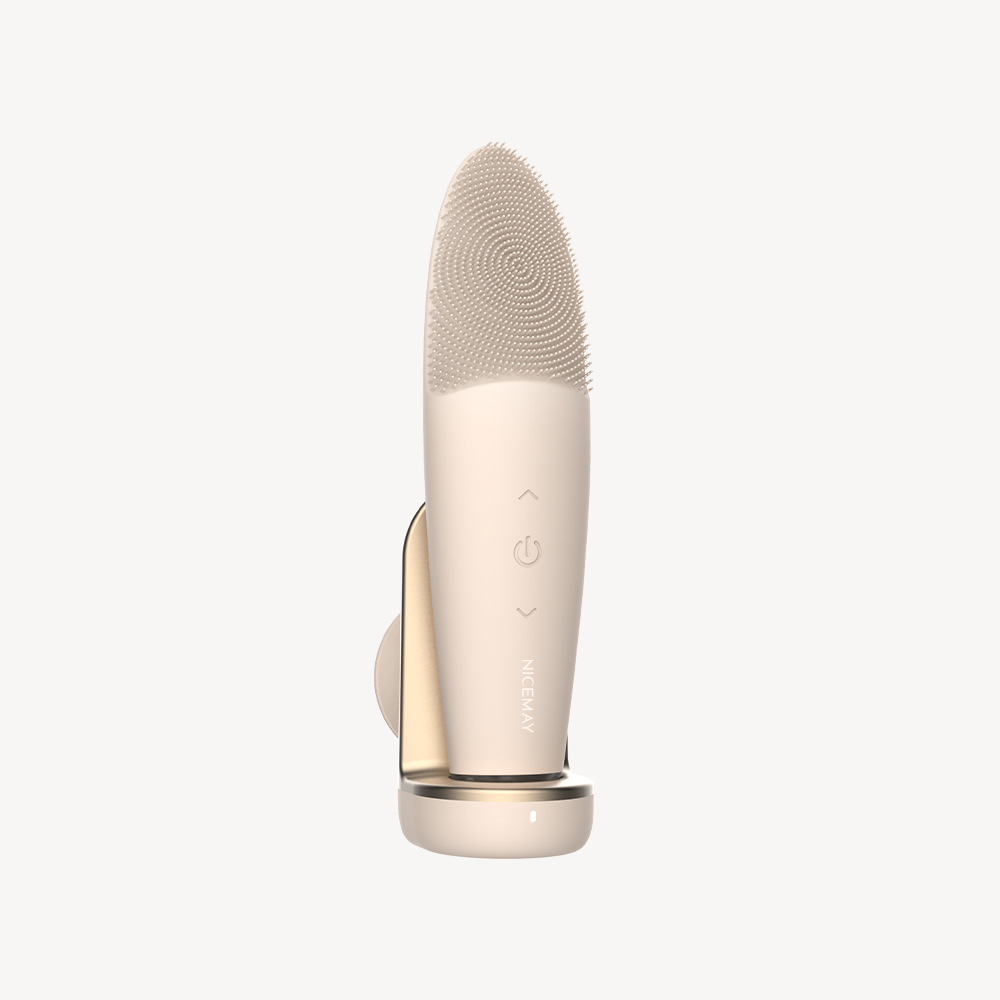
Silicone cleansing brush heads are non-porous. There’s nowhere for bacteria to hide between uses. Rinse it, leave it to air dry, and it’s genuinely clean for the next session. Nylon bristle heads are a different story — they need more deliberate rinsing and occasional deep cleaning.
If hygiene and daily usability are your main priorities, 최고의 실리콘 페이셜 클렌징 브러시 (테스트 및 리뷰) evaluates specific models on bristle quality, how easy they are to keep clean, and whether the performance holds up after months of daily use.
Which one is right for your skin type?
Use a cleansing brush if…
- Your skin is oily or prone to clogged pores
- You wear SPF or full-coverage makeup daily
- You’re targeting dull texture or uneven tone
- You want serums and moisturizers to absorb better
- You have normal to thick skin with no active sensitivity
Stick with a washcloth if…
- Your skin is reactive, sensitized, or prone to redness
- You have active rosacea or a disrupted skin barrier
- You prefer a no-device, no-maintenance routine
- You’re currently on retinoids or strong exfoliating acids
- You’re traveling and can’t bring another device
A facial cleansing brush cleans more thoroughly than a washcloth — that part is clear. The more important question is whether your skin can handle it, and how often. For most people, the practical answer is both: a fresh microfiber washcloth for quick daily cleanses, and a silicone brush two to three evenings a week for a deeper clean. If you’ve only ever used a washcloth and your skin is congested or dull despite a solid routine, adding a brush is likely the change that makes the difference.