


Eye Microcurrent vs Eye LED Therapy: Which Technology Actually Works for the Eye Area?

Eye microcurrent and eye LED therapy are two of the most clinically validated at-home technologies for addressing the signs of aging around the eyes—but they work through entirely different biological pathways. Microcurrent uses low-level electrical impulses to re-educate and tone the delicate periorbital muscles, producing a visible lift and improved contour. LED therapy, by contrast, uses specific wavelengths of light to stimulate cellular repair deep within the dermis, targeting collagen production, fine lines, and chronic inflammation.
Neither technology is universally superior. The right choice depends on whether your primary concern is structural—sagging, drooping, or loss of definition—or textural: wrinkles, crow’s feet, dark circles, or skin quality. For many, the most effective approach involves using both in a coordinated protocol. This guide breaks down the science, compares outcomes, and helps you build a strategy that fits your goals.
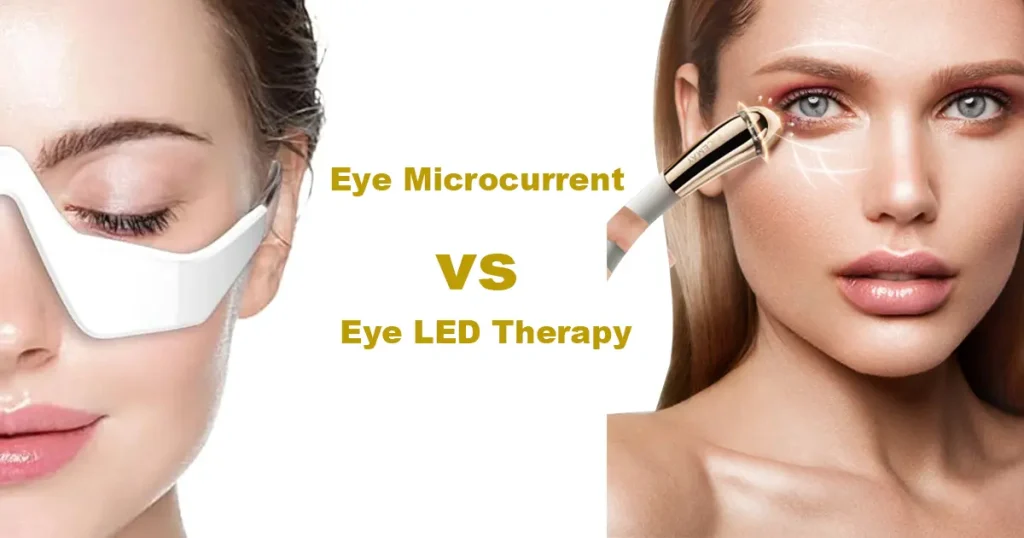
How Eye Microcurrent Technology Works?
Microcurrent beauty devices deliver sub-sensory electrical currents—typically between 10 and 600 microamperes—that mirror the body’s own bioelectrical signals. At this intensity, the current is imperceptible to the skin’s pain receptors but sufficient to influence muscle fiber activity and cellular energy metabolism.
The Mechanism Behind Microcurrent Lifting
When applied to the periorbital region, microcurrent stimulates the orbicularis oculi and surrounding facial muscles through a process called muscle re-education. This involves two interrelated mechanisms: the direct stimulation of muscle fibers to contract and tone, and the upregulation of adenosine triphosphate (ATP) production within cells. Clinical studies have found that microcurrent can increase ATP synthesis by up to 500% in treated tissue—a significant driver of cellular repair and protein synthesis.
Beyond muscle tone, increased ATP availability accelerates the production of collagen and elastin, the structural proteins responsible for skin firmness. This is why consistent microcurrent use produces benefits that extend beyond immediate lifting to include gradual skin quality improvements over weeks of use.
What microcurrent addresses around the eye
- Ptosis (drooping upper eyelid) caused by muscle laxity
- Loss of brow arch definition and hooded appearance
- Under-eye hollowing and reduced tissue firmness
- Overall sculpting and contouring of the orbital bone area
What to Expect from Eye Microcurrent Results
Results from a single session are often visible immediately—a subtle lift and improved definition that typically lasts 24 to 72 hours. With consistent daily or near-daily use over four to eight weeks, these temporary effects can accumulate into longer-lasting structural improvements as muscle tone and ATP-driven collagen synthesis build over time. Maintenance sessions are required to preserve results once the initial protocol phase is complete.

How Eye LED Therapy Beauty Device Works?
LED (light-emitting diode) therapy operates on a principle called photobiomodulation: specific wavelengths of light penetrate the epidermis and dermis, where they are absorbed by chromophores—light-sensitive molecules within cells—triggering a cascade of biological responses. Unlike microcurrent, LED therapy has no mechanical or electrical interaction with tissue; it works entirely through light-induced cellular signaling.
Wavelengths Used in Eye LED Therapy
For the eye area, the two most clinically relevant wavelengths are red light (typically 630–670 nm) and near-infrared light (800–850 nm). Red light penetrates to approximately 8–10 mm, directly stimulating fibroblasts—the cells responsible for collagen and elastin synthesis. Near-infrared light penetrates more deeply, reaching subcutaneous tissue, where it supports mitochondrial function, reduces chronic low-grade inflammation, and accelerates cellular turnover.
Some eye-specific LED devices also incorporate amber or yellow wavelengths (570–620 nm), which have shown efficacy in reducing vascular redness and addressing the discoloration component of dark circles by targeting hemoglobin and superficial capillary networks.
What LED therapy addresses around the eye
- Dynamic and static fine lines including crow’s feet
- Thinning, crepey skin beneath the eye
- Periorbital inflammation and puffiness
- Pigmentation-related dark circles
- Overall skin density and elasticity
If you’re deciding between a dedicated eye LED device and a full-face panel, it’s worth reading our comparison of LED Mask vs High-Power LED Device: Which is Better for Home Light Therapy? to understand how device design affects energy delivery and clinical outcomes in the eye area specifically.
What to Expect from Eye LED Results
LED therapy produces gradual, cumulative results. Most users begin to notice measurable improvements in skin texture and fine line depth after four to six weeks of consistent use, with optimal outcomes typically visible at the 12-week mark. Unlike microcurrent, LED results do not diminish as rapidly between sessions—the biological changes it triggers (new collagen fibers, reduced inflammatory load) are structural and persist for weeks to months with appropriate maintenance.

Eye Microcurrent vs Eye LED Therapy: Side-by-Side Comparison
| Feature | Eye Microcurrent | Eye LED Therapy |
|---|---|---|
| Primary Target | Periorbital muscles and connective tissue | Dermal fibroblasts and mitochondrial activity |
| Primary Mechanism | Bioelectrical muscle stimulation + ATP upregulation | Photobiomodulation via targeted wavelengths |
| Onset of Results | Immediate (temporary lift visible after 1 session) | Gradual (4–12 weeks of consistent use) |
| Result Duration | 24–72 hours per session; cumulative with consistency | Weeks to months; structural collagen changes |
| Best Concerns | Sagging lids, brow droop, loss of contour | Crow's feet, crepey skin, dark circles, puffiness |
| Sensation | Mild tingling or muscle twitch (often imperceptible) | Gentle warmth or no sensation at all |
| Session Length | 5–10 minutes daily | 10–20 minutes per session |
| Prep Required | Conductive gel essential for current delivery | Clean, dry skin; no prep needed |
| Clinical Evidence | Strong for facial muscle tone; moderate for periorbital | Strong for collagen synthesis; growing for eye area |
| Downtime | None | None |
Which Technology Treats Which Eye-Area Concern?
Concerns Better Addressed by Eye Microcurrent
Microcurrent is the preferred modality when the underlying cause is muscular or structural. If you notice that your eyelids feel heavier than they used to, your brow has flattened, or there is a visible loss of definition along the orbital rim, the issue is most likely rooted in reduced muscle tone—not simply skin texture. Microcurrent’s ability to directly stimulate and re-educate these small, delicate muscles makes it uniquely suited to these presentations.
Concerns Better Addressed by Eye LED Therapy
LED therapy is the preferred modality when the concern is dermal rather than muscular. Crow’s feet, the fine crepey lines that form beneath the lower lid, and the puffiness driven by chronic low-grade inflammation all respond more reliably to light-based treatment. Dark circles that originate from pigmentation or vascular causes also fall within LED’s wheelhouse, particularly devices that include amber and yellow wavelengths alongside red and near-infrared.
Concerns That Benefit from Both Technologies
Many of the most common eye-area complaints involve both muscular and dermal components simultaneously. Under-eye hollowing, for instance, involves both loss of volume and reduced skin density. A combined protocol—microcurrent for structural lift, LED for skin quality—often produces more comprehensive and durable results than either technology in isolation. This is particularly relevant for those in their 40s and beyond, where multiple aging mechanisms are typically active at the same time.

How to Choose Between Eye Microcurrent and Eye LED Therapy
Choose Eye Microcurrent if…
Your primary concern is structural: sagging upper lids, flattened brows, a loss of sculpted definition around the orbital area, or reduced muscle firmness that gives a tired or aged appearance regardless of skin texture.
Choose Eye LED Therapy if…
Your primary concern is textural: fine lines and crow's feet, crepey or thin under-eye skin, persistent puffiness, inflammation-driven dark circles, or overall skin density and elasticity in the periorbital zone.
Use Both if…
You are addressing multiple concerns simultaneously, or want to build a comprehensive anti-aging protocol. Use microcurrent in the morning for its lifting effect, and LED in the evening to support overnight cellular repair.
Consider a Full-Face Device if…
You want to treat both the eye area and the broader face in the same session. Understanding device coverage and power output is key—and our guide on Eye Beauty Device vs Full-Face RF/Microcurrent: Better for Fine Lines? covers the tradeoffs in detail.
Building a Combined Eye Microcurrent and LED Protocol
For those who want to integrate both technologies, timing and sequencing matter. Most clinical aestheticians recommend using microcurrent before LED therapy in the same session, as the increased ATP production from microcurrent may enhance cellular receptivity to photobiomodulation. If using them in separate sessions, alternating days is a practical and low-risk approach—microcurrent on odd days, LED on even days—which prevents overstimulation of the delicate periorbital tissue while maintaining consistency.
Avoid using retinol or active exfoliants within 24 hours of either treatment, as compromised skin barrier function can increase sensitivity, particularly with microcurrent. If you have received neurotoxin injections (Botox) or dermal fillers in the eye area, allow at least two weeks before resuming either technology to avoid interfering with the settling process.

MR-2389

MR-2387

MR-2121
Safety Considerations for Eye Microcurrent and Eye LED Therapy
Both technologies are well-tolerated and carry low risk profiles when used as directed. However, there are specific contraindications that every user should review before beginning a home protocol.
Eye Microcurrent Safety
- Contraindicated for individuals with implanted pacemakers, defibrillators, or any active electronic medical device
- Not recommended during pregnancy due to insufficient safety data on electrical current and fetal development
- Use with caution in individuals with a history of epilepsy or seizure disorders, as electrical stimulation may act as a trigger
- Avoid direct application over active skin infections, open wounds, or inflamed lesions
- Do not use over metal implants, dental work, or surgical hardware located near the treatment area
- Those with thyroid conditions should consult a physician before use, particularly if using devices near the neck and jawline in addition to the eye area
Eye LED Therapy Safety
- Avoid LED therapy if currently using systemic or topical photosensitizing medications (certain antibiotics, retinoids, NSAIDs, and chemotherapy drugs can increase photosensitivity)
- Eye protection is essential: always use the shielding provided by the device; never direct LED light at open eyes without proper ocular-grade protection
- Those with active ocular conditions (retinal disease, macular degeneration, recent eye surgery) should obtain medical clearance before use
- Individuals with lupus or other light-sensitive autoimmune conditions should consult a dermatologist prior to beginning LED therapy
- Pregnant women should seek medical advice before use, as research on LED therapy during pregnancy remains limited
FAQs About Eye Microcurrent vs Eye LED Therapy
Can I use eye microcurrent and eye LED therapy on the same day?
How long before I see results from each technology?
Is eye microcurrent or LED therapy better for dark circles?
Do these technologies work on hooded eyelids?
Is it safe to use these devices near the eye?

Please fill in your email in the form and we’ll get back to assist you soon!