


How Deep Do Beauty Device Technologies Penetrate the Skin?

Beauty device technologies penetrate the skin at varying depths—from superficial (0.5-2 mm for cleansing and antibacterial effects) to deep dermal or subcutaneous (3-10 mm for collagen remodeling and contouring)—allowing targeted treatment of epidermis, dermis, or even muscle/fat layers for specific concerns like texture, firmness, or cellulite. This guide details how deep beauty device technologies penetrate the skin, with wavelengths, frequencies, mechanisms, and evidence to understand their true impact.

How Deep Beauty Device Technologies Penetrate the Skin Layers?
Skin consists of the epidermis (0.05-1.5 mm), dermis (1-4 mm thick, containing collagen/elastin), and subcutaneous fat/muscle. Penetration depth determines efficacy—surface for immediate glow, mid for texture, deep for structural tightening (source: Journal of Cosmetic Dermatology, energy device penetration review, 2023-2025).
Deeper penetration often requires higher energy or focused delivery, balanced with safety for home use.
How Beauty Device Technologies Reach Different Skin Layers?
Leading technologies vary in reach and interaction.
LED Light Therapy: Wavelength-Dependent Penetration from Surface to Deep Dermis
LED wavelengths determine depth: Blue (415-465 nm) acts superficially (0.5-2 mm) on epidermis; red (630-660 nm) reaches mid-dermis (2-5 mm); near-infrared (800-900 nm) penetrates deepest (5-10 mm) into subcutaneous tissue.
How it penetrates: Light photons are absorbed by chromophores (cytochrome c oxidase, porphyrins) with minimal scattering, allowing selective activation without heat (source: Harvard Health Publishing; Journal of Clinical and Aesthetic Dermatology depth and wavelength studies).
Result: Layer-specific effects from antibacterial to deep repair
Microcurrent: Surface to Facial Muscle Layer Penetration
Low currents (100-500 μA) travel through conductive gel, reaching epidermis and underlying facial muscles.
How it penetrates: Ionic flow follows least-resistance paths, stimulating muscle fibers and dermal cells for ATP boost and tone (source: PubMed microcurrent depth imaging and muscle response, 2024).
Result: Beyond surface—direct muscle re-education for lift.

Radio Frequency (RF): Mid to Deep Dermal Penetration with Thermal Focus
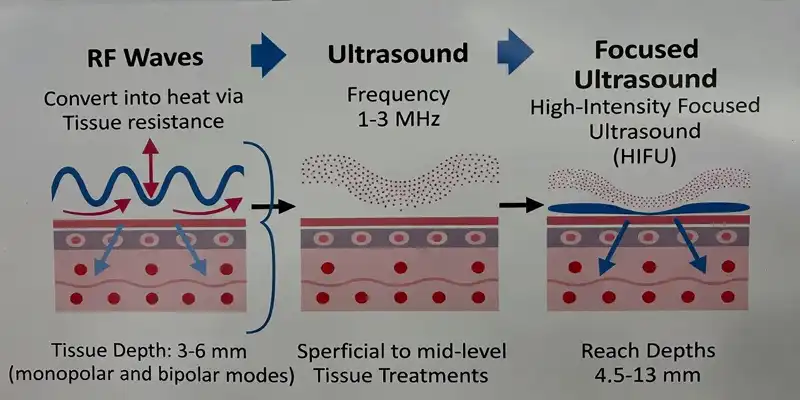
RF waves convert to heat via tissue resistance, penetrating 3-6 mm in monopolar/bipolar modes.
How it penetrates: Energy targets water-rich dermis, bypassing epidermis with cooling mechanisms in pro/home devices—creating controlled heating for collagen contraction (source: PMC/NIH RF penetration biopsy trials).
Result: Structural remodeling in deeper matrix.
Ultrasound: Variable and Focused Penetration from Surface to Subcutaneous
1-3 MHz for superficial-mid; focused HIFU reaches 4.5-13 mm.
How it penetrates: Acoustic waves create cavitation or thermal focal points at precise depths, loosening lipids or disrupting fat cells (source: International Journal of Dermatology ultrasound depth meta-analysis).
Result: From pore cleansing to body contouring.
| Technology | Type | Depth | Primary Target Layer | Key Effect | Backed By Sources |
|---|---|---|---|---|---|
| LED Light Therapy | Type | 0.5-10 mm (color-dependent) | Epidermis to subcutaneous | Photobiomodulation, repair | Harvard Health; Journal of Clinical and Aesthetic Dermatology |
| Microcurrent | Surface to muscle | Epidermis + facial muscles | Toning, ATP boost | PubMed 2024 imaging | |
| Radio Frequency (RF) | Type | 3-6 mm | Deep dermis | Thermal collagen remodeling | PMC/NIH trials |
| Ultrasound | Type | 1-10 mm (frequency/focus) | Variable dermis/subcutaneous | Cavitation, absorption | International Journal of Dermatology |
This table shows how deep beauty device technologies penetrate the skin.
For ultrasound details, see “How Ultrasonic Beauty Devices Work on the Skin?”. Renewal mechanisms? Explore “How Do Energy-Based Beauty Devices Stimulate Skin Renewal?”.
Realistic Expectations Based on Penetration Depth
- Superficial (blue LED): Quick acne/glow (4-8 weeks).
- Mid-dermal (red LED/RF): Firmness/wrinkles (8-12 weeks).
- Deep (near-infrared/HIFU): Structural lift (3-6 months).
Deeper often means longer timelines but more lasting change (source: American Academy of Dermatology depth-outcome guidelines, 2025).
Pro Tips for Beauty Device Technologies Maximizing Penetration Benefits
- Prep skin: Clean and use gel/serum for conductivity.
- Choose wavelength/frequency for concern.
- Consistent sessions without overexposure.
- Combine for layered effects.
Targeted use enhances outcomes (source: RealSelf depth-specific reviews, 2024-2025).
Final Verdict: Depth Drives Targeted Effectiveness
Beauty device technologies penetrate the skin at precise depths to address specific layers and concerns—making the right choice key to effective, customized rejuvenation.
Ready for deeper results? Take our quick Depth Quiz to find the NICEMAY device that penetrates perfectly for your skin goals. Reach your target layer today!
Please fill in your email in the form and we’ll get back to assist you soon!