


LED Face Mask Manufacturing Process: From OEM Design to Certified Production

Some LED face masks deliver measurable collagen increases within weeks—others barely emit therapeutic light at all. The difference? It’s in the LED face mask manufacturing process: precision engineering, accurate wavelengths, calibrated irradiance, and strict certifications separate premium photobiomodulation devices from ineffective ones.
This guide walks through the LED mask factory process, from design to final testing—ideal for brands evaluating LED mask OEM manufacturers, private label LED face mask suppliers, or LED light therapy device production lines.
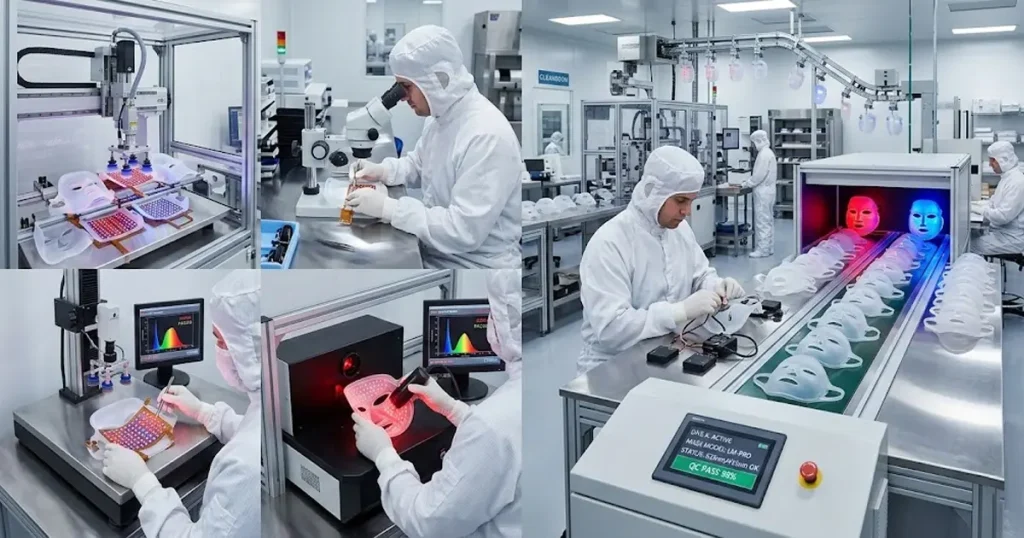
How an LED Mask for Face is Manufactured: A Behind-the-Scenes Look ?
Choosing the right manufacturing partner is critical. Here is how premium production differs from budget alternatives:
| Aspect | High-Quality / Premium Manufacturing | Low-Cost / Generic Production |
|---|---|---|
| LED Quality | Precise wavelengths, high irradiance (40–70 mW/cm² common effective range), uniform output | Inaccurate bands, low power (<20–30 mW/cm²), hotspots or flickering |
| Build & Durability | Medical-grade silicone, flex PCBs rated 10,000+ bends, robust seals | Cheap plastics, weak soldering, quick degradation |
| Testing & Certs | Full optical/safety testing, ISO 13485, FDA 510(k) clearance, IEC 60601-1, IEC 62471 photobiological safety, EMC, RoHS | Minimal QC, no certifications, inconsistent results |
| Efficacy | Delivers clinical doses (e.g., 4–20 J/cm² for skin benefits) | Sub-therapeutic, minimal visible improvements |
| Longevity | 10,000+ LED hours, reliable battery management | Short lifespan, overheating risks |
Step 1: Product Definition, Ergonomic Design, and Wavelength Engineering
The process starts with defining specs for the facial phototherapy equipment—often in OEM/ODM collaboration. Teams target skin concerns: red/near-infrared for anti-aging, blue for acne.
CAD modeling creates ergonomic shapes for universal fit, optimizing LED arrays (typically 100–600+ diodes in professional models) for even coverage. Wavelength engineering ensures narrow bands like red (630–660 nm) and near-infrared (830–850 nm), validated against photobiomodulation research.
Prototypes test fit and light distribution via simulations and trials.
Step 2: Sourcing Medical-Grade Materials and Components
Premium LED beauty device manufacturing sources medical-grade silicone or TPU for shells—hypoallergenic, breathable, and ISO 10993-compliant.
LEDs from certified suppliers feature stable, narrow-band chips. Flexible PCBs (polyimide) withstand repeated use, while batteries include advanced protection.
Reputable LED mask OEM manufacturers prioritize RoHS-compliant, traceable supply chains to avoid drift or failures.
Step 3: Precision LED Selection, Testing, and Circuit Assembly
Calibrating LEDs is crucial. Diodes undergo spectroradiometer validation for exact wavelengths, irradiance (e.g., 40–70 mW/cm² for effective home-use masks), uniformity, and low heat.
Integrating via SMT: automated placement populates flex PCBs, followed by reflow soldering and AOI inspection.
Circuits synchronize modes, timers, and drivers. Strain-relief designs endure 10,000+ bends.
Dose example: A device at 50 mW/cm² for 15 minutes delivers ~45 J/cm²—within therapeutic photobiomodulation ranges (typically 4–20 J/cm² per session for skin benefits).
For detailed compliance requirements, see our guide on What Quality Control Standards Should LED Mask Manufacturers Follow?
Step 4: Shell Molding and Component Integration
Custom CNC molds enable injection molding of contoured shells, polished for smoothness with diffusion layers for even light transmission.
Cleanroom assembly secures LED panels, installs touch/app controls, attaches straps, and seals for moisture resistance. Thermal management (passive or pulsed) prevents overheating.
Step 5: Comprehensive Functionality, Safety, and Optical Testing
Validating every unit:
- Optical mapping confirms wavelength accuracy and irradiance uniformity.
- Safety per IEC 60601-1 (electrical), IEC 62471 (photobiological), EMC, and thermal limits.
- Full burn-in, fit trials, and certifications (ISO 13485 quality system, FDA 510(k) clearance for Class II claims, CE, RoHS).
- Reputable manufacturers publish spectral test reports upon request; clinical validation often supplements lab data.
FAQ About LED Face Mask Manufacturing
What irradiance level is effective for an LED face mask?
Effective home-use masks typically deliver 40–70 mW/cm² irradiance, enabling therapeutic doses of 4–20 J/cm² per session (e.g., 50 mW/cm² for 10–20 minutes). Lower (<30 mW/cm²) may be sub-therapeutic; higher suits shorter exposures but risks discomfort.
Are LED masks considered medical devices?
Yes, many are Class II medical devices under FDA regulations, requiring 510(k) clearance (not “approval”) for claims like wrinkle reduction or acne treatment—demonstrating safety and equivalence to predicates.
How many LEDs should a professional LED mask have?
Professional models often feature 200–600+ LEDs (e.g., 236–292 in high-end devices) for uniform full-face coverage, ensuring even light distribution without gaps.
What certifications should an OEM LED mask manufacturer hold?
Key ones include ISO 13485 (medical device quality management), IEC 60601-1 (electrical safety), IEC 62471 (photobiological), FDA 510(k) clearance, CE marking, RoHS, and sometimes TGA/MDL for global markets.
For Brands Seeking OEM/ODM LED Mask Manufacturing
Partner with facilities offering:
- ISO 13485-certified production lines
- In-house spectroradiometer testing
- Custom wavelength engineering
- Private label support
Request a manufacturing capability brief or sample evaluation today to ensure your light-based skincare device meets premium standards.
Data on irradiance (40–70 mW/cm² effective range), dosing (4–20 J/cm²), LED counts (200–600+), FDA Class II/510(k), and certifications drawn from photobiomodulation studies (e.g., Journal of Cosmetic Dermatology, PMC reviews), FDA 510(k) summaries, and industry sources (e.g., IEC standards, manufacturer specs). Curious about tailoring? Explore Can You Customize Wavelengths in an LED Mask for Face?
Please fill in your email in the form and we’ll get back to assist you soon!