Is your microcurrent device delivering real lifting results — or are you unknowingly using the wrong intensity and either irritating sensitive skin or wasting sessions on a setting too low to trigger meaningful muscle re-education? Choosing the right microcurrent intensity isn’t guesswork: it’s a science-backed decision based on your skin’s electrical conductance, its baseline reactivity, and the μA (microampere) threshold at which your facial muscles actually respond without experiencing galvanic shock or neural overstimulation. This guide gives you the complete, technical roadmap — from understanding what microcurrent waveforms actually do at the cellular level, to matching precise intensity ranges to your skin type, to knowing the red flags that mean you’ve dialed it too high.
What Microcurrent Intensity Actually Means (And Why the μA Number Matters)?
Most at-home device marketing treats “intensity levels” as a simple 1–5 dial, but the underlying measurement — microamperes (μA) — is what determines whether your treatment is genuinely therapeutic or completely ineffective. Professional microcurrent devices used in aesthetic clinics typically operate between 200–600 μA, while FDA-cleared at-home devices are purposefully capped in the 40–350 μA range to ensure consumer safety without requiring practitioner supervision.
Here’s why the specific number matters: the human body’s own bioelectric current — the cellular signaling that drives ATP (adenosine triphosphate) production, collagen synthesis, and muscle fiber re-education — operates at roughly 500–1000 μA in healthy tissue. At-home microcurrent devices work by gently supplementing this bioelectric field, not overwhelming it. Deliver too little current (below ~40 μA on most devices) and you get superficial circulation benefits only — no meaningful muscle stimulation. Exceed what your skin’s impedance can safely conduct without sufficient conductive gel coverage, and you risk a sharp galvanic sting that can temporarily disrupt the skin barrier.
The waveform type compounds this: biphasic waveforms (where the current alternates direction) are far safer for at-home use than monophasic, because they prevent ion buildup under the electrodes that causes skin burns with repeated sessions. When evaluating any device, always confirm it uses biphasic current — especially if you plan to use it at higher intensity settings three or more times per week.
Key specification to verify: Any device claiming professional-grade results should operate in at least the 100–350 μA range and specify biphasic waveform output. Devices vaguely labeled “microcurrent” that only output below 40 μA are operating more as galvanic toning tools than true muscle re-education devices.
The Four Skin Types and Their Ideal Microcurrent Intensity Ranges
Understanding your skin’s electrical properties — not just its cosmetic characteristics — is the foundation of safe intensity selection. Skin impedance (resistance to electrical current) varies dramatically based on hydration levels, thickness, and reactivity. Here’s how to match your profile to the right setting:
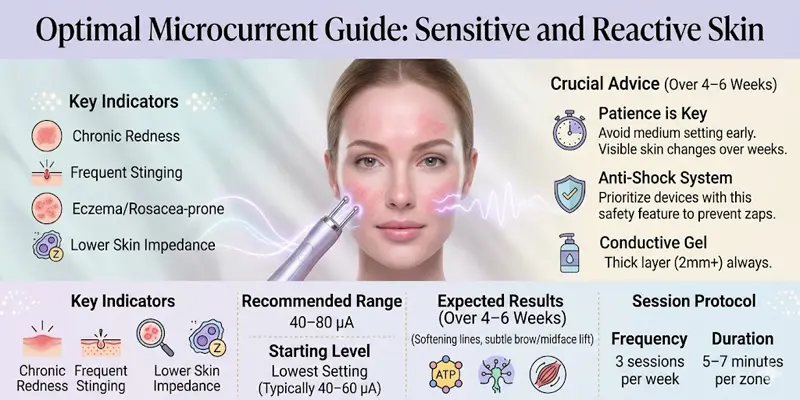
Sensitive and Reactive Skin: Stay in the 40–80 μA Range
Sensitive skin — characterized by chronic redness, rosacea-prone behavior, frequent stinging from topical actives, or diagnosed conditions like eczema — has a compromised skin barrier with inherently lower impedance. Counterintuitively, lower impedance means current travels more easily through the skin, which makes it easier to accidentally over-stimulate. Starting at the device’s lowest available setting (typically 40–60 μA on quality at-home units) gives genuine therapeutic benefit — enhanced ATP production, improved lymphatic circulation, and gentle facial muscle activation — without triggering inflammation.
A mistake seen too often with sensitive-skin users is assuming “nothing is happening” at low settings and jumping to medium immediately. In reality, visible skin changes from microcurrent — a softening of expression lines, a subtle lift in the brow and midface — appear over 4–6 weeks of consistent use at any setting above the ATP-stimulation threshold of ~40 μA. Patience at the lower end outperforms impatience at a painful setting.
If your skin is prone to flushing or your device has an anti-shock system (a feature that detects inadequate gel coverage and pauses the current before it zaps), prioritize devices with this feature above all others. It’s a genuine safety differentiator, not a marketing addition.
Protocol for sensitive skin: 3 sessions per week, 5–7 minutes per zone, lowest setting, with a thick layer of conductive gel — never reduced to less than 2mm coverage.
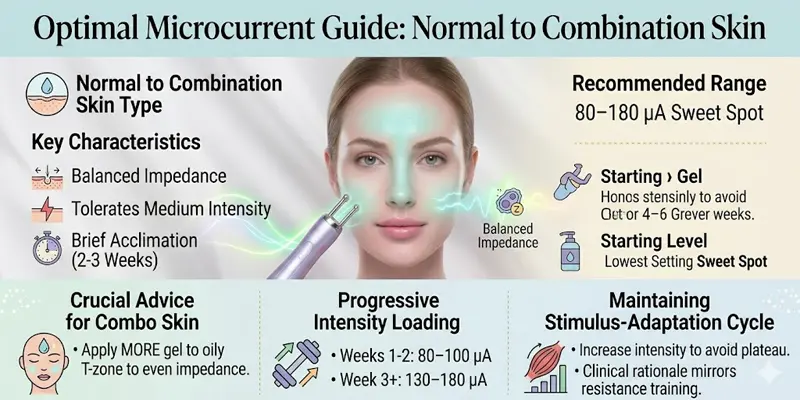
Normal to Combination Skin: The 80–180 μA Sweet Spot
Normal-to-combination skin has balanced impedance and tolerates a medium intensity range comfortably after a brief acclimation period of 2–3 weeks. This skin type benefits most from progressive intensity loading: starting at low-medium (80–100 μA equivalent) for weeks one and two, then advancing to medium (130–180 μA equivalent) once the facial muscles and skin have adapted to electrical stimulation.
The clinical rationale mirrors resistance training: muscle fibers require increasing stimulus to continue adapting. In microcurrent terms, this means a setting that initially produces noticeable facial muscle contraction will feel less intense after 3–4 weeks because the neuromuscular system has adapted. At that point, advancing to the next setting maintains the stimulus-adaptation cycle and continues producing results — a more defined jawline, lifted brow tail, and reduced nasolabial fold depth.
For combination skin specifically, pay attention to your T-zone during treatment: the naturally higher sebum content in the forehead and nose area slightly reduces impedance, which can cause those zones to feel the current more intensely than drier cheek areas. Adjust by applying slightly more gel to oilier zones before treatment.
Protocol for normal/combination skin: 4–5 sessions per week during the first 60-day loading phase, then 2–3 maintenance sessions weekly. Advance intensity after week 3 if treatments remain entirely pain-free.
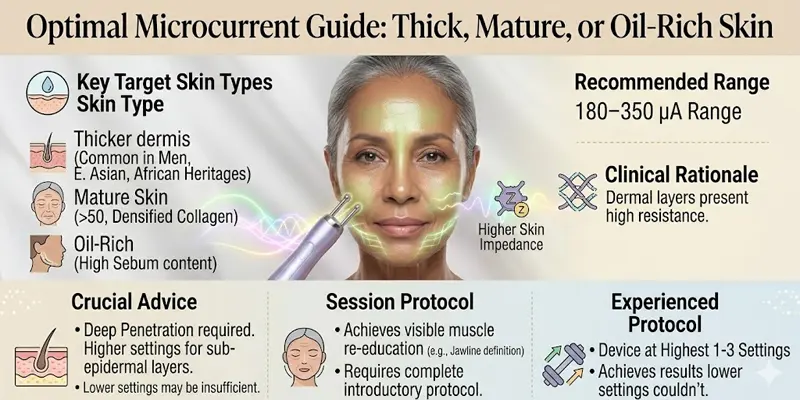
Thick, Mature, or Oil-Rich Skin: 180–350 μA for Effective Penetration
Thicker skin — common in men, in individuals of African or East Asian heritage (where dermis thickness averages 10–15% greater), and in mature skin over 50 where collagen has densified through cross-linking — has significantly higher impedance. This means standard low-to-medium settings are often insufficient to reach the sub-epidermal muscle layer, leaving users with superficial results and a false sense that microcurrent “doesn’t work for them.”
Experienced users who have completed a 60-day introductory protocol and face-experienced practitioners consistently report that higher settings (180–350 μA, or the device’s highest 1–3 settings) produce the visible muscle re-education results — the defined jawline, lifted orbital area, and restored midface volume — that lower settings couldn’t achieve on thicker tissue. At these intensities, the proprioceptive feedback (the slight “pulling” sensation as muscles contract) becomes clearly noticeable, which is actually a positive sign confirming the current is reaching the target muscle layer.
Critical rule at high intensities: The conductive gel layer becomes even more important, not less. Thin or patchy gel application at high intensity is the primary cause of the sharp electrical “zap” that can cause post-treatment redness or temporary skin sensitivity lasting 24–48 hours. Double your gel application at maximum settings.
Protocol for thick/experienced skin: 5 sessions per week during the 60-day loading phase. Maximum intensity, full conductive gel coverage, 8–10 minutes per zone for deeper muscular engagement.
How to Start Your First Session: A Step-by-Step Intensity Protocol?
Getting the first session right sets the tone for long-term results. Follow this sequence regardless of skin type:
Step 1 — Cleanse and prep. Remove all makeup, SPF, and skincare residue. Microcurrent efficiency drops significantly through product buildup — one study found that a standard SPF layer increases skin impedance by up to 30%, effectively reducing the delivered current by nearly a third even at maximum device settings.
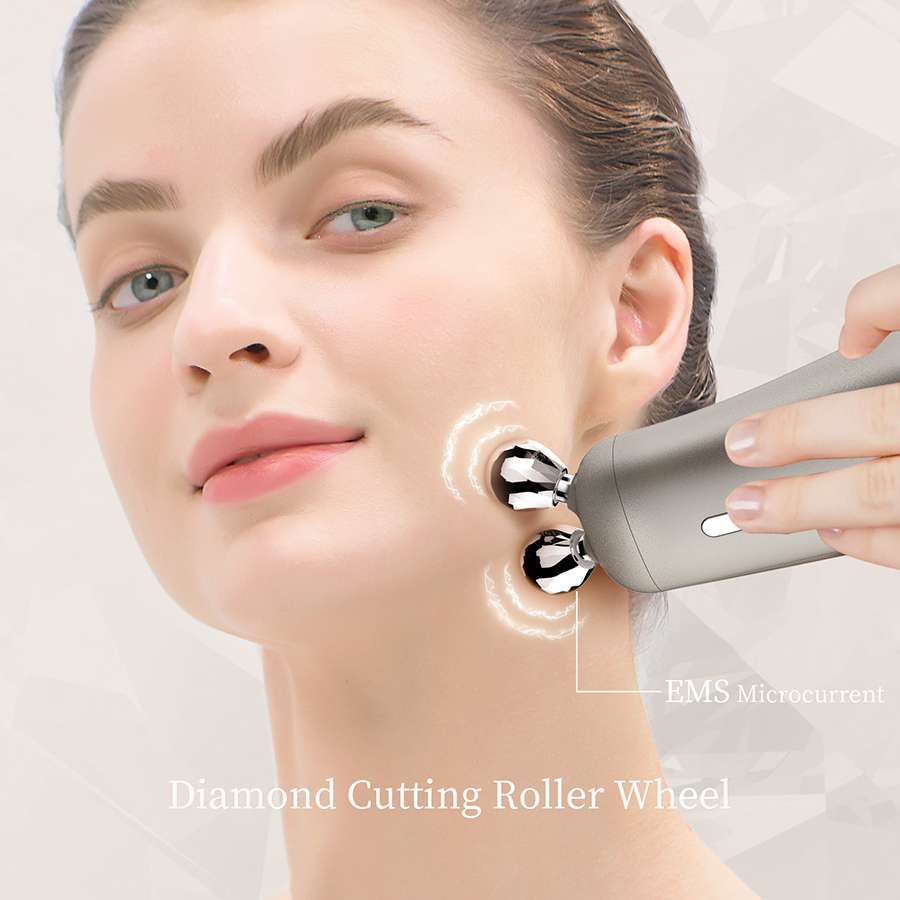
Step 2 — Apply conductive gel generously. This is the single most critical step. Use a purpose-formulated microcurrent conductive gel or a water-based conductive serum at minimum 2mm thickness. Never substitute with regular moisturizer, oil, or water — these either have insufficient conductivity or can react with electrical current to irritate the skin barrier. The NICEMAY MR-2623 Micro-Current Lifting Roller is a strong example of a well-designed at-home device that pairs effectively with conductive gel to deliver current through its roller electrode system, making gel distribution over the contoured areas of the cheeks and jawline more even than wand-style devices.
Step 3 — Set to the lowest intensity. Even if your skin type analysis suggests you could start higher, begin at the lowest setting for your first two sessions. This establishes your personal baseline and lets you confirm there’s no unexpected sensitivity before advancing.
Step 4 — Work in lifting motions, section by section. Move from the chin to the ear along the jawline, from the corner of the mouth toward the temple, and from the brow toward the hairline. Each stroke should be slow and deliberate — 3–5 seconds per pass — so the current has adequate contact time to stimulate the underlying muscle fibers.
Step 5 — Advance intensity only when pain-free. After two sessions at your baseline setting, evaluate: was there any stinging, visible redness that lasted more than 20 minutes post-treatment, or flashing lights in your peripheral vision? If yes, stay at the same setting for two more sessions. If the experience was entirely comfortable, advance one intensity level for session three.
Step 6 — Post-treatment serum application. Immediately after microcurrent, the skin’s permeability window is elevated for approximately 20–30 minutes — a well-documented phenomenon called “electroporation.” Apply a peptide or hyaluronic acid serum immediately post-session to maximize absorption into the dermal layers.
The Warning Signs You've Set Intensity Too High
Understanding the failure modes of over-intensity is as important as knowing the target ranges. In practice, there are four clear signals that your current setting is too high or your gel coverage is insufficient:
Sharp electrical zaps or stinging sensations are the most immediate signal. Correctly applied microcurrent at an appropriate intensity produces either a mild tingling or — at higher settings — a noticeable muscle contraction with a dull, pulling sensation. Sharp pain is always a warning sign, not a sign of effectiveness.
Flashes of light in your peripheral vision occur when current near the orbital area is high enough to stimulate the optic nerve. This is a serious physiological signal to reduce intensity immediately and recheck gel coverage around the eye area. Always keep devices at least 1cm away from the orbital rim, and reduce intensity by at least one level when working near the eye zone even if you use a higher setting elsewhere on the face.
Post-treatment redness lasting over 30 minutes suggests the current was too high relative to gel coverage in that zone, causing minor galvanic irritation rather than therapeutic stimulation. This is more common on the forehead (naturally drier in some skin types) and the nasolabial folds where product tends to absorb quickly.
Facial sagging or “microcurrent fatigue” after several weeks — one of the most alarming failure modes — occurs when devices with incorrect waveforms or users who over-treat (daily sessions at maximum for months without breaks) essentially overstimulate and exhaust the facial muscles rather than tonify them. The mechanism mirrors overtraining in exercise: without adequate recovery, muscles weaken rather than strengthen. The safeguard is a structured protocol: 60-day loading phase (4–5 sessions per week) followed by a maintenance phase (2–3 sessions per week), never exceeding the device’s recommended maximum session frequency.
Microcurrent Intensity by Skin Concern: Matching Treatment Goals to Settings
Your skin type is one input into intensity selection. Your primary concern is the other:
For fine lines and preventive anti-aging (ages 25–35): Low-to-medium settings are sufficient and preferable. At this age, the goal is enhanced ATP production for collagen maintenance and circulation improvement — not aggressive muscle re-education. A medium intensity setting 3–4 times per week produces measurable improvements in skin firmness within 8–12 weeks, as confirmed by independent assessments referenced in aesthetic medicine reviews.
For moderate facial sagging and jawline loss (ages 35–50): Medium-to-high settings are warranted, with particular focus on the platysma muscle (responsible for neck and lower face lift) and the zygomatic muscles (cheek lifting). These larger, deeper muscles require more current to engage than the superficial orbicularis muscles around the eyes. Work up to the higher end of your skin-type-appropriate range specifically during jawline and neck passes, then dial back slightly for the more sensitive periorbital area.
For significant skin laxity (ages 50+): Maximum available intensity (within your device’s safe range) is appropriate after proper acclimation. The reduced elastin network in mature skin means the visual “rebound” from muscle re-education is slower — expect a realistic 12–16 weeks to see the full compounding effect of consistent treatment rather than the 6–8 weeks often cited for younger skin. This is not a failure of the device or the intensity setting; it’s a reflection of the underlying biology of mature dermal tissue.
Choosing a Device: How Intensity Range and Waveform Determine Real Results
Not all devices advertised as microcurrent are equal. When evaluating any device for at-home use, these are the specifications that separate effective tools from ineffective ones:
The μA output range should be clearly disclosed in the product specification — not just “5 intensity levels.” A device that lists only “levels” without disclosing the actual microampere range is a red flag, as it prevents you from comparing it to clinical benchmarks or understanding whether it can actually engage the subdermal muscle layer.
Waveform type — biphasic vs monophasic — determines long-term safety. As outlined earlier, biphasic current prevents ion buildup that causes galvanic burns with repeated high-intensity sessions. This specification should be listed in product documentation or confirmed with the manufacturer before purchasing for regular use.
Frequency (Hz) of the alternating current is a separate but equally important variable. The Hz setting determines which tissue layer is preferentially stimulated — lower frequencies (below 100 Hz) tend to engage muscle fibers more directly, while higher frequencies can stimulate collagen-producing fibroblasts in the dermis. For a full breakdown of how frequency settings interact with intensity to shape your results, see our guide: How Frequency (Hz) Settings on Microcurrent Devices Affect Your Results.
For a curated selection of devices at every price tier that meet the biphasic, disclosed-μA-range, and safety-feature criteria, see The Top 10 Microcurrent Devices of 2026.
FAQs About How to Choose the Right Microcurrent Intensity for Your Skin Type
Can I use microcurrent at maximum intensity from my very first session?
This is one of the most common mistakes, and it’s worth being direct: no, even if your skin type theoretically tolerates higher settings. The facial muscles — like any muscles — benefit from a progressive loading protocol. Starting at maximum intensity risks overstimulation, potential barrier disruption from galvanic effect, and the kind of sharp sting that makes people abandon devices prematurely. Two sessions at low intensity establishes your baseline, after which you can advance confidently. The overall results timeline is not meaningfully shortened by starting at maximum; the 60-day loading phase produces cumulative benefits regardless of where in the intensity range you spend that time.
My device only has three intensity levels with no μA disclosure. Is that a problem?
It limits your ability to make informed intensity decisions, but doesn’t necessarily indicate an ineffective device. Contact the manufacturer or check regulatory filings (for FDA 510(k)-cleared devices, the disclosed specifications are publicly searchable) to find the actual output range. If the device can’t or won’t disclose this information, that’s a stronger concern — particularly for regular high-intensity use.
How do I know if my current setting is actually stimulating my muscles vs. just my skin surface?
At effective muscle-stimulation intensities, you should feel a subtle but unmistakable proprioceptive sensation — a slight tightening or pulling as the muscle underneath contracts in response to the current. This is distinct from simple skin tingling (which indicates superficial current) and from sharp stinging (which indicates inadequate gel coverage or excessive intensity). If you feel only surface tingling after several weeks of use, advance your intensity one level. If the feeling is absent entirely even at maximum settings, recheck your conductive gel application and ensure your device is making full electrode contact with the skin at all times during movement.
Can I use microcurrent if I'm pregnant, have metal implants, or have epilepsy?
Microcurrent devices are contraindicated for use during pregnancy, for individuals with pacemakers or metal implants in the face/neck area, for those with active epilepsy, and for skin over open wounds, active infections, or inflammatory conditions (including active rosacea flares). These contraindications apply regardless of intensity level. Consult a dermatologist or physician if you have any of these conditions before beginning use.
How long before I see visible results from microcurrent treatments?
Clinical protocol data and user outcome studies consistently show a three-phase timeline. The first visible changes — subtle improvements in skin luminosity and a slight reduction in morning puffiness — appear within 2–4 weeks due to improved lymphatic circulation. Measurable lifting of the brow, midface, and jawline becomes apparent between weeks 4–8 as muscle re-education progresses. The full compounding benefit of a 60-day loading phase — the most significant structural change in contour and firmness — is visible by week 10–12 for those under 45, and week 14–18 for those over 50. Maintaining a consistent protocol through this full loading period is what separates transformative results from minimal change.