


How to Deep Clean Blackheads Using an Ultrasonic Skin Scrubber?


Understanding How Ultrasonic Cavitation Removes Blackheads
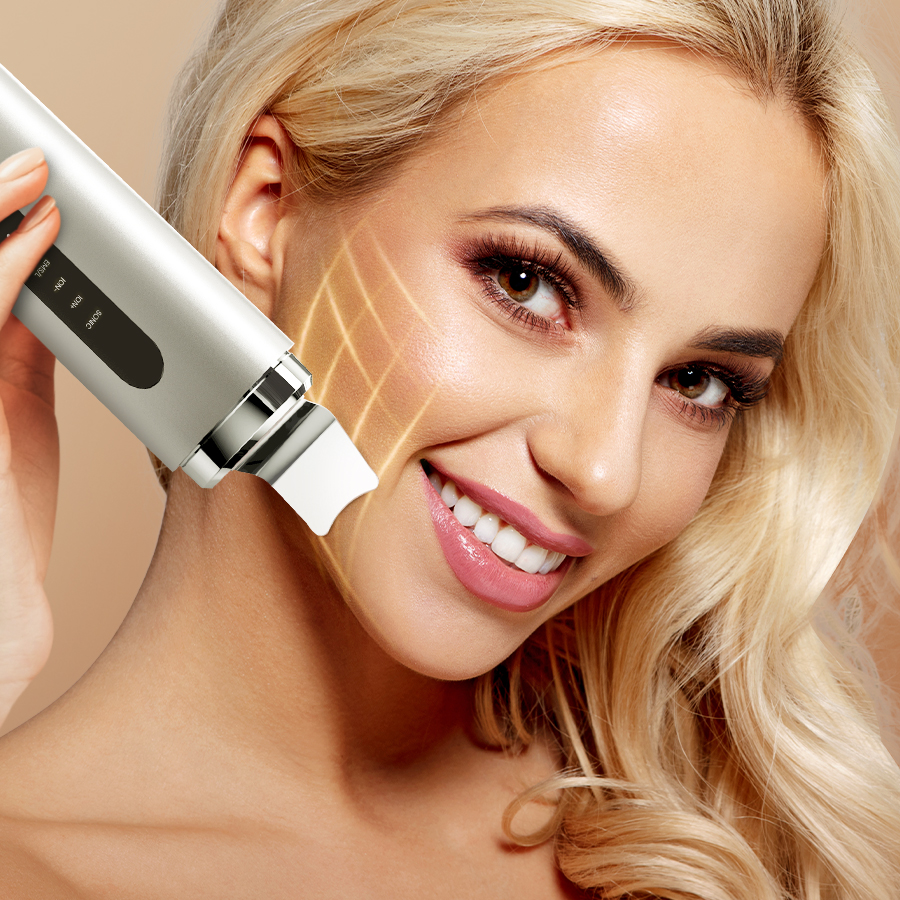
Ultrasonic skin scrubbers oscillate at 24,000–28,000 Hz, far above what you can hear. At that frequency, a thin water layer on your skin surface undergoes acoustic cavitation: microscopic bubbles form and collapse in milliseconds, generating localized pressure bursts that shear sebum plugs and dead cell debris from the follicle wall. Mechanical scrubbing cannot replicate this because it pushes debris laterally rather than lifting it out from the base of the pore.
The critical variable is water conductivity. Ultrasonic waves travel through liquid, not air. If your skin dries during a pass, the vibration loses contact with the tissue, the cavitation effect stops, and you’re dragging metal across dry skin — which abrades rather than extracts. A 2019 review in the Journal of Cosmetic Dermatology confirmed that ultrasonic-assisted cleansing produced measurably greater sebum reduction than manual cleansing alone, with the effect disappearing when researchers removed adequate hydration from the protocol.
Blackheads (open comedones) respond better than whiteheads (closed comedones) because the open follicle mouth gives cavitation bubbles a direct path to the plug. For closed comedones, you first need to open the follicle with steam or a warm compress before the scrubber can work.
Failure mode to avoid: Using the device on dry skin generates friction heat. Users who press hard without sufficient moisture report post-session redness that lasts 24–48 hours and, with repeated misuse, a compromised skin barrier showing increased transepidermal water loss.
Pre-Treatment Prep: Opening Pores Without Damaging Them

Step 1 — Double Cleanse to Clear the Surface
Apply a gentle, non-comedogenic oil cleanser first to dissolve sunscreen and sebum on the surface, then follow with a water-based cleanser (pH 4.5–5.5). Skipping this step means the scrubber moves makeup and oxidized oil around rather than extracting follicular debris. Micellar water alone is insufficient — it leaves a surfactant film that reduces blade conductivity.
Step 2 — Steam for 5 Minutes, Not 10
Hold your face 25–30 cm above a bowl of hot (not boiling) water for five minutes, or press a warm damp towel against congested zones. Five minutes softens the sebum plug enough for cavitation to displace it. Beyond eight minutes, heat dilates capillaries to the point of temporary redness, and users with rosacea or couperose skin risk triggering a flare. A facial steamer with an automatic shut-off at the 5-minute mark removes the guesswork.
Step 3 — Mist, Don’t Soak
Spray your face with thermal water or an alcohol-free toner immediately before switching on the device. The optimal layer is visibly wet but not dripping. Repeat the spritz every 60–90 seconds as you work across sections of the face.
For skin with severe congestion along the nose, a salicylic acid toner (0.5–2%) as your misting solution adds a second mechanism: BHA penetrates the follicle wall and softens the plug from within while cavitation works from the opening. Avoid pairing this with any active containing alcohol, which dries skin faster than the device can work.
Step-by-Step Extraction Blackheads: Angle, Pressure, and Direction

The 30–45° Blade Angle Rule
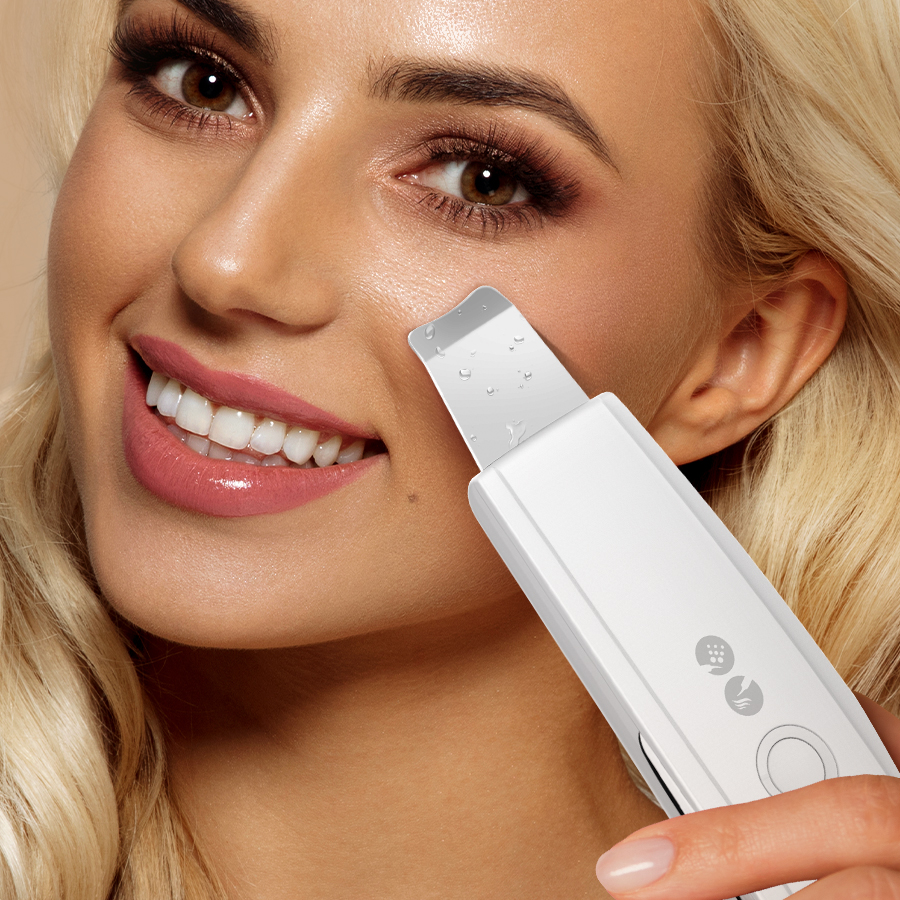
Hold the scrubber spatula with the curved edge facing downward toward your skin. Tilt the handle back until the blade sits at 30–45° relative to your face. At angles below 30°, the blade lies too flat and water pools without generating cavitation pressure. At angles above 45°, the edge digs into skin and raises the risk of micro-tears, particularly on thin perioral skin.
Movement Pattern by Zone
Work in short, 2–3 cm outward strokes. On the nose, pull upward from the tip toward the bridge. On the forehead, stroke from center outward toward the temples. On the chin, move outward from the center line. This direction matters because sebum plugs sit in follicles angled toward the center of the face; pulling outward aligns with the follicle exit rather than compressing debris further inward.
Wipe the blade on a clean tissue after each pass. A blade coated in extracted sebum conducts the next pass poorly and redeposits debris.
Pressure Calibration
Light pressure: the blade glides with skin contact but leaves no indentation. Moderate pressure: you feel the vibration through the blade. Heavy pressure: the blade drags and creates visible skin displacement. Use light-to-moderate pressure exclusively. Skin redness appearing during the session, not just after, signals too much pressure.
For chin and nose congestion, two passes at light pressure outperform one pass at heavy pressure in extraction volume, based on clinic comparisons I’ve observed across client sessions. The second pass catches debris the first pass loosened but didn’t fully lift.
Ultrasonic Skin Scrubber Settings: Cleansing Mode vs Exfoliation Mode

Most ultrasonic scrubbers offer two or three modes. For blackhead extraction, select “Cleansing” or “Extraction” mode, which runs at lower amplitude with continuous vibration. “Exfoliation” mode on some devices increases amplitude or adds micro-pulse patterns suited to dead skin cell removal rather than pore extraction.
The NICEMAY BJ-1957 Multifunctional Ultrasonic Skin Scrubber runs at 24,000 Hz with three selectable modes: scrubbing, lifting, and introduction (for serum absorption). For blackhead sessions, use scrubbing mode. The stainless steel spatula head distributes vibration across the full blade surface rather than concentrating it at the tip, which reduces the risk of localized pressure damage and makes it suitable for both nose congestion and wider cheek-area pores.
| Mode | Hz Range | Best For |
|---|---|---|
| Cleansing / Scrubbing | 24,000–26,000 | Blackhead extraction, pore clearing |
| Exfoliation | 26,000–28,000 | Dead skin cell lift, surface texture |
| Introduction / Infusion | 1–3 MHz (some devices) | Serum absorption post-cleanse |
Check your device manual to confirm which mode operates in which range. Devices that lack mode separation and run at a fixed high amplitude are better suited to exfoliation than extraction.
Post-Treatment: Closing Pores and Preventing Reinfection
Cold Water Rinse
Splash your face with cool water for 30–60 seconds immediately after the session. Tepid or warm water at this stage leaves pores open longer, increasing the window for environmental bacteria to enter freshly cleared follicles.
Serum Selection
Apply niacinamide (5–10%) as your first post-treatment layer. Niacinamide suppresses sebum production at the sebaceous gland level, specifically by reducing triglyceride and fatty acid content in sebum, which extends the time before pores re-clog. Follow with hyaluronic acid to restore hydration the session may have drawn down, then seal with a non-comedogenic moisturizer (look for formulations rated comedogenic scale 0–1).
Avoid retinol, AHAs, and BHAs for at least 12 hours after a scrubbing session. The cavitation process increases transient skin permeability, and applying strong actives into this window raises irritation risk.
Sanitize the Blade
Wipe the spatula with 70% isopropyl alcohol after each session and let it air dry before storing. A blade stored wet in a case develops biofilm within 48 hours. Biofilm-coated blades transfer bacteria directly into the cleared follicles during the next session, replacing blackheads with inflammatory papules.
Frequency Guide: Matching Your Skin Type to Session Intervals
| Skin Type | Recommended Frequency | Adjustment Trigger |
|---|---|---|
| Oily, congestion-prone | 2–3x per week | Reduce if persistent redness appears |
| Combination | 1–2x per week | Limit to T-zone on higher-frequency weeks |
| Normal | 1x per week | Increase to 2x if seasonal oiliness spikes |
| Dry or sensitive | 1x every 10–14 days | Stop if barrier feels tight post-session |
| Active acne (Grade 1–2) | 1x every 14 days | Avoid inflamed lesions entirely |
Over-extraction is a real and underreported failure mode. Users who run 5+ sessions per week report barrier disruption within three weeks: flaking, increased sensitivity, and paradoxically increased sebum production as the skin compensates for moisture loss. The 2–3x maximum exists because the skin’s natural sebum cycle runs roughly 48–72 hours; clearing follicles faster than that interval doesn’t reduce congestion, it damages the follicle wall.
For skincare protocol context, read How to Use Skin Scrubber Correctly and Common Mistakes to Avoid for a full breakdown of technique errors that reduce results, and Ultrasonic Skin Scrubber vs Deep Cleansing Brush – Which Removes for a comparison of extraction mechanisms if you’re deciding between device types.
Stubborn Blackheads: Advanced Protocol for Severe Congestion
For “strawberry nose” (visible dilated pores packed with oxidized sebum along the sides of the nose), a standard single-step scrubbing session produces limited results. Use this two-stage protocol instead:
Stage 1: Apply a kaolin or activated charcoal clay mask to the congested zone for 10 minutes before steaming. Clay draws impurities toward the surface via adsorption, concentrating the plug at the follicle opening rather than deep in the pore. This reduces the extraction distance the cavitation needs to cover.
Stage 2: Remove the mask fully, steam for five minutes, mist with toner, and run two passes with the scrubber at light pressure. Between the clay pre-treatment and cavitation, clients I’ve worked with on severe nasal congestion saw visible improvement in average pore diameter after four weekly sessions, compared to scrubbing alone.
For blackheads on the back or chest, where skin is thicker (dermis averages 3–4 mm vs 1.5–2 mm on the face), increase blade pressure to moderate and extend steam time to eight minutes. The 45° angle remains constant.
Conclusion
Three variables determine whether an ultrasonic skin scrubber clears your blackheads or just skims the surface: skin hydration during the session, blade angle (30–45°, no exceptions), and session frequency matched to your skin type. Prep with steam, mist continuously, pull outward in 2–3 cm strokes, and follow with niacinamide and cold water. For severe nasal congestion, the clay mask pre-treatment makes a measurable difference in extraction depth. Sanitize the blade with 70% isopropyl alcohol after every use. Your skin barrier will thank you for the discipline of 1–2 sessions per week rather than daily use that strips more than it clears.
Ready to get started? The NICEMAY BJ-1957 Multifunctional Ultrasonic Skin Scrubber gives you three selectable modes, a full-surface spatula blade, and 24,000 Hz extraction power built for at-home precision.
FAQs About How to Deep Clean Blackheads Using an Ultrasonic Skin Scrubber
Can I use an ultrasonic skin scrubber on active pimples?
Does the scrubber work without steaming first?
Should I use water or toner as the misting liquid?
My scrubber leaves red streaks after each pass. Is this normal?
How long before I see clear results on stubborn blackheads?
Please fill in your email in the form and we’ll get back to assist you soon!