


How to Use Conductive Gel with a Microcurrent Device Correctly?

Most people apply conductive gel the same way they’d apply a face cream — a small dab, maybe rubbed in. That single mistake is why their microcurrent device produces zero visible lift after weeks of use. The gel isn’t cosmetic; it’s the literal conductor that allows electrical current to travel safely from the device probes into your facial muscles.
This guide cuts through the noise. You’ll learn the exact preparation protocol, how much gel is actually needed, how to troubleshoot the most common failure points, and which gel formulations work. You’ll also see how to get the most from a device like the NICEMAY MR-2610 Microcurrent + LED + Gua Sha Massager, which combines three treatment modalities in one tool.
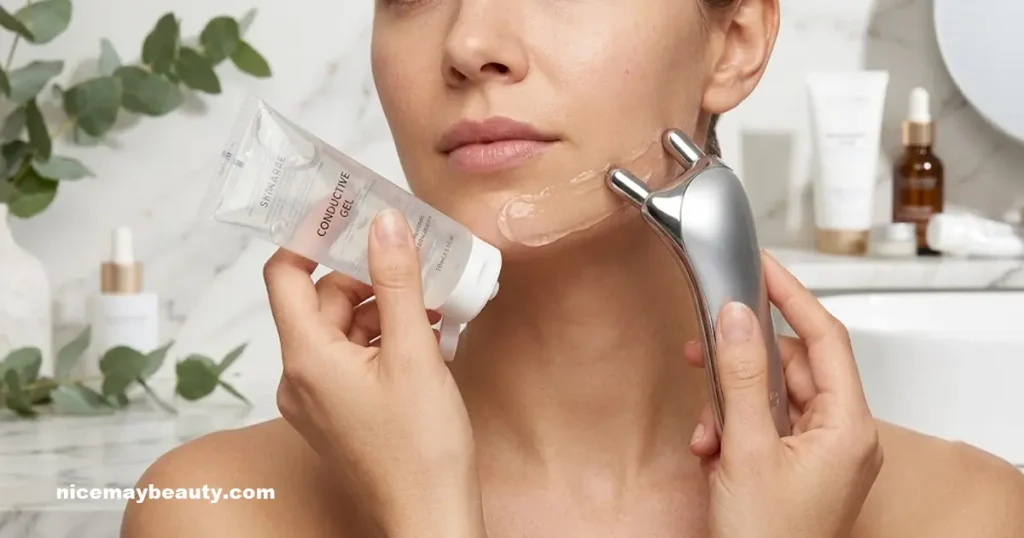
Why Conductive Gel Is Non-Negotiable for Microcurrent?
Microcurrent therapy delivers low-level electrical impulses — typically in the range of 200–600 microamperes (μA) for at-home devices — to stimulate the facial muscles beneath the skin. These impulses mimic the body’s own bio-electrical signals, re-educating and re-toning muscles that lose definition with age.
But electricity requires a conductive medium to travel efficiently. Dry skin has high electrical resistance. Without a gel layer to bridge the probes and the skin, two things happen: the current either fails to penetrate meaningfully, or it concentrates at the probe contact points, causing a sharp, uncomfortable zap. Neither outcome benefits your skin.
The physics is straightforward: conductive gel (typically water-based with electrolytes like sodium chloride or aloe vera) lowers the skin’s surface impedance, allowing the microcurrent to distribute evenly across the treatment area and reach the target muscle depth — approximately 3–5mm below the epidermis, where the SMAS (superficial musculoaponeurotic system) layer and facial muscles reside.
This is why every clinical microcurrent protocol — from the NuFace treatment guidelines to spa-level Caci treatments — specifies gel as mandatory, not optional.
| Issue Without Gel | Why It Matters |
|---|---|
| High skin impedance | Current cannot penetrate beyond the epidermis — no muscle stimulation occurs |
| Uneven current distribution | Hot spots at probe tips cause discomfort or micro-burns over time |
| Skin drag & friction | Moving dry probes across skin causes surface irritation and redness |
| Device safety shutoff | Many quality devices detect resistance spikes and cut the session short |
Not all gels are equal, and some serums marketed as ‘microcurrent-compatible’ actually reduce conductivity. Our full breakdown in Conductive Gels vs. Serums: What Works Best with Microcurrent? covers exactly which formulations to use — and which to avoid entirely.

Step-by-Step: How to Use Conductive Gel with a Microcurrent Device
Follow this sequence exactly. Skipping or reordering steps — especially prep and drying — is the most common reason users report ‘it’s not working’ after two weeks.
Step 1 — Cleanse with an Oil-Free, Residue-Free Cleanser
Cleanse your face with a gentle, oil-free gel or foam cleanser. This is critical: even a thin residue of oil, silicone, SPF, or heavy moisturizer acts as an insulator. Oils are hydrophobic and electrically non-conductive. A cleanser containing sulfates or surfactants effectively removes these barriers without stripping the skin.
What to avoid before treatment: oil-based cleansers (including balm or micellar oil formulations), heavy cream moisturizers, sunscreen (which contains UV-filtering silicones), and facial oils. Any of these left on the skin will reduce current penetration by 30–60% based on conductivity testing data from device manufacturers.
Step 2 — Pat Dry, but Leave Skin Slightly Damp
Pat — don’t rub — your skin dry with a clean towel. The goal is to remove excess water while leaving the skin in a slightly hydrated state. Fully dried, tight skin has higher impedance. A slightly moist surface helps the conductive gel spread and adhere evenly.
Step 3 — Apply a Generous, Mask-Like Layer of Conductive Gel
This is where most users go wrong. A mask-like application means covering the treatment zone in a layer approximately 2–3mm thick — roughly the equivalent of spreading a thick coat of Greek yogurt, not a thin smear of moisturizer. You should not be able to see the skin’s texture clearly through the gel.
Why so much? Two reasons. First, the gel must stay wet throughout the entire treatment zone. Microcurrent stimulation typically takes 3–5 minutes per facial zone. If the gel dries mid-treatment — which a thin layer will — the impedance spikes and you lose conductivity. Second, the device probes need to glide smoothly without any resistance to skin. Drag causes micro-friction and reduces the arc of your stroke.
Practical amount: use approximately 1–1.5 ml of gel per treatment zone (forehead, cheeks, jaw, neck each count as separate zones). For a full-face session, plan to use 4–6 ml total. Most conductive gel products come in 100–150ml bottles, meaning a single bottle provides 20–30 full sessions.
Step 4 — Work in Zones, Reapplying as Needed
Don’t apply gel to your entire face at once. Divide your face into 4–5 treatment zones and apply fresh gel before treating each zone:
- Zone 1: Forehead and brow area
- Zone 2: Right cheek and cheekbone
- Zone 3: Left cheek and cheekbone
- Zone 4: Jawline and lower face
- Zone 5: Neck and décolletage (if treating)
Treating one zone at a time prevents the gel from drying on untreated areas. If you notice the gel starting to become tacky or sticky (rather than slippery) mid-zone, pause and mist with water or add a small amount of fresh gel before continuing.
Step 5 — Device Technique: Slow, Upward Strokes with Full Node Contact
Both probes (nodes) of the microcurrent device must maintain full, simultaneous contact with the skin at all times. This is a circuit: current flows from one probe, through the muscle layer, and returns through the second probe. Lifting one probe off breaks the circuit entirely.
Stroke speed: move at approximately 2–3 cm per second — deliberately slow. Fast strokes reduce the duration of muscle stimulation per pass and decrease the cumulative ATP-stimulation effect that drives collagen production. Slow, intentional upward and outward movements follow the direction you want the muscle to be re-educated toward.
Pressure: light to medium. You’re not massaging — you’re conducting. Pressing too hard compresses the gel layer and reduces the contact surface area, which increases current density and discomfort at the probe tips.
Step 6 — Post-Session: Rinse or Massage In
After your session, two options exist depending on your device and gel type:
- If using a basic conductive gel: rinse off with lukewarm water and follow with your usual serum and moisturizer routine.
- If using a conductive serum/gel hybrid: massage the remaining product into the skin as a treatment serum — this adds a skincare benefit beyond the electrical session.
Do not apply active ingredients (retinol, AHA/BHA acids) immediately after a microcurrent session. The skin has temporarily increased permeability from the electrical stimulation — actives absorb more aggressively and may cause sensitivity. Wait at least 30 minutes before applying any treatment products.

Conductive Gel Formulations: What to Use and What to Avoid
The type of gel matters. Our detailed guide on Conductive Gels vs. Serums: What Works Best with Microcurrent? goes deep on this topic, but here’s the essential summary:
| Gel Type | Conductivity | Best For |
|---|---|---|
| Water-based conductive gel (electrolyte-enhanced) | Excellent | All device types; recommended as default |
| Aloe vera gel (pure, no additives) | Good | Sensitive skin; lightweight feel |
| Hyaluronic acid serum (thin, water-based) | Moderate | Dual-purpose: conductivity + hydration |
| Vitamin C serum (low-viscosity, water-based) | Moderate | Anti-aging combo; check pH below 3.5 |
| Oil-based serum / facial oil | Poor / Blocks current | Never use — insulates skin surface |
| Silicone-based primer or foundation | None | Completely blocks current — never use |
| Gel with alcohol > 5% | Reduces conductivity | Avoid — dries skin mid-session |
Expert note: In my experience testing over a dozen device-gel combinations, the single most reliable conductor for at-home use is a purpose-formulated microcurrent gel with sodium hyaluronate and electrolytes (like potassium chloride or sodium chloride). These maintain optimal pH (5.5–6.5) to match skin’s natural acid mantle, stay hydrated for 8–12 minutes without reapplication, and rinse off cleanly. If you’re using a thin vitamin C or peptide serum, supplement with 2–3 spritzes of mineral water or a plain hydrating mist to maintain gel moisture throughout the session.
The Right Device Makes a Difference: A Note on Probe Design
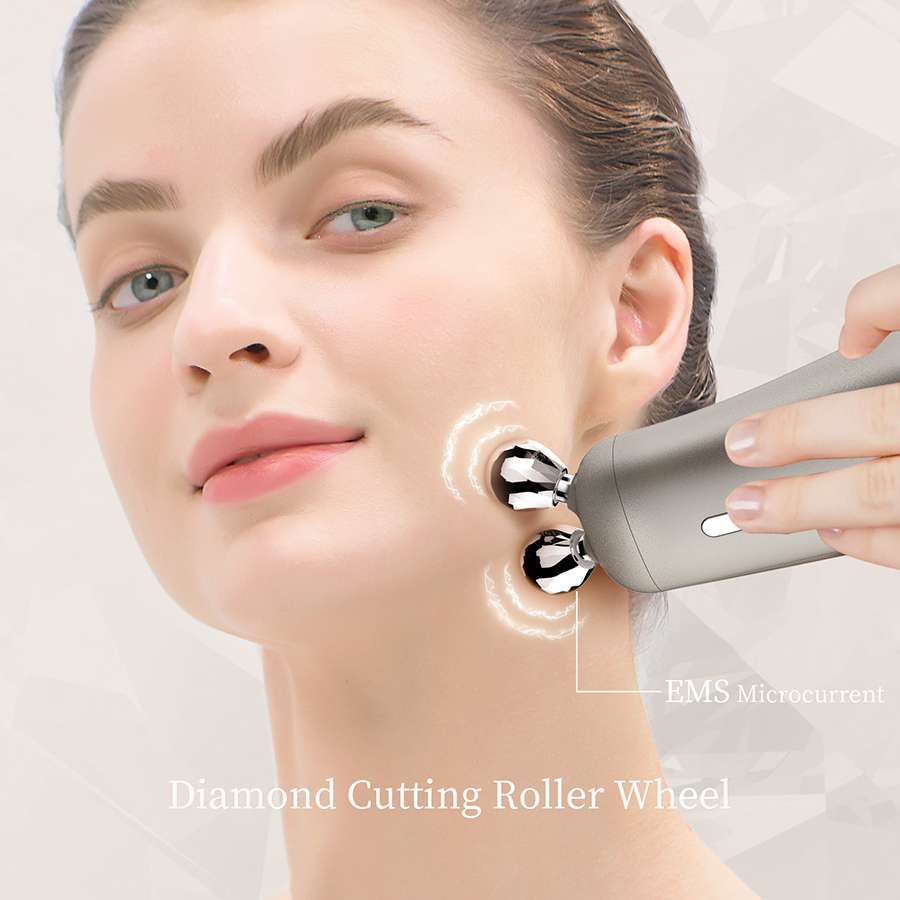
Not all microcurrent devices interact with conductive gel the same way. Probe design — specifically the surface area, material, and spacing of the electrodes — directly affects how efficiently the current is transferred through the gel layer into the muscle tissue.
Devices with large, flat probes distribute current over a wider area, requiring more gel volume but producing a gentler sensation. Devices with small, pin-like probes concentrate current more intensely — effective for precise contouring but requiring thicker gel to avoid pinpoint discomfort.
The ideal setup for at-home users combines adequate probe surface area (≥1 cm² per node), smooth rounded edges (no sharp angles that cause gel displacement), and a biphasic waveform that alternates current polarity — this prevents ion buildup in the gel layer that can cause a burning sensation after prolonged sessions.
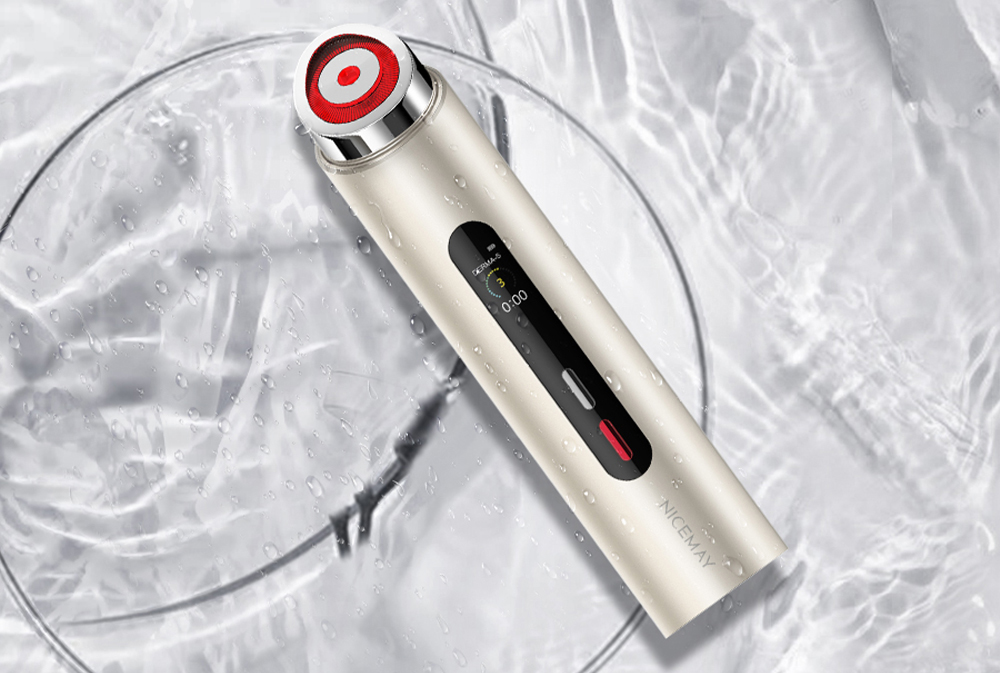
NICEMAY MR-2610 Microcurrent + LED + Gua Sha Massager
The NICEMAY MR-2610 combines three evidence-backed technologies in one handheld device: biphasic microcurrent (output in the 200–400 μA safe home-use range), multi-wavelength LED (red 630nm + near-infrared 830nm), and a T-shaped gua sha massage head. Its dual-probe design ensures both nodes stay in full contact with conductive gel — which is the #1 technical requirement for effective current delivery. The device features a built-in auto shut-off after 10 minutes, preventing the overuse that causes the muscle fatigue some users experience with basic single-channel devices.
Why it works well with conductive gel: The stainless steel probes have a smooth, rounded surface area of approximately 1.5 cm² each, which distributes the current evenly and minimizes any hot-spot sensation — especially important when using lighter-weight gels (hyaluronic acid-based) versus thicker conductive gels.
Common Mistakes That Sabotage Every Session
Mistake #1: Using Too Little Gel
The most common. A thin smear evaporates within 60–90 seconds under the warmth of the probes and skin. Once dry, the current path is broken. You feel less stimulation, the device may auto-shut off, and the muscular re-education that drives lift simply doesn’t happen. Use a mask-like layer, not a moisturizer-thin spread.
Mistake #2: Treating Over Oily or Product-Loaded Skin
SPF, silicone primers, heavy creams, and facial oils create an insulating barrier. Even a full layer of conductive gel on top cannot fully compensate. Always cleanse first with an oil-free cleanser, then apply gel to bare skin.
Mistake #3: Moving the Device Too Quickly
The clinical benchmark: professional microcurrent treatments use 3–5 second holds per point and strokes lasting 5–8 seconds per pass. At home, most users rush — especially when treating the full face, which can take 15–20 minutes for a proper session. Rushing reduces ATP stimulation time per muscle and produces minimal visible change. Slow down significantly.
Mistake #4: Overusing the Device to ‘Speed Up’ Results
More is not better. Daily use beyond the manufacturer’s protocol — typically 5 days per week maximum for most at-home devices — can cause temporary muscle fatigue. The facial muscles need 24–48 hours to respond to the stimulation. Overuse can actually cause temporary loosening in the short term. Stick to the recommended schedule, especially in the first 90-day ‘loading phase’ when muscles are re-learning their tone.
Mistake #5: Neglecting the Neck and Décolletage
The platysma (neck muscle) is directly connected to the lower facial muscles. Neglecting it while treating the face creates a disconnect — the jaw and jowl area lifts slightly but the neck remains lax, making the result look incomplete. Always extend your gel application and treatment down the neck.
Troubleshooting: What to Do When Something Feels Off
| Symptom | Likely Cause & Fix |
|---|---|
| Stinging or zapping sensation | Gel too thin or drying out — reapply gel or mist with water immediately |
| No sensation at all | Possible: oil/silicone residue blocking current, gel type wrong (silicone-based), or device issue — re-cleanse skin and use proper conductive gel |
| Uneven sensation (strong one side, weak other) | One probe losing full contact — slow down and ensure both nodes stay flush against skin |
| Skin redness lasting > 30 min after session | Current intensity too high for current skin sensitivity — lower the level and increase gel thickness |
| Gel drying after 1–2 minutes | Ambient temperature too warm or layer too thin — increase gel amount, work in smaller zones, or use a gel with higher aloe/hyaluronic acid content |
| Device auto shut-off mid-session | Impedance spike from dry/resistive skin — re-wet the area and reapply gel before continuing |
Curious whether conductive gel is truly essential or just a manufacturer recommendation? Our evidence-based guide Does Microcurrent Work Without Conductive Gel? A Clear, Realistic Guide answers this directly — including the one exception where dry use is acceptable.
FAQs About How to Use Conductive Gel with a Microcurrent Device Correctly
How much conductive gel should I use per session?
Can I use my regular hyaluronic acid serum as a conductive gel?
How long does conductive gel last before drying during a session?
Can I apply skincare products before the conductive gel?
What happens if I skip conductive gel entirely?
Without conductive gel, the current from a microcurrent device cannot adequately penetrate the epidermis to reach target facial muscles. You may experience increased discomfort as current concentrates at probe contact points, and the therapeutic benefit is essentially zero. Some users also risk skin irritation from the probes dragging on dry skin. The only partial exception is devices with fabric or gel-embedded pads — but even these perform significantly better with additional gel applied. For a full analysis, see our guide: Does Microcurrent Work Without Conductive Gel? A Clear, Realistic Guide.
Please fill in your email in the form and we’ll get back to assist you soon!