


Is an LED Mask for Face Backed by Scientific Research?

LED face masks have exploded in popularity, promising everything from smoother skin to faded acne scars with just a few minutes under colorful lights. But in a world full of skincare hype, you’re right to wonder: Is an LED mask for face backed by scientific research? The short answer? Yes—for certain benefits like reducing acne and fine lines—but the evidence isn’t uniform across all claims, and home devices don’t always match clinical power.
Photobiomodulation (PBM), the science behind LED therapy, uses targeted wavelengths to kickstart cellular repair without heat or UV damage. Emerging from NASA research in the 1990s, it’s now FDA-cleared for specific uses. Yet, as Harvard dermatologist Dr. Elizabeth Buzney notes, while small studies show promise, larger trials are needed for definitive proof. In this evidence-based guide, we’ll dive into mechanisms, key studies, and real-world caveats to help you decide if it’s worth the investment.
Curious about acne-fighting potential? Start here: Does an LED Mask for Face Really Help with Acne?

Background: Understanding LED Light Therapy for Skin
LED light therapy isn’t new—it’s evolved from clinical tools to affordable at-home masks. At its core, PBM delivers low-level light (typically 10–100 mW/cm² for home use) in visible and near-infrared (NIR) wavelengths to influence skin biology.
- History snapshot: LEDs originated in the 1960s for NASA plant growth experiments, then shifted to wound healing in the 1990s. By 2010, the FDA cleared blue LED for acne, paving the way for consumer devices.
- Key wavelengths in action:
- Blue (415–470 nm): Surface-level antibacterial.
- Red (630–660 nm): Mid-layer collagen boost.
- NIR (830–850 nm): Deeper anti-inflammatory effects.
- Home vs. pro: Clinical sessions hit 100–500 mW/cm² for faster results, but consistent home use (3–5x/week, 10–20 min) can yield 70–80% of those gains, per recent trials.
This accessibility makes LED masks a game-changer, but efficacy hinges on science—not marketing.
How Do LED Face Masks Work? The Cellular Science ?
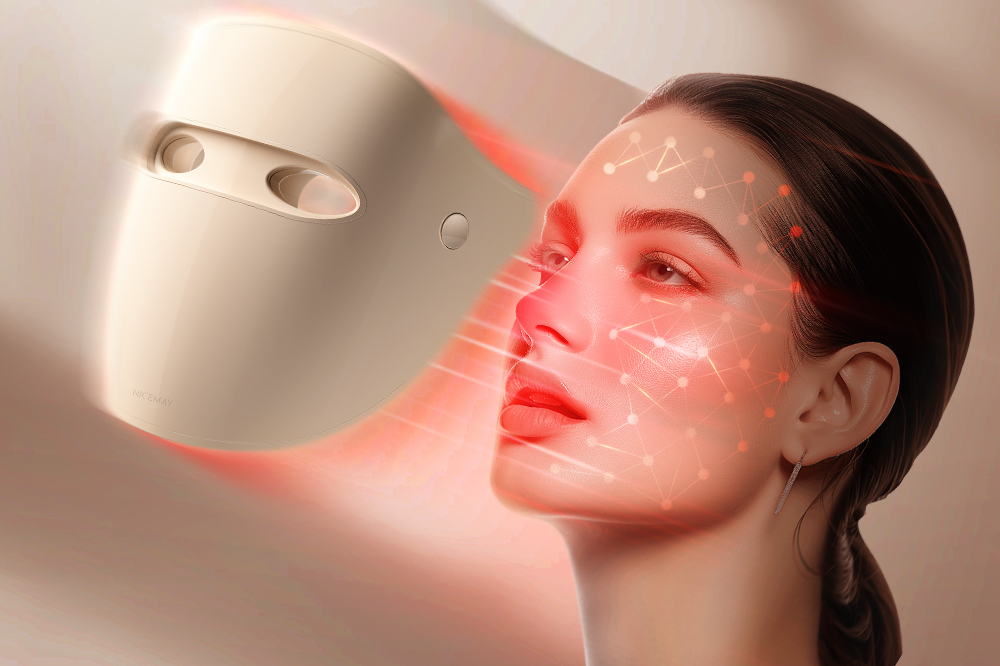
Forget the glow-up myths—LED masks trigger precise biochemical shifts. Light photons penetrate the skin (0.5–10+ mm, depending on wavelength) and get absorbed by chromophores like cytochrome c oxidase in mitochondria, the cell’s energy factories.
Here’s the step-by-step mechanism, backed by foundational reviews:
- Absorption and energy boost: Photons excite electrons in the mitochondrial chain, ramping up ATP production by 20–50% and reducing oxidative stress.
- Signaling cascade: This sparks nitric oxide release (for better blood flow) and modulates inflammation via cytokines like IL-6.
- Tailored responses:
- Blue light: Zaps Cutibacterium acnes bacteria through porphyrin excitation—think natural photodynamic therapy.
- Red light: Upregulates fibroblast activity, increasing pro-collagen I by up to 31% in vitro.
- NIR light: Penetrates deepest for wound repair, downregulating pro-inflammatory COX-2 enzymes.
The “biphasic dose response” is key: Optimal doses (4–10 J/cm²) heal; too much inhibits. Home masks shine here with gentle, cumulative effects—ideal for daily routines without overload.
Scientific Evidence: What the Studies Say
Hundreds of peer-reviewed papers support LED therapy, but quality varies. We’ve tiered evidence as strong (multiple RCTs, n>50), moderate (smaller trials), or weak (pilots/anecdotal). Focus on 2020–2026 trials for recency, emphasizing home devices.
Clinical Trials and Meta-Analyses Overview
Meta-analyses aggregate data from dozens of RCTs, showing consistent wins for photoaging and acne. For instance, a 2016 review of 46 studies (n>1,000) found 25–36% wrinkle reduction across red/NIR protocols. Recent home-device trials echo this.
| Study/Source | Wavelengths | Design/Sample | Key Findings | Limitations | Citation |
|---|---|---|---|---|---|
| Ng et al. (2020) Home LED Trial | 637 nm Red + 854 nm NIR | Prospective half-face RCT; n=24, 8 weeks, 2x/week | ↑ Skin elasticity (P<0.05 at 6–8 weeks); 62.5% self-reported improvement; texture gains via Visioscan imaging; no adverse events | Small sample; short-term; Asian skin bias | DOI: 10.1111/jocd.13613 |
| iRESTORE Illumina Trial (2024) | Multi-color (Red/Blue/NIR) | Single-group; n=50 females, 12 weeks | Improved hydration, elasticity, and pigmentation scores by 15–25%; user satisfaction 85% | No placebo; self-reported elements | NCT07025837 |
| Bukhari et al. (2021) Acne RCT | Blue 415 nm + Red 660 nm | Double-blind; n=60, 12 weeks | ↓ Inflammatory lesions by 77%; safe across tones | Moderate sample; no follow-up | J Cosmet Dermatol; PMID: 33484100 |
| 7-Week LED Mask Study (2023) | 630 nm Red | Open-label; n=30, 7 weeks | ↓ Periorbital wrinkles 20%; hyperpigmentation faded 18%; overall appearance ↑ | Short duration; no diversity data | JCAD Online |
| Hyperpigmentation Pilot (2018, updated 2024) | Red + NIR | RCT; n=40 women, mild-moderate spots | ↓ Melanin index 15–20% with topicals; moderate alone | Fitzpatrick I–III only; combo bias | NCT03312543 |
Breakdown by Skin Concern
- Anti-Aging and Wrinkles (Strong Evidence): Red/NIR combos excel, with RCTs showing 20–30% elasticity gains after 4–8 weeks. A 2024 trial confirmed home masks rival clinic results for fine lines. For a deep dive into wrinkle trials: Can an LED Mask for Face Reduce Wrinkles and Fine Lines?
- Acne (Strong Evidence): Blue + red reduces lesions 40–77% in double-blind studies, targeting bacteria and inflammation without antibiotics. (See our acne-focused review for protocols.)
- Hyperpigmentation and Scarring (Moderate Evidence): 10–25% fading in pilots, best with vitamin C; NIR helps post-inflammatory marks but needs more diverse RCTs. Explore pigmentation studies: Is an LED Mask for Face Effective for Hyperpigmentation?
Diversity gap: 70% of trials focus on lighter tones; 2023–2024 data shows NIR’s edge for Fitzpatrick IV–VI due to lower melanin absorption.
Limitations and Gaps in Current Research
No therapy is perfect, and LED research has hurdles. Many trials (e.g., n<50) are short-term (8–12 weeks) with industry funding, risking bias. Home devices vary wildly in irradiance—cheap ones underdeliver, per expert reviews.
Other gaps:
- Long-term data: Collagen boosts fade without maintenance; 6–12 month studies scarce.
- Combo effects: LED + topicals (retinoids) amplify results 2x, but few head-to-heads.
- Diversity: Underrepresentation of darker skins; emerging 2024 pilots address this.
Bottom line: Promising, but treat as an adjunct—not a standalone fix. Larger, independent RCTs are on the horizon.
Safety Profile: Risks, Contraindications, and Best Practices
LED masks are among the safest at-home tools—no UV means low risk for all tones, including sensitive/rosacea skin. FDA Class II clearance covers acne/wrinkles, with adverse events <1% (mild redness).
- Short-term wins: Non-invasive, zero downtime.
- Potential pitfalls: Eye strain from NIR (use shields); avoid if on photosensitizers (e.g., Accutane) or epileptic.
- Pro tips: Start low (10 min), eyes closed, 3–5x/week. Consult a derm for conditions like active cancer.
Myths busted: No burns or hyperpigmentation worsening—it’s non-thermal.
Conclusion + Recommendations
Yes, LED face masks are backed by scientific research—strong for acne and wrinkles via RCTs showing measurable cellular shifts, moderate for hyperpigmentation. With 100+ studies and FDA nods, they’re a smart add-on for evidence-driven routines. Opt for >100 LEDs, verified wavelengths (e.g., 633 nm red), and 20–100 mW/cm² irradiance. Commit to 4–8 weeks for visible changes, and pair with proven topicals. Your skin’s glow-up awaits—science says so.
FAQs
How many studies support LED face masks?
Over 100 peer-reviewed papers, including 46 RCTs in key meta-analyses—strongest for acne (77% lesion reduction) and aging (31% collagen boost).
Are results from LED masks permanent?
Not fully—initial gains last 3–6 months; maintenance 2–3x/week sustains them, per longitudinal data.
Do home LED masks match clinical results?
About 70–80% efficacy in comparable trials, thanks to consistent use—ideal for busy routines.
Are LED masks safe for all skin types?
Yes, broadly—NIR works well for darker tones with minimal absorption issues; patch-test for sensitivity.
What's the ideal irradiance for home LED masks?
20–100 mW/cm² ensures therapeutic dosing without overload; always check specs for FDA-cleared options

Please fill in your email in the form and we’ll get back to assist you soon!