If your skin feels tight, flaky, or unexpectedly inflamed after using your silicone cleansing brush. You’re likely making one of three common mistakes that compromise your skin barrier. The good news: a silicone brush can deep cleanse pores, lift away SPF residue, and boost product absorption without causing micro-tears, redness, or sensitivity, as long as you control pressure, timing, and cleanser pairing with precision.
In this guide, you’ll get the exact technical parameters — vibration speed ranges, pressure thresholds, time-per-zone limits, and cleanser pH targets — that separate a barrier-safe routine from one that quietly damages your skin over weeks of “gentle-looking” overuse.
Why Silicone Brushes Are Safer Than Nylon — But Still Risky If Misused
But “safer material” doesn’t mean “risk-free technique.” The same source notes that physical scrubbers can cause micro-abrasions, a disrupted skin barrier, and broken capillaries in rosacea-prone skin when misused. In my work reviewing skin tech routines, the failure pattern is almost always identical: users assume softer material means they can apply more pressure or use the brush more often to compensate for a “weaker” feel. That assumption is backwards — the vibration does the cleansing work, not your hand.
선택 기준: if your skin is normal-to-oily, silicone brushes with sonic vibration in the 6,000–9,000 vibrations-per-minute (VPM) range are generally well-tolerated. If you have rosacea, eczema, or active acne, cap usage at once weekly initially and prioritize a soft-touchpoint brush head over a stiffer textured one — exactly the caution dermatologists Dr. Nishita Ranka and Dr. Shefali Trasi Nerurkar both raise regarding mechanical irritation on reactive skin.
The Step-by-Step Routine That Protects Your Barrier
Step 1: Prep Skin and Tool Before You Start
Never run a silicone brush over makeup, sunscreen, or heavy SPF residue. Use a cleansing balm or micellar water first — this is a double cleanse, not an optional extra. Skipping it means the brush’s vibration drives pigment, mineral filters, and pollutants 더 깊이 into the pore rather than lifting them out, which is one of the most overlooked causes of post-brush breakouts. Wet both your face and the brush head with lukewarm water before applying cleanser; this single step cuts surface friction by softening the silicone nubs and reducing drag against the skin.
Step 2: Choose a pH-Balanced, Non-Abrasive Cleanser
Step 3: Apply Zero Pressure — Let Vibration Do the Work
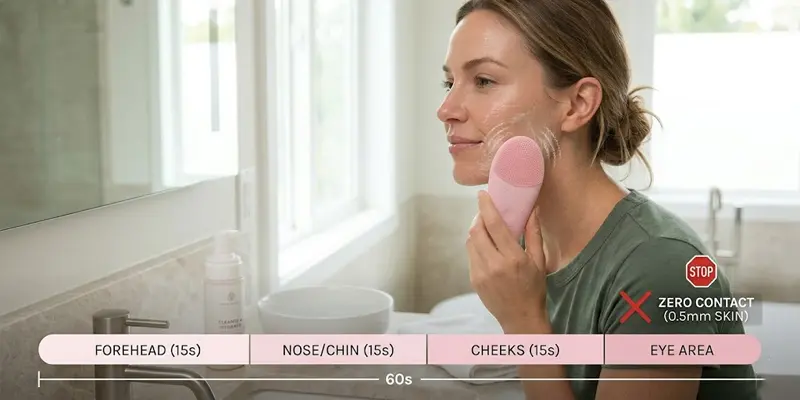
This is the step most people get wrong. Rest the brush against your skin with roughly the same pressure you’d use to hold a phone to your ear — not the pressure of scrubbing a dish. Move in small circles and let the sonic pulse (not your wrist) do the lifting. Cap total face time at 60 seconds: about 15 seconds each for forehead, nose/chin, and cheeks, skipping the eye area entirely, where skin is roughly 0.5mm thick — less than a third the thickness of facial skin elsewhere.
Step 4: Rinse, Pat, and Immediately Repair
Rinse until no cleanser film remains, then pat — never rub — with a clean towel. Within 60 seconds, while skin is still damp, apply a moisturizer containing ceramides, peptides, or hyaluronic acid. This window matters: damp skin absorbs humectants more efficiently, and ceramides specifically help rebuild the lipid matrix that mechanical cleansing temporarily disrupts.
Why "1 to 3 Times a Week" Isn't a Fixed Rule?
Most general guidance points to limiting sonic brush use to one to three sessions weekly, but the right number depends heavily on skin type and condition — treating this as a flat rule across all skin types is where a lot of advice falls short. Dr. Shefali recommends normal-to-oily skin can tolerate deep cleansing once or twice a week, while sensitive-skin users should start at once weekly and only increase if the skin tolerates it without irritation.
피부 타입
권장 빈도
Key Risk if Overused
Oily / acne-prone
2–3x weekly
Disrupted lesions, irritation of active breakouts
보통
2x weekly
Mild dryness, sensitization
건조
주 1–2회
Barrier stripping, flaking
Rosacea / eczema / active acne
1x weekly or avoid
Broken capillaries, flare-ups
A mistake I see too often: people increase frequency the moment they see a “purging” breakout, assuming more cleansing will clear it faster. It does the opposite — purging is often a sign the barrier is already compromised, and the correct response is to scale back, not intensify.
Brush Hygiene: The Overlooked Barrier Threat
Bacteria buildup on the brush head — not the vibration itself — is one of the most common hidden causes of barrier irritation and breakouts. Silicone’s non-porous structure helps, but it isn’t self-cleaning.
After every single use:
Rinse the brush head thoroughly with warm water and a mild soap (the same pH-balanced cleanser works fine)
Shake off excess water and air-dry in a ventilated spot — never seal it in a closed case while damp, which creates a humid breeding environment
Periodically (roughly every 1–2 weeks) wipe or briefly soak the silicone head in isopropyl rubbing alcohol for deeper sanitization, then rinse and air-dry fully before next use
Replace the brush head or unit once silicone shows discoloration, tackiness, or cracking — typically the 12–18 month mark for daily users, sooner for sensitive skin users who can’t afford bacterial accumulation on top of an already-reactive barrier.
How to Choose a Brush That Won't Compromise Your Barrier?
Not all silicone brushes are engineered equally, and the spec sheet matters more than marketing copy. Look for:
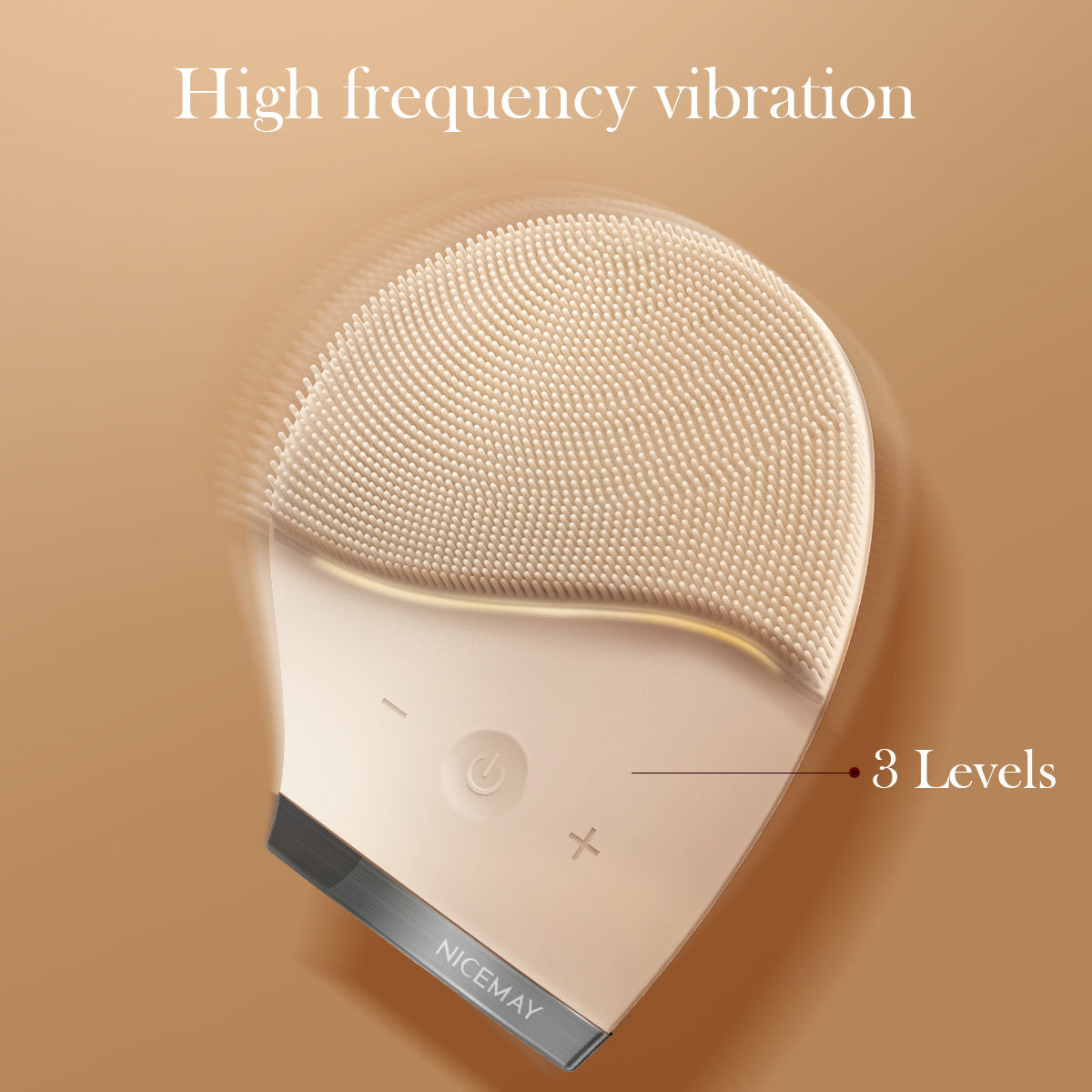
Adjustable vibration intensity (at least 3–5 speed settings) so you can dial down for sensitive zones like the under-eye perimeter and jawline
Medical-grade or food-grade silicone — confirmed hypoallergenic, not just “silicone-coated”
Auto shut-off timer around the 60-second mark, which mechanically enforces the time discipline most users fail to self-regulate
IPX6 or higher waterproof rating for safe shower use without internal moisture damage
식품의약품안전청(FDA) NICEMAY MR-2369 silicone facial cleansing brush is built around exactly this safety-first spec set — multiple intensity levels, soft medical-grade silicone touchpoints, and a built-in timing function that helps users stay within the zero-pressure, 60-second protocol outlined above, rather than relying on guesswork.
If you’re unsure whether you’re cleaning your current brush correctly between uses, our guide on how to clean a silicone face scrubber walks through the full step-by-step maintenance process in more depth.
What Actually Breaks the Skin Barrier (And What Doesn't)?
To be direct: the brush itself rarely causes barrier damage. The combination of behaviors does. The real failure modes, in order of frequency:
Applying downward pressure instead of letting vibration do the work — causes micro-tears even with soft silicone
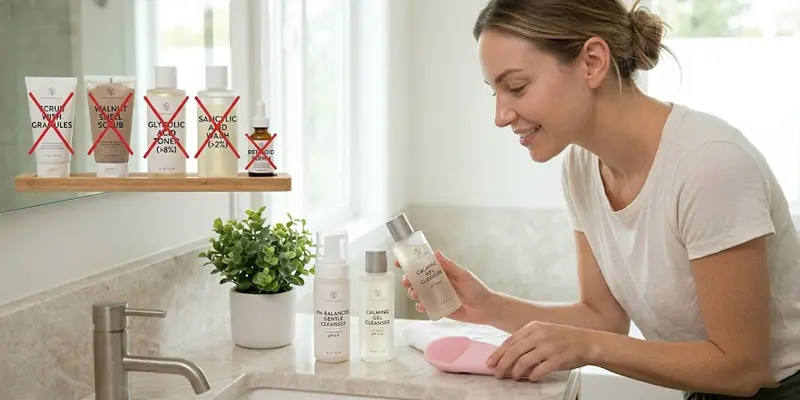
Combining the brush with active acids or physical scrubs — double exfoliation strips lipids faster than skin can replenish them
Skipping post-cleanse moisturizer — leaves the disrupted barrier without ceramide reinforcement during its most vulnerable window
Using on broken, sunburned, or actively inflamed skin — mechanical action on compromised tissue accelerates irritation rather than treating it
If you also use LED light therapy in your routine, it’s worth understanding how device-related redness differs from brush-related irritation — our breakdown on LED face mask redness and silicone facial cleansing brushes separates the two so you’re not misdiagnosing the cause.
Conclusion: Three Rules That Keep Your Barrier Intact
If you take away nothing else: let vibration — not pressure — do the cleansing; pair the brush only with pH-balanced, non-abrasive cleansers; and cap sessions at 60 seconds, 1–3 times weekly based on your skin type. Sanitize the brush after every use, and follow immediately with a ceramide-rich moisturizer while skin is still damp.
A silicone brush, used this way, is a barrier-safe upgrade to your routine — not a risk to it. If you’re ready to build this protocol around a brush engineered for exactly this kind of controlled, gentle use, the NICEMAY MR-2369 is designed to take the guesswork out of pressure and timing so your skin gets the deep cleanse without the trade-off.
FAQs About How to Deep Cleanse with a Silicone Brush Without Breaking the Skin Barrier
실리콘 브러시가 정말로 피부 장벽을 손상시킬 수 있나요?
Yes, but typically through misuse rather than the material itself. Applying pressure, over-exfoliating with acids on the same pass, or using it more than 3 times weekly on sensitive skin are the primary causes — not the silicone bristles.
실리콘 클렌징 브러시를 한 번 사용 시 얼마나 오래 사용해야 하나요?
세션당 총 사용 시간을 60초로 제한하세요: 이마, 코/턱, 볼 각각 약 15초씩. 눈 주변은 완전히 피하세요.
레티놀이나 각질 제거 성분이 포함된 산과 함께 실리콘 브러시를 사용할 수 있나요?
No. Combining mechanical brushing with high-strength AHAs, BHAs, or retinoids in the same routine significantly raises the risk of barrier disruption. Use the brush on non-active days, or separate sessions by at least 12 hours.
브러시 자체를 얼마나 자주 세척해야 하나요?
매번 사용 후 따뜻한 물과 순한 비누로 헹구고 완전히 자연 건조하세요. 더 깊은 위생 관리를 위해 1~2주마다 알코올 소독을 하세요.
실리콘 브러시는 주사 피부 또는 습진 피부에 안전한가요?
주의해서 접근하세요. 가장 낮은 진동 세팅으로 일주일에 한 번 시작하고, 홍조 또는 민감도가 증가하는 것을 보면 사용을 중단하세요. 많은 피부과 전문의들은 활성 염증성 피부 상태가 있을 경우 기계 도구를 도입하기 전에 전문가와 상담할 것을 권장합니다.