

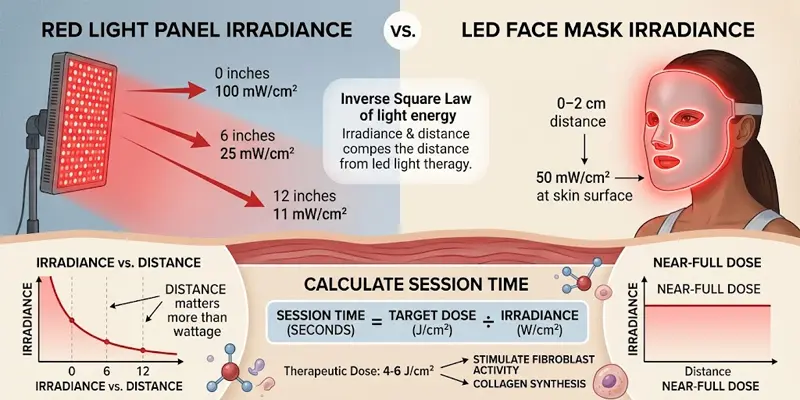
Before comparing form factors, you need to understand why distance matters more than wattage on the spec sheet.
Irradiance, measured in milliwatts per square centimeter (mW/cm²), drops with the square of the distance from the light source. A panel rated at 100 mW/cm² at 6 inches delivers roughly 25 mW/cm² at 12 inches. An LED mask, by contrast, sits 0–2 cm from your skin. A mask with an irradiance of 50 mW/cm² at the emitter surface still delivers nearly that full dose because there is no distance for energy to bleed off. This is the core physics advantage masks hold for facial skin.
To reach a therapeutic energy dose of 4–6 J/cm² (the minimum shown in peer-reviewed studies to stimulate fibroblast activity and collagen synthesis), you can calculate the session time required:
Session time (seconds) = Target dose (J/cm²) ÷ Irradiance (W/cm²)
A mask with 60 mW/cm² at-skin irradiance reaches 4 J/cm² in roughly 67 seconds per zone. A panel delivering 80 mW/cm² at a 15-cm treatment distance reaches the same dose in 50 seconds, but only if you hold that distance precisely. Move back to 30 cm and your actual irradiance drops to around 20 mW/cm², requiring 3.3 minutes for the same dose.
Understanding the relationship between irradiance and effective LED therapy tells you why two devices with identical watt ratings on the box can produce opposite clinical outcomes.
Wavelength and Tissue Penetration Depth
Red light at 630–660 nm reaches the dermis at roughly 2–3 mm below the skin surface. Research published in the Journal of Photochemistry and Photobiology confirms this wavelength range drives cytochrome c oxidase activity in mitochondria, accelerating ATP production and fibroblast proliferation. For acne, wrinkle reduction, and surface pigmentation, 630–660 nm is the primary tool.
Near-infrared (NIR) at 810–850 nm penetrates 5–10 mm, reaching the hypodermis and underlying muscle fascia. At 830 nm specifically, multiple randomized controlled trials demonstrate statistically significant reductions in musculoskeletal pain and inflammatory markers in synovial tissue. If your goal is jaw tension, temporomandibular joint discomfort, or post-workout facial muscle recovery, NIR matters for you.
The critical gap most buyers miss: many consumer LED masks omit NIR entirely. A mask with only 630 nm red LEDs cannot reach the tissue depth needed for anti-inflammatory or muscle recovery effects, regardless of how long you wear it. You can read a detailed breakdown of how LED wavelengths penetrate different skin layers before committing to a device.
Targeted Facial Photobiomodulation
An LED face mask concentrates every photon on a fixed treatment area: your face. For wrinkle reduction, acne clearance, and hyperpigmentation, this concentration produces consistent energy delivery across the entire facial surface in a single session. A 2014 study in Dermatologic Surgery found that subjects using 633 nm LED therapy twice weekly for 8 weeks showed a mean 36% reduction in rhytide depth as measured by profilometry. Subjects in the panel-treated group who held variable distances showed higher outcome variance, which the researchers attributed to inconsistent dose delivery.
Masks also let you move. You can wear one while folding laundry, reading, or sitting in a meeting. For someone fitting treatment into a packed schedule, 10–20 minutes without sitting still in front of a stand is a non-trivial benefit.
Multi-Wavelength Mask Technology
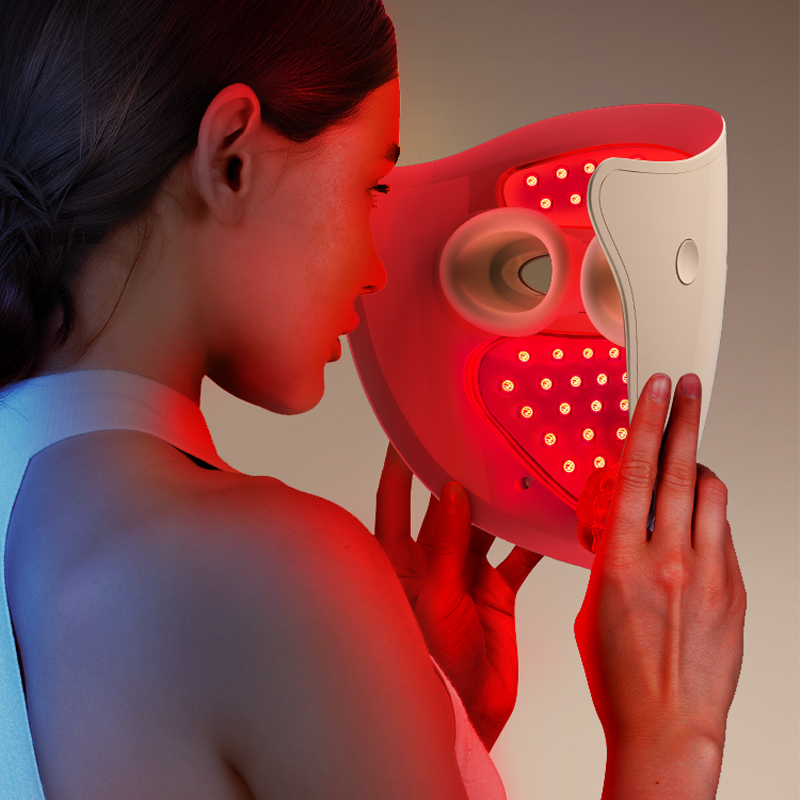
Premium LED masks now combine red (630–660 nm), near-infrared (830 nm), blue (415–430 nm for Propionibacterium acnes eradication), and yellow (590 nm for redness and lymphatic stimulation) in a single device. The NICEMAY MR-2308 Nude Beauty Pro LED Mask uses 648 individual LED chips across seven wavelength modes, covering red, near-infrared, blue, yellow, green, cyan, and white light. At 60 mW/cm² measured at-skin irradiance, it reaches the 4 J/cm² threshold in under 70 seconds per zone, with a full-face session completing in 10–20 minutes. The flexible silicone panel conforms to facial contours, which reduces the light gaps that occur with rigid masks on areas like the nose bridge or jaw angle.
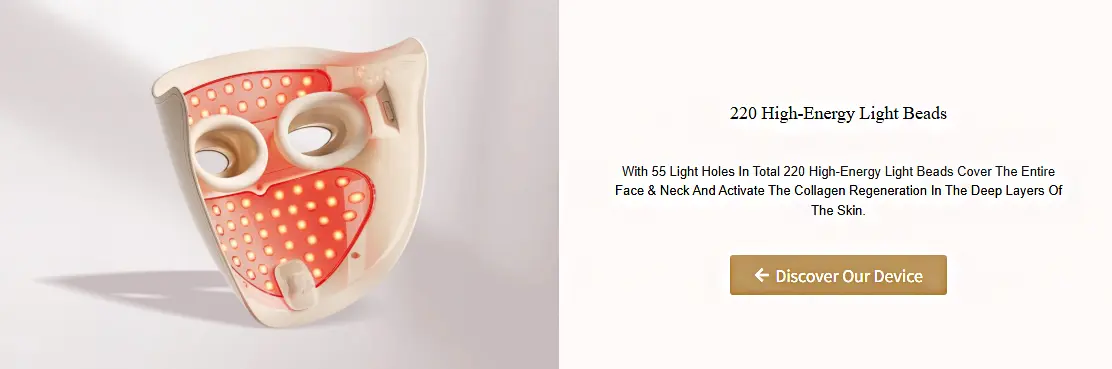
The practical failure mode of low-quality masks: cheap devices use LED clusters rather than individual chips spread across a uniform grid. This creates irradiance hot spots (above 100 mW/cm²) near clusters and dead zones between them. You might receive an overdose at your forehead while your cheekbones sit below therapeutic threshold. Check for published irradiance maps or ask manufacturers for third-party spectrophotometer data before buying.
Coverage Limits
A mask treats your face. It cannot address your neck, décolletage, shoulders, or back. Buyers who want skin rejuvenation from the collar down will need a panel or a separate body device. This boundary is fixed by form factor, not technology.
Irradiance Output and Clinical-Grade Power
Full-size red light therapy panels (typically 12″x36″ or larger) are engineered to deliver 100–200 mW/cm² at a 15 cm treatment distance. At that irradiance, a 10-minute session at 15 cm delivers 60–120 J/cm², which exceeds the therapeutic window for most dermatological applications and enters the tissue repair range studied for tendon healing and cartilage regeneration. For chronic pain management, published research in Photomedicine and Laser Surgery shows 808 nm NIR at 100 mW/cm² reduces inflammatory cytokine expression (TNF-α, IL-6) in treated tissue within 4–8 sessions.
Panels routinely combine 660 nm red and 850 nm NIR at a 1:1 or 3:1 ratio, which means a single session addresses both surface collagen stimulation and deeper joint or muscle recovery simultaneously. For someone dealing with both facial aging and chronic neck tension, a panel positioned to cover the full head and neck area addresses both in one session.
Distance Management: The Critical Skill
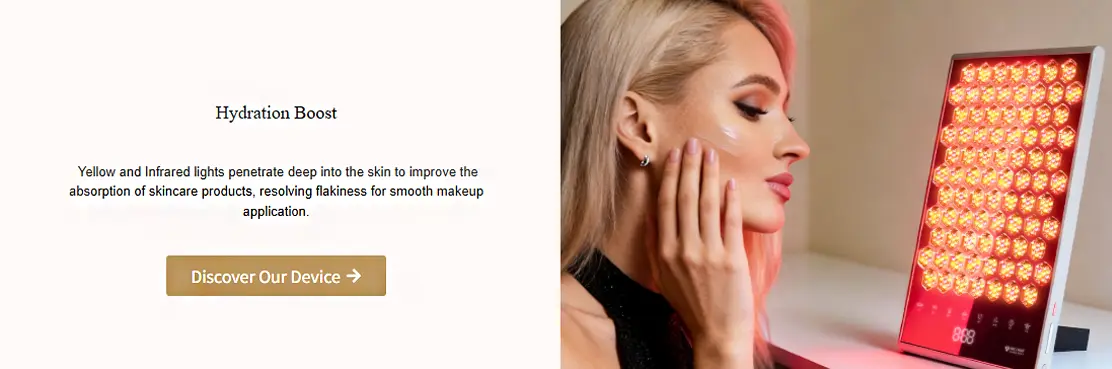
The mistake panel users make most often is sitting too far back. At 60 cm from a 150 mW/cm² panel, you receive only about 17 mW/cm² at skin surface. To hit 10 J/cm² at that distance, you need 10 minutes. At 15 cm from the same panel, you hit the same dose in under 70 seconds. Most consumer guides omit this calculation. You should measure your treatment distance with a tape measure and confirm the irradiance value at that distance from the manufacturer, not the peak spec.
Panels also require you to stay stationary. A 10–20 minute session in front of a mounted panel means committing to that position. Rotating your body to address back and legs adds session time. For users with a reliable routine and space for a wall-mounted or standing panel, this is manageable. For someone who already skips skincare steps due to time, a panel session schedule often collapses within 6 weeks.
Cost and Infrastructure
Entry-level panels from established brands (Joovv, Mito Red Light, PlatinumLED) start at $300–$400 for small panels and reach $800–$2,000 for modular full-body setups. You also need a mounting solution, a dedicated space, and consistent positioning across sessions. LEDs in quality panels carry rated lifespans of 50,000 hours, so long-term cost is low, but the upfront investment and space commitment are real barriers.