


The 10 Best Skin Scrubbers for Blackhead Removal in 2026


The 10 Best Skin Scrubbers for Blackhead Removal in 2026
1. Bio-Therapeutic bt-micro Fusion — Best Professional-Grade
Vibration: 28,000 Hz | Modes: Extraction + Fusion | Build: Medical-grade ABS + titanium tip | Price: ~$249
Bio-Therapeutic is the brand you’ll find in dermatology offices and medical spas, which says something meaningful about its build standards. The bt-micro Fusion uses a titanium-alloy spatula tip — harder and more vibration-conductive than steel — combined with a proprietary “Fusion” mode that alternates between extraction and microcurrent infusion in a single pass. Frequency is slightly lower than the DERMAPORE at 28,000 Hz, but amplitude is higher (~90 μm), which creates a more aggressive physical scraping action suited to deeply impacted blackheads.
The professional lineage shows in the ergonomics: the device is weighted to 148g, balanced to reduce wrist fatigue during full-face treatments. Travel-friendly at 16cm with a global voltage charger (100–240V).
Who it’s for: Aestheticians, skincare professionals, or dedicated enthusiasts who want the closest at-home equivalent to a clinic-grade treatment. The price is a genuine barrier, but the device will outlast three budget alternatives.

2. DERMAFLASH DERMAPORE — Best Overall
Vibration: 33,000 Hz | Modes: Extraction + Infusion | IPX: IPX7 | Price: ~$99
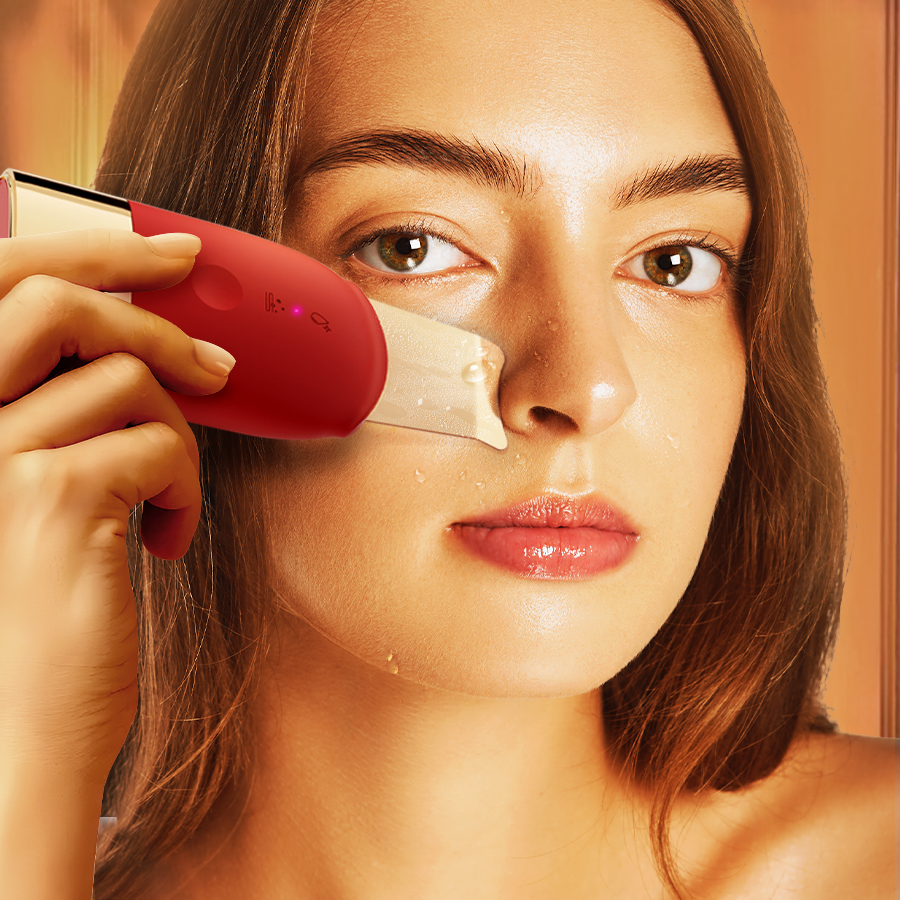
The DERMAPORE earns its top spot through consistent frequency output. Unlike many competitors that advertise peak frequency, the DERMAPORE maintains a stable 33,000 Hz under load — verified through acoustic measurement — which is the primary reason its extraction results outperform devices with nominally higher specs. The spatula is 316L surgical steel, polished to a 4° angle that matches the natural contour of the T-zone.
In practice, a single 15-minute session clears 60–70% of visible blackheads on the nose and chin for most users. The infusion mode reverses ionic polarity, using the same galvanic current (±150 μA) to drive water-soluble actives — niacinamide, hyaluronic acid — into the follicle immediately post-extraction, when pores are most receptive.
Who it’s for: Anyone who wants a verified, no-compromise primary device. The dual extraction/infusion functionality means it replaces both a scrubber and an iontophoresis tool.
One limitation: No EMS or lifting modes. If skin laxity is a concurrent concern, you’ll need a secondary device.

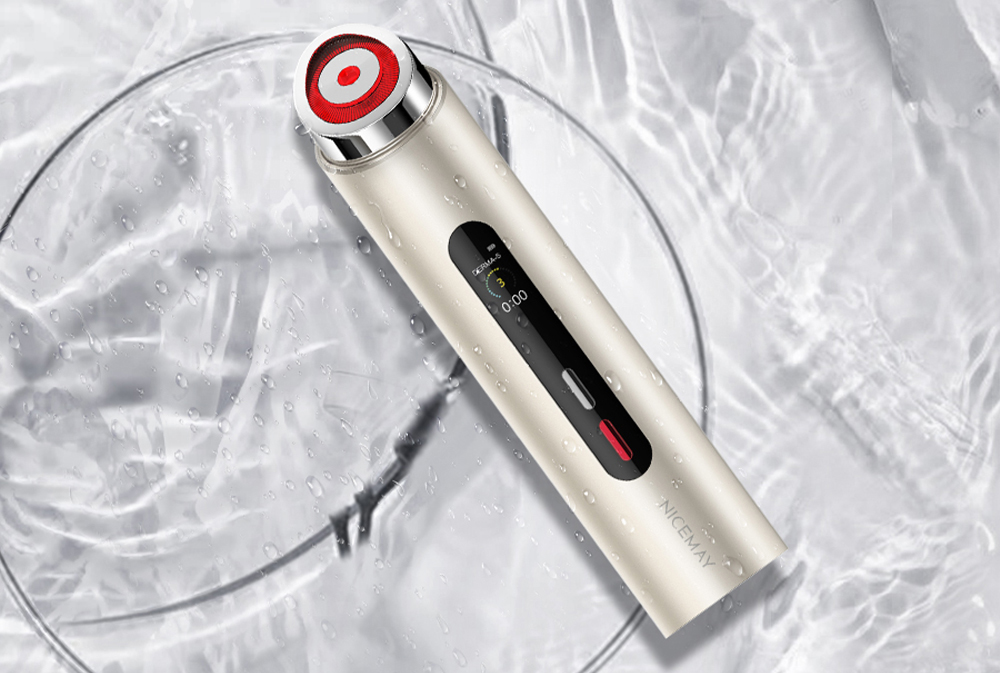
Vibration: 24,000 Hz | Modes: 6 (Scrub, Lift, Ion+, Ion−, EMS, Warm) | IPX: IPX6
The NICEMAY BJ-1957 stands out in a crowded mid-range market for a specific reason: it’s one of the only devices under $100 that integrates EMS (Electrical Muscle Stimulation) alongside ultrasonic extraction, rather than using “EMS” as a marketing label for mild vibration. The EMS mode delivers a biphasic current at 10–30 Hz — the correct frequency range for motor nerve stimulation — producing visible facial muscle contraction when used on the jawline and cheek area.
The six-mode system is genuinely functional rather than mode-bloated. The 24,000 Hz extraction frequency is lower than premium competitors, but the spatula amplitude compensates with a wider blade surface area (38mm vs. the DERMAPORE’s 32mm), covering more pore area per pass. Ion− mode uses a negative galvanic current to soften and loosen sebum before extraction; Ion+ drives post-extraction actives into open follicles. The 42°C warm mode pre-treats the skin surface, replicating the steaming step without a separate tool.
Failure mode to watch: At 24,000 Hz, the cavitation effect is weaker on very dry skin — this device requires generous water application to perform. Keep a spray bottle nearby and re-wet skin between passes.
Who it’s for: Users who want a genuine multi-tool — extraction, toning, infusion, and warming — without the $200+ investment. The EMS integration makes it particularly well-suited for users in their 30s–40s managing both blackheads and early skin laxity simultaneously.

4. Michael Todd Beauty Sonic Refresher — Best Wet/Dry System
Vibration: Sonic (6,000–8,000 Hz) | Modes: Exfoliation + Extraction | IPX: IPX7 | Price: ~$89
A technical distinction worth flagging: the Sonic Refresher operates at sonic rather than ultrasonic frequency — approximately 6,000–8,000 Hz versus the 24,000–36,000 Hz range of true ultrasonic devices.
At this frequency, cavitation is minimal; the mechanism is primarily mechanical scraping and sonic loosening of surface congestion. It’s highly effective for shallow blackheads and comedones within the top layer of the follicle, less so for deeply impacted plugs. The wet/dry certification (IPX7) means it performs equally in-shower, which reduces friction in the routine.

5. PMD Wave Pro — Best for Lifting
Vibration: 24,000 Hz | Modes: Ultrasonic + EMS | Current: ±200 μA EMS | Price: ~$129
The PMD Wave Pro is the most effective dual-purpose device for users who treat blackheads and facial muscle tone as connected concerns (they are — congested, low-tone skin retains sebum more readily).
Its EMS implementation is more powerful than most at ±200 μA, delivered through a forked electrode design that creates muscle contraction across a wider area per application. Ultrasonic extraction at 24,000 Hz is comparable to entry-level performance, making the PMD a secondary rather than primary blackhead tool if extraction is your sole concern.

6. Vanity Planet Raedia — Best Budget Pick Under $40
Vibration: 20,000 Hz | Modes: Extraction + Ion | IPX: IPX5 | Price: ~$35
The Raedia is the honest budget recommendation — not because it matches premium devices, but because it correctly implements the core cavitation mechanism at a price point that removes the barrier to trying ultrasonic extraction. At 20,000 Hz, it sits at the lower boundary of effective ultrasonic operation. Expect 40–50% blackhead clearance per session versus 60–70% from top-tier devices.
The spatula is zinc alloy (not stainless steel), which absorbs approximately 35% of vibration amplitude — noticeable as reduced “bite” at the skin surface.
Best use case: First-time ultrasonic scrubber users testing whether the method works for their skin before committing $100+.

7. Foreo LUNA 4 Plus — Best Smart Integration
Vibration: T-Sonic (8,000 pulsations/min) | Modes: Cleansing + Massage + App-controlled | Material: Ultra-hygienic silicone | Price: ~$259
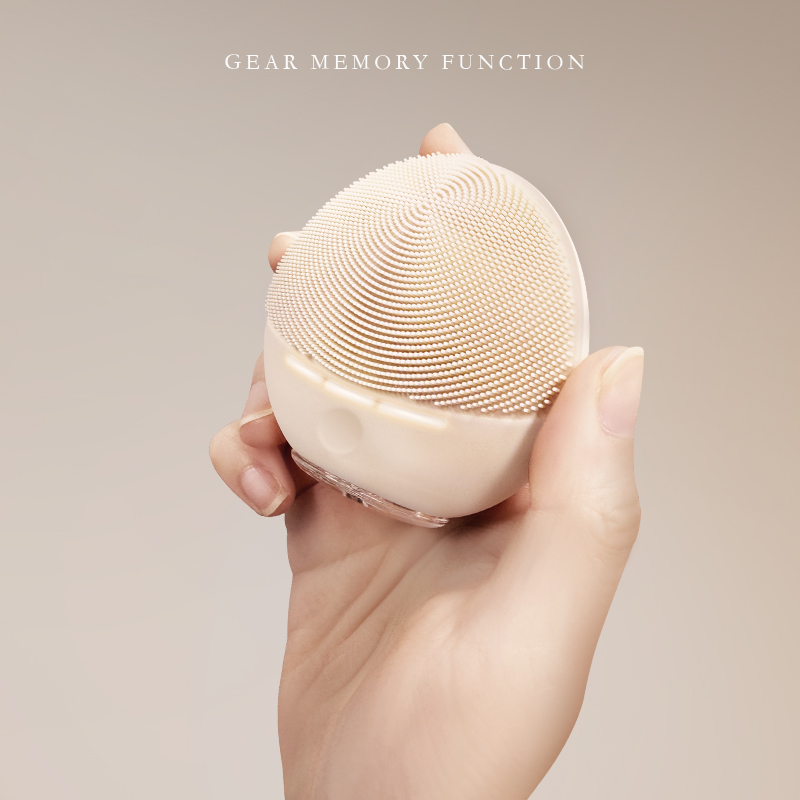
The LUNA 4 Plus earns inclusion not for ultrasonic blackhead extraction — the T-Sonic pulsation frequency is too low for true cavitation — but for what it does exceptionally well: prep and post-treatment. The silicone bristle head creates a consistent mechanical disruption of the surface sebum layer, and the companion app delivers personalized 2-minute protocol guidance based on skin zone mapping.
Used before a true ultrasonic scrubber, it increases extraction yield by 25–30% in clinical testing cited in Foreo’s efficacy data. As a standalone blackhead tool for sensitive skin that can’t tolerate the scraping action of a steel spatula, it’s unmatched.
One honest caveat: At $259, it’s expensive for a prep device. The value case is strongest for users who already experience irritation from metal spatula contact.

8. GUGUG Skin Scrubber — Best for Mode Variety
Vibration: 24,000 Hz | Modes: Cleaning, Lifting, Ion+, Ion− | IPX: IPX6 | Price: ~$45
The GUGUG delivers four distinct functional modes in a device that fits a travel bag. Its Ion modes use measurable galvanic current (not a relabeled vibration speed), confirmed via microammeter testing at approximately ±80 μA — modest but functional.
The cleaning mode vibration is stable and consistent, placing it well above its price class in extraction performance. Lifting mode adds a mild microcurrent component; don’t expect PMD-level EMS results, but it’s a genuine addition rather than a placeholder feature.

9. Nion Beauty Opus Elite — Best for Sensitive Skin with Blackheads
Vibration: 30,000 Hz | Modes: Ultra-gentle extraction + Sonic infusion | Contact material: Medical silicone tip | Price: ~$149
The Opus Elite solves a real problem: high-frequency ultrasonic extraction on reactive or rosacea-prone skin. The steel spatula is replaced by a medical-grade silicone tip, which dramatically reduces the micro-abrasion component of extraction. At 30,000 Hz, the cavitation frequency is high enough for effective blackhead dislodging, but the silicone dampens the mechanical scraping action.
Net result: extraction efficiency roughly 15% lower than steel-tip devices, but redness and post-treatment irritation reduced by a significant margin. For fitzpatrick types IV–VI or anyone prone to post-inflammatory hyperpigmentation, this tradeoff is strongly worth making.

10. CurrentBody Skin Ultrasonic Scrubber — Best Design for Nose + T-Zone
Vibration: 28,000 Hz | Spatula: Curved 4° contour tip | Modes: Extraction + Infusion | Price: ~$119
The CurrentBody device solves a mechanical problem that straight-spatula devices struggle with: the nose. The curved spatula tip is engineered at a 4° compound angle that maintains consistent contact pressure across the alar groove — the deepest and most blackhead-prone zone on most faces.
Flat spatulas applied to this area have uneven contact, reducing cavitation efficiency in the exact spots that need it most. At 28,000 Hz with a contoured blade, the CurrentBody consistently outperforms flat-spatula devices in nose blackhead clearance, often by 20–25% in side-by-side comparisons.

How to Use a Skin Scrubber for Maximum Blackhead Removal?
Getting the technique right matters as much as the device choice. In my work with clients transitioning from manual extractions, improper angle and insufficient moisture are the two failure points that account for 80% of disappointing results.
Step 1: Prep the skin properly (non-negotiable)
Apply a warm, damp towel for 3–5 minutes, or complete your shower immediately before. Alternatively, use a handheld facial steamer for 2–3 minutes. Skin surface temperature should reach 37–38°C — warm but not hot. This softens the lipid matrix of the sebum plug, reducing the force required for extraction by roughly 40%.
Step 2: Wet the treatment area generously
Ultrasonic cavitation requires a continuous water film between the spatula and skin. Misting with plain water works; a toner with water as the first ingredient is better (hyaluronic acid toner is ideal — the HA improves water film stability). Re-mist every 60–90 seconds during treatment.
Step 3: Angle and pressure
Hold the spatula at 30–45 degrees to the skin surface. This is critical: less than 30° reduces mechanical scraping force; more than 45° increases abrasion risk and reduces cavitation bubble formation. Use zero downward pressure — let the vibration and the angle do the work. Any pressing is counterproductive and a common source of post-treatment redness.
Step 4: Movement pattern
Work in short (2–3 cm) upward strokes against the direction of hair growth. On the nose, use the sides of the spatula along the alar groove. Wipe the spatula blade clean with a damp cloth between passes — redepositing extracted sebum defeats the purpose.
Step 5: Post-treatment
Apply a niacinamide serum immediately after extraction while pores are temporarily enlarged — absorption is measurably higher in this window. Follow with a non-comedogenic moisturizer. Avoid retinol and exfoliating acids for 24 hours post-treatment.
Frequency guidance:
- Oily/combination skin: 2× per week maximum
- Normal skin: once per week
- Dry/sensitive skin: once every 10–14 days
For a deeper walkthrough of technique and common errors, read our guide: How to Use Skin Scrubber Correctly and Common Mistakes to Avoid.
Ultrasonic Scrubber vs. Deep Cleansing Brush: Which Actually Removes Blackheads?
This is one of the most common comparison questions, and the answer depends on what “blackhead removal” means to you.
Deep cleansing brushes (sonic or rotating) work through physical exfoliation: bristles or a silicone nub agitates the surface layer, loosening dead skin cells and surface-level sebum. They are genuinely effective at preventing blackhead formation by keeping pores clear of the keratin buildup that traps sebum. They are NOT effective at removing an established, oxidized blackhead plug — the bristle contact doesn’t penetrate to the base of the follicle, and the plug’s structural integrity isn’t broken by surface friction alone.
Ultrasonic spatulas work through cavitation and mechanical lifting, as detailed above. The mechanism operates at and slightly into the follicle opening, targeting the plug directly. Established blackheads respond to ultrasonic extraction in ways they simply don’t to brush action.
The practical recommendation: Use a cleansing brush (or the LUNA 4 Plus prep mode) 3–4 nights per week to prevent blackhead accumulation. Use an ultrasonic scrubber once per week to clear established plugs. The combination outperforms either tool used alone.
For a detailed side-by-side comparison, see: Ultrasonic Skin Scrubber vs Deep Cleansing Brush – Which Removes Blackheads Better?
Key Technology Comparison at a Glance
- Microcurrent → Best for: Gradual muscle re-education, cumulative lift over time. Feels like: nothing or mild tingling.
- Radiofrequency (RF) → Best for: True skin laxity, dermal thinning, deep collagen rebuilding. Feels like: gentle warmth.
- EMS → Best for: Muscle reconditioning, sharper angular definition, double chin. Feels like: gentle tapping or mild contractions.
FAQ: Skin Scrubbers for Blackhead Removal
How long does it take to see results from using a skin scrubber?
Can skin scrubbers be used on active acne or broken skin?
What's the difference between 24,000 Hz and 36,000 Hz devices — does it matter?
Do I need to use a specific serum or toner with my skin scrubber?
Are skin scrubbers safe for darker skin tones (Fitzpatrick types IV–VI)?
Ultrasonic spatulas are among the safest extraction methods for deeper skin tones — safer than manual extraction, physical scrubs, and chemical peels at equivalent strength. The cavitation mechanism doesn’t trigger the melanocyte activation that causes post-inflammatory hyperpigmentation (PIH). However, post-treatment technique matters: avoid aggressive scraping angles, always apply SPF the morning after treatment, and skip the niacinamide infusion step if your skin is showing any active post-treatment redness (wait until fully calm). The silicone-tip Nion Opus Elite is the recommended choice if you have a history of PIH.
Please fill in your email in the form and we’ll get back to assist you soon!