


The 10 Best Jawline Contouring Devices for Home Use in 2026

Dull, tired-looking skin is one of the most common complaints dermatologists and estheticians hear — and it rarely has just one cause. Sluggish microcirculation, collagen depletion, impaired cellular turnover, and chronic dehydration all conspire to strip the skin of its natural luminosity. The good news is that in 2026, the home beauty device market has advanced to a point where clinical-grade technologies — once reserved for $500 in-office sessions — are accessible, affordable, and genuinely effective from your bathroom counter.
This guide goes beyond the buzzwords. You’ll find the exact technologies behind each device, the specific wavelengths or current parameters that drive results, honest comparisons between competing approaches, and the red flags to watch for when evaluating a device’s safety credentials. Whether you’re dealing with post-sleep puffiness, persistent sallowness, or the kind of deep tiredness that no concealer can fix, there’s a targeted solution below.
Related reading: Explore our companion guide — Best At-Home Anti-Aging Devices of 2026 — for devices focused specifically on wrinkle reduction, skin laxity, and long-term collagen rebuilding.

The top 10 beauty devices for dull and tired skin in 2026
1. CurrentBody Skin LED Light Therapy Face Mask Series 2
CurrentBody’s Series 2 remains the benchmark flexible LED mask for home use. It delivers three clinically validated wavelengths — 633 nm red, 830 nm near-infrared, and a proprietary 1072 nm deep near-infrared — at an irradiance of approximately 55 mW/cm². That third wavelength is the differentiator: penetrating to the subcutaneous layer, it activates the mitochondrial photoreceptor cytochrome c oxidase, stimulating ATP production at a depth where most competing masks simply cannot reach.
A published randomised controlled trial (published in the Journal of Clinical and Aesthetic Dermatology) found a statistically significant improvement in skin tone, texture, and radiance after 4 weeks of daily 10-minute use — exactly the protocol CurrentBody recommends. The flexible silicone mask conforms closely to all facial contours, ensuring consistent light delivery rather than the dead spots common with rigid plastic masks.

Expert insight: Do not use this mask if you are taking photosensitising medications (isotretinoin, certain antibiotics, St John’s Wort). The near-infrared wavelengths in particular have a measurable warming effect — any medication that reduces your skin’s heat tolerance increases the risk of a photothermal reaction
2. ZIIP HALO Nanocurrent and Microcurrent Device
The ZIIP HALO operates at two distinct current levels that most competing devices conflate. At the nanocurrent level (sub-10 μA, frequencies of 0.1–1 Hz), it works at the cellular membrane level, enhancing ATP and protein synthesis with virtually no sensation — this is the “invisible workout” that promotes genuine, long-term tissue health. At the microcurrent level (100–500 μA, 0.5–2.5 Hz biphasic waveform), it stimulates the underlying facial musculature, producing the instant toning and lifting response often described as the “facial gym effect.”
What distinguishes the HALO from older ZIIP devices is the app-controlled waveform library: over 15 different treatment programs target specific outcomes — glow, lift, depuff, and recovery — and can be personalised by skin age, sensitivity, and hydration status. The biphasic waveform is critical: uniphasic microcurrent devices (common in cheaper alternatives) carry a small but real risk of stimulating fibrosis in the periosteum with prolonged use. Biphasic current alternates polarity, making the treatment both safer and more physiologically appropriate.
3. NICEMAY MR-2310 Skin Rejuvenation Beauty Device
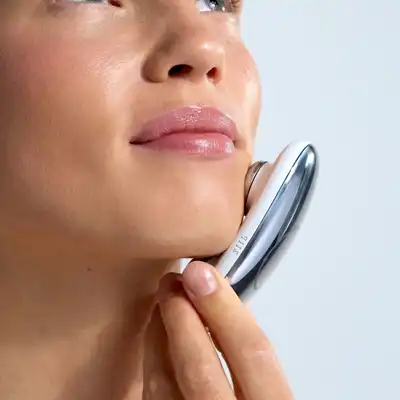
The NICEMAY MR-2310 earns its position here by solving a problem that single-modality devices simply cannot: the compounding effect of simultaneously addressing dullness, laxity, and poor product absorption in one session. It combines EMS (electrical muscle stimulation) at a precise 330 μA to firm and tone, 630 nm red LED for collagen stimulation, high-frequency vibration (6,000 rpm) to boost microcirculation, and a 42°C therapeutic warmth function that dilates pores for serum infusion — all in a form factor that weighs under 90g.
The 42°C thermal ceiling is not an accident. Clinical RF and thermotherapy literature consistently identifies 42–45°C as the optimal therapeutic range for dermal fibroblast activation; above 45°C, denaturation of collagen fibrils begins. The MR-2310’s temperature-controlled heating stays within safe parameters by design, making it significantly safer than unregulated “warming” devices that can spike unpredictably.
In practice, the most compelling use case is pairing the vibration and heat functions with a brightening serum (vitamin C or niacinamide) immediately before running the LED cycle. The warmth opens the follicular channel, vibration drives serum molecules into the intercellular spaces via sonophoresis-like action, and the red LED then accelerates the cellular response to those actives. Users consistently report a “glass skin” quality within 3–4 weeks of daily use — a result that mirrors findings from multi-modal combination therapy in professional settings.

4. Omnilux Contour FACE LED Mask
Omnilux occupies a rare position in the home LED market: it is both FDA-cleared and has its clinical efficacy published in peer-reviewed dermatology journals, including the Journal of Cosmetic Dermatology. The Contour FACE delivers 633 nm red (collagen and elastin synthesis, anti-inflammatory) and 830 nm near-infrared (deep tissue repair, improved circulation) at a combined energy density of 126 J/cm² over a standard 10-minute session — a dose that mirrors what aesthetic practitioners use in clinical LED protocols.
Where Omnilux differs from the CurrentBody mask is in its semi-rigid panel construction and the spatial uniformity of its diode array. The rigid panels maintain a fixed source-to-skin distance across the entire face, ensuring every zone — chin, forehead, cheeks — receives consistent irradiance. For users with pronounced facial contours or bony prominences, this geometry can actually outperform flexible masks that lose contact.

5. Shark FacialPro Glow At-Home Hydro-Powered Facial System
Shark’s FacialPro brings professional hydrodermabrasion — a technique that simultaneously exfoliates, extracts pore debris, and infuses active serums — into the home environment at a fraction of the £200–£400 per-session clinic cost. The device uses a vortex-tip tip that creates a negative pressure swirling motion: it removes the dead cell layer (physical cause of surface dullness) while a positive-pressure infusion channel simultaneously deposits hydrating and brightening actives into freshly cleared skin.
Clinically, this two-phase approach addresses dullness at the structural level in a way that LED or current-based devices simply cannot: mechanical cell turnover combined with immediate humectant infusion (typically hyaluronic acid and peptide concentrates in the accompanying serum pods) delivers results in a single 10-minute session rather than requiring weeks of cumulative use. The tradeoff is that it is the most “active” device on this list — it should not be used on sensitised, sunburned, or actively broken-out skin, and sessions should be limited to once per week maximum for most skin types.

6. NuFACE FIX MicroWand
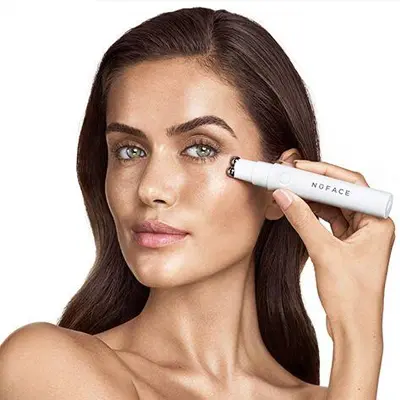
NuFACE is the category-defining microcurrent brand, and the FIX MicroWand is their most targeted offering — designed specifically for the eye and perioral areas where the earliest signs of fatigue present. At 335 μA with a 0.5 Hz biphasic waveform, it is precisely calibrated for the delicate musculature around the eyes (orbicularis oculi) without the risk of over-stimulation that a larger device at full power would carry.
Three minutes per treatment area is the protocol, and the results — reduced under-eye puffiness, softened crow’s feet, improved orbital tone — are visible within a single session, though cumulative structural benefit requires 4–6 weeks of consistent use. A mistake I see often is users doubling up the session length thinking it will accelerate results. With microcurrent, overuse produces the opposite effect: excess stimulation causes temporary muscle fatigue rather than invigoration. Stick to the protocol.
7. Therabody TheraFace Depuffing Wand
Therabody’s entry into facial devices leverages the brand’s proprietary percussive technology background to deliver cryo-thermal cycling — alternating between 5°C (cold) and 40°C (warm) — to the face. The physiological rationale is well established: cold contact causes vasoconstriction, temporarily reducing puffiness and inflammation; when cold is followed by warmth, the resulting vasodilation brings a rush of oxygenated blood to the skin surface, creating that immediately “awake” appearance that makes this an essential morning device.
The TheraFace Wand is best positioned as a compliment to — not a replacement for — the LED or current-based devices on this list. It addresses the acute, vascular component of dullness (poor circulation, fluid retention, overnight puffiness) but does not stimulate collagen synthesis or improve cellular metabolism. Used as the first step in a combination routine, it primes skin to respond more strongly to LED or serum-delivery treatments that follow.

8. Solawave Radiant Renewal 4-in-1 Skincare Wand
The Solawave is the most accessible multi-modal wand at this price point, combining 660 nm red LED (collagen stimulation), 3 μA galvanic current (drives charged molecules deeper into the epidermis), 43°C therapeutic warmth, and oscillating facial massage in a single ergonomic tool. The galvanic current is particularly relevant for dullness: by creating a weak electrical field between the wand’s metal surface and the skin, it enhances the penetration of water-soluble actives — vitamin C serum, for instance — by up to 60% compared to manual application, according to galvanic iontophoresis studies in the cosmetic dermatology literature.
The honest limitation is that each individual modality operates at a lower intensity than a dedicated device. The red LED irradiance is lower than either the CurrentBody or Omnilux mask; the galvanic current is modest. But for a user seeking a one-device morning ritual that addresses circulation, product absorption, and collagen support simultaneously without a complex multi-step protocol, it delivers genuine value.

9. Foreo UFO 3 Smart Mask Treatment Device
The Foreo UFO 3 addresses a specific problem that most beauty device brands overlook: the delivery gap between topical mask ingredients and the skin’s ability to absorb them. The device combines T-Sonic™ pulsations (8,000 micro-pulsations per minute) with simultaneous LED therapy (red, blue, and green wavelengths), a 45°C thermotherapy phase to open the skin’s absorption pathways, and a 14°C cryotherapy phase to seal everything in — all completed in a 90-second to 3-minute protocol using app-controlled treatment programs.
The pairing system — Foreo’s own single-use biodegradable mask sheets — has a clinical elegance to it: the active ingredients (typically hyaluronic acid, niacinamide, peptides) are released directly into the treatment zone while the T-Sonic pulsations are simultaneously driving transdermal penetration. Independent testing commissioned by Foreo found a 7x improvement in active ingredient absorption versus manual mask application. For dull, dehydrated skin specifically, the hydration-and-circulation combination makes this the device that delivers the most immediate, visible result of anything on this list.

10. TriPollar STOP Vx Gold 2 RF Skin Tightening Device
Radiofrequency (RF) devices are the most technically demanding category in the home beauty market — and the most frequently misused. The TriPollar STOP Vx Gold 2 uses focused 1 MHz RF energy to heat the dermis uniformly to 40–43°C, which triggers an immediate collagen contraction response and, with repeated sessions, stimulates new collagen synthesis via a wound-healing cascade. The device also combines optical energy (pulsed light at 580–980 nm) to address surface pigmentation and redness that contributes to the uneven, tired look.
The critical safety feature here is the device’s built-in real-time skin temperature monitoring: it will not deliver RF energy until it reads the correct coupling (ensuring the treatment head is properly in contact with skin) and will pause if skin temperature exceeds the 45°C safe ceiling. This auto-regulation is the reason TriPollar stands apart from cheaper RF devices where temperature control is left entirely to the user — studies have documented dermal fibrosis and paradoxical fat loss as real complications of excessive RF temperature in unregulated home devices.

What makes skin look dull — and how devices reverse it?
Before investing in any device, it’s worth understanding the biological mechanisms behind dullness. Dead cell accumulation on the stratum corneum diffusely scatters light rather than reflecting it evenly. Reduced microvascular flow — common with stress, poor sleep, and age — decreases oxygenation and gives skin its grey, flat appearance. Collagen decline (which begins as early as the mid-twenties at a rate of approximately 1% per year) reduces the structural density that creates a “plump” light-catching surface.
The devices in this list target one or more of these mechanisms: LED wavelengths in the 630–660 nm red range stimulate fibroblasts to produce collagen and elastin; near-infrared at 810–850 nm penetrates the dermis to trigger mitochondrial ATP synthesis; microcurrent at 300–500 μA re-educates the underlying facial muscles; and cryo-therapy temporarily vasoconstricts then vasodilates to flush the skin with freshly oxygenated blood. None of these are magic — but all are supported by peer-reviewed clinical data when used correctly and consistently.
A note on device safety credentials: Always look for FDA clearance (Class II, 510(k)) or CE marking before purchasing any electrical or light-based device for home use. Unregistered LED masks, in particular, have been found to emit UV radiation or dangerously high irradiance levels in independent lab testing. The devices featured in this guide all carry recognised safety credentials.
Please fill in your email in the form and we’ll get back to assist you soon!