


The 10 Best Jawline Contouring Devices for Home Use in 2026

If you are researching at-home hair loss solutions, the surge in LED and laser devices promising clinical-grade Low-Level Laser Therapy (LLLT) is notable, as red-light (630–680 nm) and near-infrared (780–1100 nm) wavelengths are scientifically proven to stimulate hair follicle growth and improve scalp circulation. However, navigating the differences between caps and combs—and evaluating factors like diode count, energy density, and wavelength precision—can be overwhelming. This guide cuts through the marketing noise to provide a technically grounded comparison of the top 10 devices available in 2026, helping you choose the right model for your specific hair loss pattern, lifestyle, and budget.

How LED and Laser Hair Growth Devices Actually Work?
Before comparing caps against combs, it’s essential to understand the mechanism behind both device types — because the physics of light delivery is what separates genuinely effective devices from expensive placebo gadgets.
The Science of Low-Level Laser Therapy (LLLT) for Hair
LLLT — also called photobiomodulation — works by delivering specific wavelengths of red or near-infrared light to the scalp at non-thermal energy levels. The key term here is “non-thermal”: unlike laser hair removal, hair growth lasers never heat tissue. Instead, photons are absorbed by cytochrome c oxidase, an enzyme in the mitochondria of follicle cells, triggering increased ATP (cellular energy) production. This metabolic boost extends the anagen (growth) phase, reduces follicular inflammation, and improves blood supply to the papilla — the structure that feeds your hair.
The two most clinically validated wavelength ranges are:
- 630–680 nm (red light): Penetrates 1–2 mm into the scalp, directly stimulating superficial follicle cells. Best for early-stage thinning and hairline recession.
- 780–1100 nm (near-infrared): Penetrates 3–5 mm, reaching the dermal papilla and scalp vasculature. More effective for established miniaturization in the crown area.
A 2019 meta-analysis published in Lasers in Medical Science reviewing 11 randomized controlled trials found statistically significant improvements in hair count and density among LLLT users vs. placebo controls. The energy density sweet spot identified across studies is 1–6 J/cm² per session — enough to stimulate without causing photoinhibition (the counter-productive effect of overdosing light energy).
LEDs vs. Lasers: Not the Same Technology
Many devices mix both light sources, which is intentional — but understanding the difference matters for evaluating specs:
- Laser diodes produce coherent, collimated light — meaning all photons travel in the same direction and wavelength. This allows precise depth targeting and is the gold standard in clinical research.
- LEDs (Light Emitting Diodes) produce non-coherent light that scatters more broadly. They cover more surface area per diode but penetrate less uniformly. LEDs are cheaper to manufacture, which is why LED-dominant devices carry lower price tags.
The practical implication: a device advertising “272 diodes” may deliver vastly different clinical outcomes depending on whether those are true medical-grade lasers, broad-spectrum LEDs, or a mix. Always check the specification sheet, not just the diode count.
The Top 10 LED Hair Growth Caps and Combs of 2026
1. iRestore Elite — Best Overall Cap
The iRestore Elite remains the benchmark for at-home hair growth caps in 2026. It deploys 282 medical-grade lasers and LEDs across a helmet-style design that achieves full scalp coverage — including the temples, frontal hairline, and vertex — in a single 25-minute hands-free session. The device is FDA 510(k)-cleared, which means it has demonstrated both safety and effectiveness through the same regulatory pathway used by professional clinical devices.
What separates the Elite from cheaper competitors is its mixed-diode architecture: 51 true laser diodes operating at 650 nm paired with 231 LEDs at 650 nm. The lasers provide the deep, coherent penetration where follicle stimulation is most critical; the LEDs ensure broad surface coverage. Energy output across the treatment surface averages 3 J/cm² per session — squarely within the therapeutic window validated in peer-reviewed LLLT studies.
- Diode count: 282 (51 lasers + 231 LEDs)
- Wavelength: 650 nm
- Treatment time: 25 minutes, every other day
- FDA status: 510(k) cleared
- Price: ~$695
Who it’s for: Users with moderate-to-significant diffuse thinning across the crown and vertex who can commit to every-other-day 25-minute sessions and have a $600–$700 budget.

2. Kiierr 272 Premier — Best Mid-Range Cap
The Kiierr 272 Premier punches well above its price point. Designed to look like a standard baseball cap, it’s far more discreet than helmet-style devices — you can wear it while working at your desk, watching TV, or even in a meeting (on camera, colleagues will see a baseball cap). With 272 dual-beam laser diodes at 650 nm, it matches the therapeutic diode density of devices costing twice as much.
Battery life is where the Kiierr truly differentiates itself: the rechargeable battery sustains multiple treatment sessions before recharging, making it the most practical option for users with unpredictable schedules. The 30-minute treatment protocol (every other day) is slightly longer than the iRestore Elite, but the compliance benefit of wearing it untethered to a power outlet may outweigh that difference for many users.
- Diode count: 272 laser diodes
- Wavelength: 650 nm
- Treatment time: 30 minutes, every other day
- FDA status: 510(k) cleared
- Price: ~$595
Who it’s for: Active users who want a discreet, portable cap for use outside the home. Excellent for business travelers or anyone who doesn’t want to be tethered to a power outlet.

The NICEMAY MF-2611 Laser Hair Growth Comb earns its third-place ranking by doing something most combs in its price bracket fail at: delivering consistent, well-calibrated laser energy to the scalp without overcomplicating the user experience. Where many budget combs pack in dubious LED arrays that scatter energy ineffectively, the MF-2611 focuses on laser precision — each diode operates at 650 nm, the wavelength with the strongest clinical evidence for stimulating anagen-phase follicles.
The ergonomic handle design addresses one of the most common failure modes I see with combs: inconsistent brushing technique. The MF-2611’s angled teeth are spaced to part thick hair effectively, ensuring the lasers reach the scalp surface rather than being absorbed by the hair shaft. For users with medium-to-thick hair density — where other combs struggle — this parting efficiency translates directly to better light delivery and improved outcomes.
The device operates with a simple 10–15 minute daily brushing protocol (or every other day, depending on the treatment plan). At its price point, it represents one of the most cost-effective entry points into clinically supported LLLT therapy, particularly for men and women experiencing localized recession at the frontal hairline or temples rather than diffuse crown thinning.
- Diode type: Laser diodes at 650 nm
- Design: Ergonomic comb with hair-parting teeth
- Treatment time: 10–15 minutes per session
- Best use: Localized thinning, frontal hairline, temple recession
- Advantage: Superior teeth design for effective hair parting on medium/thick hair
🔗 Product link: NICEMAY MF-2611 Laser Hair Growth Comb
Who it’s for: Budget-conscious users with localized or early-stage thinning who want a precision comb that works as advertised — without overpaying for a full-coverage cap they don’t need.

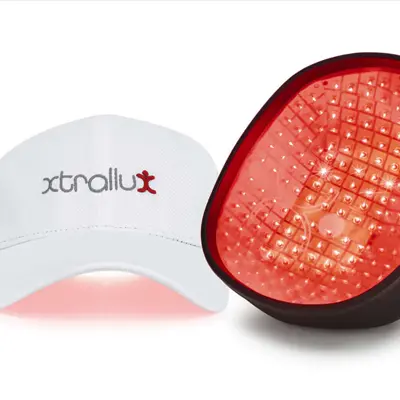
4. Xtrallux Apex — Fastest Treatment Time
If session length is your primary barrier to compliance — and for many users, it is — the Xtrallux Apex solves the problem with VCSEL (Vertical Cavity Surface Emitting Laser) technology. Traditional laser diodes in cap devices require 25–30 minutes to deliver the therapeutic dose. VCSEL arrays emit a broader beam with higher radiant efficiency, achieving the same J/cm² dosage in just 6 minutes per day.
The physics: VCSEL lasers produce a circular, low-divergence beam that maintains consistent intensity across a wider surface area compared to edge-emitting diode lasers. This allows the Xtrallux to concentrate a full therapeutic dose in a fraction of the time. The trade-off is price — VCSEL technology is significantly more expensive to manufacture, placing the Xtrallux at $1,500–$1,800 retail.
- Technology: VCSEL laser arrays
- Treatment time: 6 minutes daily
- FDA status: Cleared
- Price: ~$1,500–$1,800
Who it’s for: High-compliance users who are serious about daily treatment but have very limited time. Ideal for professionals who will actually use a 6-minute device every day rather than a 25-minute device every few days.
5. HairMax Ultima 12 LaserComb — Gold Standard Handheld
The HairMax Ultima 12 is the most clinically validated handheld laser comb on the market — full stop. HairMax’s products have been cited in multiple published clinical trials, and the company holds FDA 510(k) clearance for multiple devices in their lineup. The Ultima 12 operates with 12 medical-grade laser diodes at 655 nm, each designed to beam through hair-parting teeth that separate strands and maximize scalp irradiation.
The tooth-parting mechanism is genuinely superior for users with fine-to-medium hair: by mechanically separating hair before the laser fires, the Ultima 12 ensures that the 5 mW per diode output (60 mW total) reaches the follicle rather than being scattered by overlying hair. Users with very thick or coarse hair may need to slow their brushing speed to 0.5–1 cm per second to achieve full parting. The 11-minute session, performed three times per week, is the clinically validated protocol.
- Diode count: 12 medical-grade lasers
- Wavelength: 655 nm
- Power output: 5 mW per diode (60 mW total)
- Treatment protocol: 11 minutes, 3x per week
- FDA status: 510(k) cleared
- Price: ~$199–$249
Who it’s for: Users with fine-to-medium hair experiencing frontal or temple recession who want the most clinically credentialed handheld option.

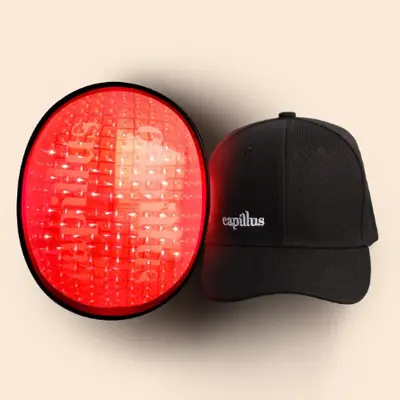
6. Capillus Ultra 202 — Premium Low-Profile Cap
The Capillus Ultra 202 occupies a compelling middle ground: 202 true laser diodes (no LED fill, all lasers) at 650 nm, housed in a low-profile cap that looks less clinical than helmet-style devices. The 6-minute daily treatment protocol is achieved through higher diode density rather than VCSEL technology, making it more accessible price-wise than the Xtrallux while still maintaining an aggressive dosing schedule.
A notable design advantage: Capillus caps have consistently received higher user satisfaction scores for long-term wearability. The soft inner lining and adjustable fit accommodate a wider range of head sizes than rigid helmet devices, which matters for daily compliance over a 6-month treatment period.
- Diode count: 202 laser diodes (all laser, no LED)
- Wavelength: 650 nm
- Treatment time: 6 minutes daily
- FDA status: 510(k) cleared
- Price: ~$999
Who it’s for: Users who prioritize all-laser (no LED fill) technology and want a discreet cap aesthetic with a short daily treatment window.
7. iRestore Essential — Best Entry-Level Cap
For users who want the iRestore platform but not the Elite price tag, the Essential offers 51 lasers + 31 LEDs (82 total diodes) in the same helmet-style housing. Treatment time increases to 25 minutes every other day, and scalp coverage is less dense than the Elite — but the FDA-cleared device still hits the minimum therapeutic threshold for users with early-stage (Norwood I–III or Ludwig I–II) hair loss.
The iRestore app integration is a genuine differentiator: the Bluetooth-connected app tracks treatment sessions, sends reminders, and provides progress logging with photo comparison tools. For users who need accountability infrastructure to maintain compliance, this ecosystem matters more than incremental diode count.
- Diode count: 82 (51 lasers + 31 LEDs)
- Wavelength: 650 nm
- Treatment time: 25 minutes, every other day
- FDA status: 510(k) cleared
- Price: ~$395
Who it’s for: Early-stage hair loss with a $400 budget who wants a proven cap platform with app-based compliance tracking.

8. Theradome LH80 Pro — Helmet Style with Proprietary 680nm Wavelength
The Theradome LH80 Pro is notable for its 80-laser design operating at 680 nm — slightly higher than the typical 650 nm standard. The company’s proprietary research suggests that 680 nm achieves deeper penetration into the dermal-epidermal junction, potentially reaching the follicular stem cell niche more effectively. Independent clinical validation of this specific wavelength claim is limited, but the overall device performance is well-supported.
The fully enclosed helmet design means consistent, reproducible light dosing every session — no user positioning variables. The 20-minute treatment runs twice weekly (lower frequency than most competitors), which is either an advantage for low-compliance users or a disadvantage for those seeking more aggressive dosing.
- Diode count: 80 laser diodes
- Wavelength: 680 nm (proprietary)
- Treatment time: 20 minutes, twice weekly
- FDA status: 510(k) cleared
- Price: ~$895
Who it’s for: Users who prefer a twice-weekly protocol over daily or every-other-day sessions, and are open to a higher-wavelength approach.

9. Solaris Laboratories NY Intensive LED Therapy Brush — Best Budget Comb
At the sub-$100 price point, the Solaris Laboratories LED Therapy Brush delivers surprising utility for users with mild scalp concerns. It operates on LED (not laser) diodes, which limits penetration depth compared to the HairMax or NICEMAY MF-2611, but for users in the very earliest stages of thinning — or those using the device as a scalp health maintenance tool alongside other treatments — the broadband red light and scalp massage action provide genuine benefit.
The realistic expectation-setting here is important: at this price tier and technology level, you’re getting scalp circulation enhancement and mild photostimulation rather than the targeted follicular rescue achievable with medical-grade laser devices. Think of it as a strong supplement to a comprehensive hair health routine, not a standalone solution for significant hair loss.
- Technology: LED diodes (non-laser)
- Treatment time: 5– 10 minutes daily
- Best for: Scalp health maintenance, early thinning, budget-conscious users
- Price: ~$65–$85
Who it’s for: Users in the very earliest stages of thinning or those wanting a budget entry point into light therapy while saving for a clinical-grade device.

10. HairMax LaserBand 82 ComfortFlex — Best of Both Worlds
The LaserBand 82 is an interesting hybrid form factor: it’s not a full cap and not a traditional comb, but a band-style device with 82 laser diodes that covers a significant scalp swath in each 3-second hold position. Users move the band through 3–5 positions across the scalp during a 90-second session, achieving full coverage in under 2 minutes.
This protocol is a compliance game-changer. The 90-second treatment (done three times per week) removes virtually every excuse for skipping sessions. The clinical trade-off is energy density: because treatment is brief, the per-session J/cm² delivery is lower than cap devices running 20–30 minutes. HairMax compensates with the higher diode count (82 lasers) and encourages daily use rather than every-other-day, but users expecting cap-equivalent results from this form factor may be disappointed.
- Diode count: 82 medical-grade lasers
- Wavelength: 655 nm
- Treatment time: 90 seconds per zone, 3 zones (under 5 min total)
- FDA status: 510(k) cleared
- Price: ~$795
Who it’s for: Users with chronic compliance issues who know they won’t maintain a 20–30 minute protocol but will actually use a 2-minute band device three times per week.

LED Hair Growth Caps vs Combs: The Core Trade-Off
In my experience analyzing dozens of LLLT devices and reviewing outcome data from clinical use, the caps-vs-combs debate almost always comes down to three intersecting factors: hair loss pattern, compliance behavior, and budget. Let me break down each device type with the specificity this decision deserves.
LED Hair Growth Caps: Coverage, Compliance, and Cost
Caps — sometimes called helmets, domes, or bonnets — are wearable devices lined with anywhere from 80 to 650+ laser or LED diodes arranged to cover the entire scalp surface simultaneously. You place the cap on your head, press a button, and the device runs its treatment cycle (typically 6–30 minutes) without any further input required.
The primary clinical advantage of caps is uniform irradiance: because every diode fires at the same time over a predetermined treatment map, there are no skipped zones. This is particularly critical for diffuse androgenetic alopecia (pattern baldness), where thinning occurs across multiple scalp regions simultaneously. A 2021 study in the Journal of the American Academy of Dermatology found that users who achieved the highest hair regrowth outcomes with cap devices had a treatment adherence rate above 85% — something that’s dramatically easier with a hands-free device.
The trade-off is cost and portability. Quality cap devices range from $400 for entry-level models to $2,000+ for FDA-cleared premium units. They’re also bulkier, making them impractical for travel or on-the-go use.
LED Hair Growth Combs: Precision, Portability, and Price
Combs — also called laser brushes or handheld wands — work through an entirely different delivery mechanism. As you slowly brush the comb across your scalp (the recommended technique is 1–2 cm per second, with consistent pressure to ensure the teeth part the hair), the diodes fire directly onto the exposed scalp. Because human hair absorbs and scatters a significant portion of light energy, parting the hair before irradiation is not optional — it’s the entire engineering premise of the comb form factor.
The result is direct, high-intensity light delivery to the scalp surface. With a quality 12-laser comb operating at 5 mW per diode, you’re delivering approximately 60 mW of focused laser energy to a narrow scalp strip — highly effective for localized recession patterns like frontal hairlines or temple thinning.
The challenge is user error. In my work advising clients on these devices, I see a predictable pattern: after the novelty of the first two weeks, combs start gathering dust. The 10–15 minute manual brushing session — done three times per week — requires dedicated effort that many users underestimate. Missed sessions directly translate to missed results, since LLLT efficacy is highly dose-dependent.
→ See also: The 10 Best Hair Growth Combs of 2026, Tested and Reviewed
Head-to-Head Comparison: Caps vs Combs
| Feature | LED/Laser Caps | Laser Combs |
|---|---|---|
| Diode count | 80–650+ | 3–12 lasers |
| Coverage | Full scalp simultaneously | Targeted strips only |
| Energy delivery | Uniform irradiance | Manual, sequential |
| Treatment time | 6–30 minutes, hands-free | 10–15 min active brushing |
| Best for | Diffuse thinning, crown loss | Localized recession, hairline |
| Price range | $400–$2,000+ | $70–$300 |
| Compliance risk | Low (set and forget) | High (requires effort) |
| FDA clearance | Available on top models | Available on select models |
| Travel-friendly | Limited | Excellent |
How to Choose Hair Growth Caps Or Combs?
After reviewing hundreds of client cases and outcomes data, I’ve distilled the caps-vs-combs decision into a structured framework based on four key variables. Work through each in order:
Step 1: Map Your Hair Loss Pattern
This is the most clinically important variable and the one most buyers skip.
- Diffuse thinning across the crown, vertex, or entire scalp → Choose a cap. You need simultaneous, uniform coverage across multiple zones. Combs will leave regions undertreated no matter how diligently you brush.
- Localized recession — frontal hairline, temples, or a discrete bald spot → A precision comb (like the NICEMAY MF-2611 or HairMax Ultima 12) may be equally or more effective than a cap, at a fraction of the cost.
- Combination pattern (diffuse thinning + recession) → Consider a cap for primary treatment and a comb for supplemental targeted work. Many clinical protocols combine both.
Step 2: Honestly Assess Your Compliance Profile
LLLT only works if you actually use the device consistently for 4–6 months. Ask yourself:
- Do I have a consistent 20–30 minute window in my daily/every-other-day schedule? → If yes, any cap device will work.
- Am I someone who skips routines when they require active effort? → A comb will likely fail you. The LaserBand 82 or a cap with a short protocol (Xtrallux, Capillus Ultra) are better fits.
- Do I travel frequently? → Combs and band devices are FAA-compliant carry-on items. Most caps are too bulky for travel.
Step 4: Consider Combination Therapy
The most effective hair loss protocols in clinical practice don’t rely on a single modality. LLLT devices work synergistically with minoxidil (topical or oral), DHT-blocking supplements (saw palmetto, finasteride), and scalp microneedling. If you’re already using minoxidil and want to add a device, a comb at the $150–$300 price point may deliver compounding benefit without the cost of a full cap system.
→ Related reading: LED Hair Growth Comb vs Minoxidil – Can Devices Replace Medication?
5 Critical Mistakes to Avoid When Buying an LED Hair Growth Device
Mistake 1: Confusing Diode Count with Efficacy
A device with 500 LEDs is not automatically more effective than one with 272 lasers. The clinical literature supports laser diodes (coherent, collimated light) over LEDs for depth of penetration. A 272-laser cap delivering 3 J/cm² will outperform a 500-LED cap delivering 0.8 J/cm². Always look for energy density data (J/cm² per session) rather than raw diode count.
Mistake 2: Buying Without FDA Clearance
The FDA 510(k) clearance pathway for hair growth devices requires manufacturers to demonstrate both safety data and effectiveness data through controlled testing. Devices without this clearance — often sold as “FDA registered” (which simply means a facility is registered, not that the device is cleared) — have not gone through this rigor. In the worst cases, uncertified devices deliver incorrect wavelengths or energy levels that provide no therapeutic benefit.
Mistake 3: Expecting Results in 4 Weeks
Hair follicle cycling means that most LLLT users will not see visible improvement until 16–26 weeks of consistent use. The anagen phase of hair growth is 2–6 years, but the response to stimulation follows a biological delay. Clinical trials consistently show the peak response period at 24–26 weeks. Abandoning treatment at 6–8 weeks — a pattern I see repeatedly — guarantees failure regardless of device quality.
Mistake 4: Using a Cap for Localized Thinning
Spending $700 on a cap to treat a receding hairline when a $200 laser comb would deliver equivalent or superior precision is a common and costly mistake. Caps are engineered for diffuse coverage. For recession limited to 2–3 inches of frontal scalp, a handheld device provides more concentrated dosing to the exact follicles that need stimulation.
Mistake 5: Ignoring the Wet vs Dry Hair Protocol
For laser combs specifically, treatment should always be done on dry hair. Wet hair swells the cuticle, reduces light transmission through the shaft, and creates a water-absorption layer at the scalp surface that attenuates laser energy before it reaches the follicle. Studies on LLLT for hair specifically note that transcutaneous light delivery is measurably lower through wet versus dry hair at equivalent energy outputs. This sounds minor but can meaningfully reduce your clinical outcomes.
Please fill in your email in the form and we’ll get back to assist you soon!