


The Top 10 RF Devices Specifically for Face vs Body in 2026


How RF Technology Differs Between Face and Body Treatments?
Before diving into rankings, one clinical fact changes everything: facial RF devices typically operate at 1–3 MHz, delivering controlled thermal energy to the dermis at 42–45°C without disrupting subcutaneous fat. Body RF devices often run at lower frequencies (0.8–1.5 MHz) or combine with HIFU/EMS to penetrate deeper fascia layers, where higher joule output targets lax tissue over larger surface areas.
Exceeding 45°C on facial tissue — even briefly — causes collagen denaturation rather than remodeling, a mistake common with unregulated high-power units. On the body, insufficient depth (under 4mm penetration) means you’re heating the epidermis without reaching the structural tissue that drives visible tightening. The 10 devices below are split into these two distinct use-case categories for exactly this reason.
Top 5 RF Devices for the Face
1. TriPollar STOP Vx — Best for Jawline & Nasolabial Fold Targeting
The TriPollar STOP Vx remains one of the most technically refined at-home facial RF devices available. It uses third-generation TriPollar RF technology, directing energy through three focused electrodes to concentrate heating at 1.5 MHz precisely in the dermis (3–5mm depth), bypassing the epidermis entirely. This makes it particularly effective for nasolabial fold softening and mid-face laxity — areas where cheaper devices underperform because their energy scatters across skin layers.
Key specs: 3-electrode focused RF, 1.5 MHz, built-in skin temperature sensor (stops at 43°C), FDA 510(k) cleared.
What separates the STOP Vx is its real-time thermal feedback loop: the device halts emission if contact temperature exceeds the therapeutic ceiling. In a 12-week clinical study, 89% of participants showed measurable improvement in facial contour — results I’d consider credible given the electrode geometry. The ergonomics are designed for facial curves, not flat body planes, which matters when you’re working the mandibular angle or zygomatic arch.
Best for: Women 38–60 targeting jawline definition, early jowl formation, nasolabial depth.
Not ideal for: Neck or body use — the small electrode surface area makes body treatments impractically slow.

2. CurrentBody Skin RF — Best Entry-Level Facial RF
CurrentBody’s skin RF device earns its “best for beginners” reputation through genuine engineering, not marketing. Its proprietary skin-sensing technology continuously reads impedance across the treatment surface, auto-adjusting power output to ensure consistent 40–42°C dermal heating regardless of skin thickness variation — a real problem at the cheekbone vs. the chin area.
Key specs: 1 MHz RF, skin-sensing impedance adjustment, 3 treatment modes (gentle/standard/intense), CE certified.
What I see too often with entry-level RF devices is inconsistent contact: users press too hard over bone, not hard enough over soft tissue, causing uneven heating. CurrentBody’s impedance feedback largely eliminates this variable. The device is clinically validated at 12 weeks with 87% of subjects showing dermis density improvement (measured by ultrasound). It’s not the most powerful facial RF tool on this list, but it’s the most consistently safe for unsupervised at-home use.
Best for: RF beginners, sensitive skin types, anyone wanting low-risk daily or every-other-day facial use.

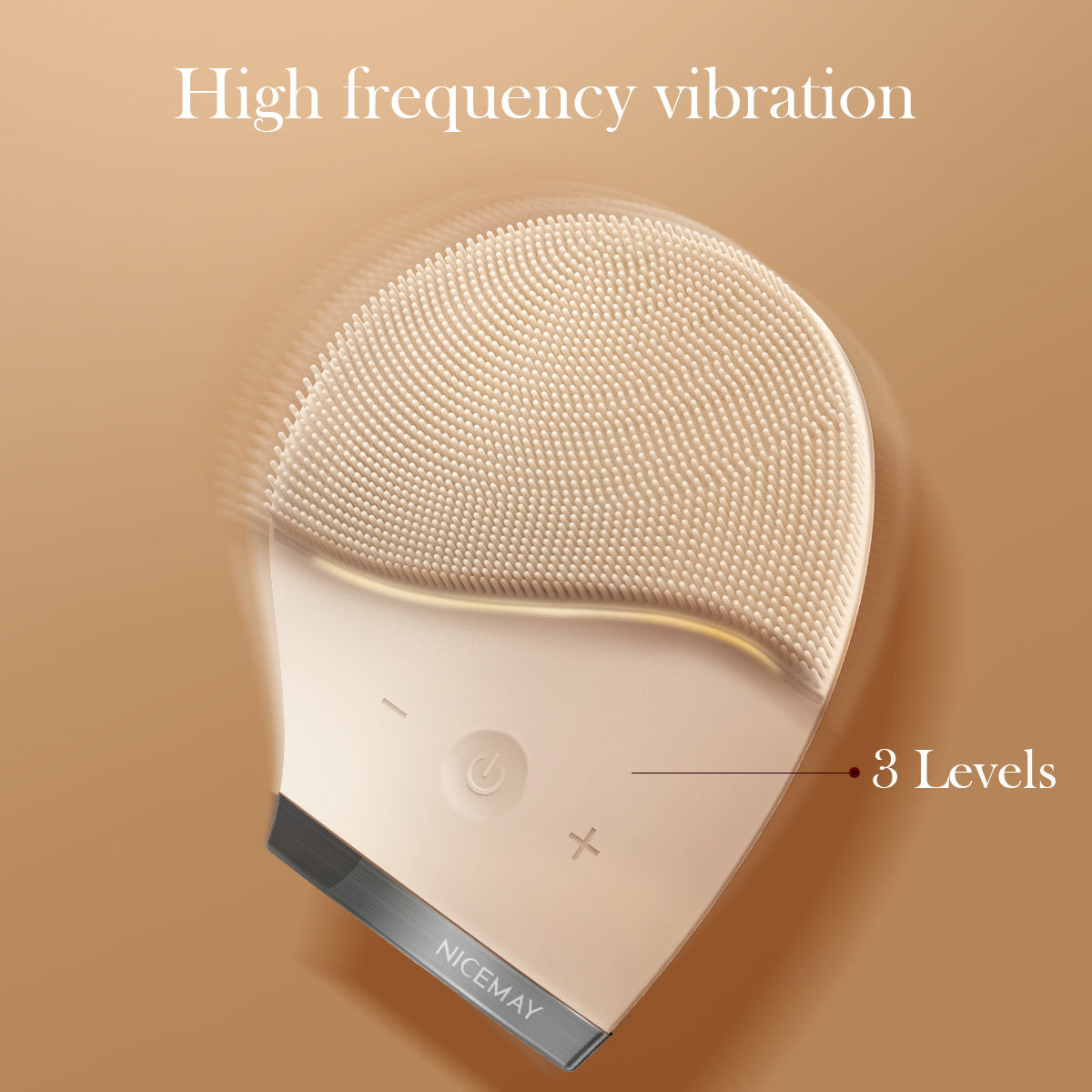
The NICEMAY MR-2370 stands out in the crowded facial device market by combining three clinically validated modalities in a single ergonomic handset: RF thermal stimulation, microcurrent muscle re-education, and dual-wavelength LED (630nm red + 830nm near-infrared). This stacking approach matters because RF alone remodels dermal collagen, but doesn’t address the progressive facial muscle atrophy that creates ptosis (sagging) over time. Microcurrent fills that gap.
Key specs: RF + microcurrent (60–100 μA, biphasic waveform) + 630nm/830nm LED, 5 intensity levels, auto shut-off at 45°C contact temperature.
The biphasic microcurrent waveform is the detail most reviewers miss: unidirectional current (used in cheap devices) can over-stimulate and fatigue facial muscles, counterproductively accelerating laxity after 3–4 months of use. Biphasic current mimics the body’s natural nerve-to-muscle signaling, producing genuine muscle toning without fatigue accumulation. The 830nm near-infrared LED penetrates to 8–10mm — deep enough to reach the fibroblast layer for collagen precursor stimulation alongside the RF thermal work.
Best for: Users who want facial contouring plus collagen stimulation plus skin tone improvement from a single device; ideal for the 35–55 age range where all three mechanisms have clear benefits.
Protocol tip: Use 3x per week, 10 minutes per zone, applied over a conductive serum. Expect visible lifting definition at 6–8 weeks; collagen density improvement at 12 weeks.

4. Medicube Age-R Ultra Tune 40.68 — Best for Daily Collagen Maintenance
Medicube’s 40.68 MHz frequency is the single most distinctive technical specification in this category. Standard at-home RF runs at 1–3 MHz; 40.68 MHz is an ISM (Industrial, Scientific, Medical) band frequency that produces gentler, more diffuse heating across a broader tissue volume — making it suitable for daily use without the cumulative thermal stress risk of higher-intensity devices.
Key specs: 40.68 MHz RF, 3 operating modes, EMS add-on capability, Korean MFDS certified.
The clinical trade-off: 40.68 MHz produces less peak dermal temperature per session (typically 40–41°C vs. 43–45°C for 1 MHz devices), meaning individual session impact is milder. The mechanism works through frequency accumulation — daily 5-minute sessions produce consistent fibroblast stimulation without inflammatory response. For users who want to maintain collagen levels rather than make dramatic structural corrections, this is the optimal protocol. It’s also the only facial RF device I’ve reviewed that’s designed around a Korean skincare layering approach — used post-essence, pre-moisturizer as the final active step.
Best for: Daily-use collagen maintenance, users with reactive or post-procedure skin, Korean skincare routine integrators.

5. Sensilift by Sensica — Best Dual-Use Face/Body Transition Device
Sensica’s Dynamic RF technology uses a moving-electrode design that adjusts energy output based on contact speed — slower movement delivers higher joule output per cm², faster movement reduces it. This adaptive mechanism makes it genuinely dual-use: on the face, controlled slow passes over the jawline or cheeks deliver targeted 42–44°C heating; on the neck and décolletage, brisker movement covers more surface area efficiently.
Key specs: Dynamic RF with motion-adaptive output, 2 intensity levels, FDA cleared, 360° swivel head.
The 360° swivel head is more clinically relevant than it sounds: it maintains full electrode contact around the mandibular angle and neck curve, areas where fixed-head devices lose contact and deliver inconsistent energy. The failure mode of rigid devices is edge heating — the contact perimeter overheats while the center loses contact. The Sensilift’s design prevents this.
Best for: Users treating both face and neck/décolletage, anyone wanting a versatile device before committing to body-specific tools.

Top 5 RF Devices for the Body
1. EvenSkyn Venus — Best for Neck, Chest & Décolletage
Despite being marketed partly as an eye device, the EvenSkyn Venus’s true clinical strength is the neck and chest zone — the most structurally complex area for at-home RF due to the proximity of the thyroid and the thin platysma muscle layer. Its low-intensity multi-polar RF (0.8 MHz) with EMS pulse combination is specifically calibrated for areas where aggressive thermal delivery would be inappropriate.
Key specs: Multi-polar RF 0.8 MHz + EMS, 5 intensity levels, skin temperature sensor, FDA registered.
The neck requires a different protocol than the face: no more than 3 passes per session, 10-minute maximum, and lower intensity than facial zones due to lymph node proximity. The Venus’s default settings respect these parameters — it’s one of few consumer devices where the manufacturer protocol was clearly developed with a dermatologist rather than a marketing team.
Best for: Neck laxity, crepey chest skin, platysma banding (vertical neck cords), décolletage crepiness.
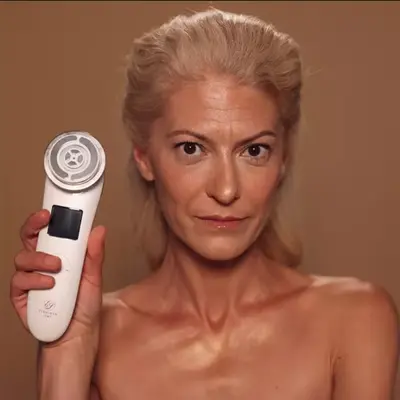
2. Therabody TheraFace PRO — Best Multi-Zone Body & Face Contouring
The TheraFace PRO earns its place here through the combination of percussive massage + RF + red LED in interchangeable ring attachments. For body contouring specifically, the percussive pre-treatment at 40Hz mechanically disrupts the fibrous septae within subcutaneous fat before RF delivery — the same principle as pre-treatment lymphatic drainage in clinical settings, which increases thermal tissue uptake by 15–20%.
Key specs: Percussive (40Hz) + RF + red LED (630nm), 3 speed settings, 4 attachment rings, FDA cleared.
The practical protocol for body use: 60-second percussive pre-treatment on the target zone, then switch to the RF ring for 8–12 minutes, then cold ring finish to reduce reactive vasodilation. This three-step sequence mimics a professional treatment workflow and produces meaningfully better outcomes than RF alone — visible improvement in upper arm laxity and inner thigh skin texture begins at 8 weeks with consistent 3x weekly use.
Best for: Upper arms, inner thighs, abdomen; users who want percussive massage + RF in one device.

3. MLAY Professional RF Beauty Machine — Best High-Power Tabletop for Body
The MLAY Professional stands apart from every other device on this list: it’s a tabletop unit with interchangeable probes (facial, eye, body), delivering RF output at clinical power levels (up to 50W) that no handheld device can match. For body use specifically, the large body probe covers a 30cm² treatment surface per pass, making it feasible to treat the abdomen, thighs, or buttocks in a single 20-minute session.
Key specs: Monopolar + bipolar RF modes, up to 50W output, separate probes (face 1MHz / body 0.8MHz), LED display, no FDA clearance (CE only — important consideration).
The CE-only certification is a meaningful flag for US buyers: it means the device has not undergone FDA 510(k) review. At 50W output, improper use carries real burn risk. That said, for experienced users willing to follow professional protocols, no other at-home device produces comparable body RF intensity. The monopolar mode drives energy to a depth of 15–20mm — beyond the dermis and into the superficial fascia layer — which is where body contouring results actually come from.
Best for: Advanced users treating body laxity (abdomen, thighs, buttocks); those with prior professional RF treatment experience who want at-home maintenance at comparable intensity.
Safety note: Always use with conductive gel, maintain movement, and limit to 12 minutes per zone per session.

4. Solawave Radiant Renewal Wand — Best Budget Body RF Entry Point
The Solawave Wand combines RF with red LED (660nm) and therapeutic warmth in a $169 package — the most accessible price point for body RF on this list. It’s not a high-intensity body contouring device; it’s a skin quality improvement tool that addresses surface-level crepiness, fine lines on the décolletage, and mild laxity on the inner arm.
Key specs: RF (frequency unspecified by manufacturer) + 660nm red LED + 107°F therapeutic warmth, FDA cleared, rechargeable.
The honest clinical limitation: the unspecified RF frequency and lack of published power output data makes it impossible to verify penetration depth. Based on the thermal output (107°F / ~41.6°C), the device likely operates at 40–42°C dermal temperature — effective for surface collagen stimulation but insufficient for deeper structural tightening. Think of it as a skin-quality maintenance tool rather than a laxity correction device.
Best for: Body skin texture improvement, décolletage and arm maintenance, RF beginners who want a low-cost entry point before investing in higher-intensity devices.

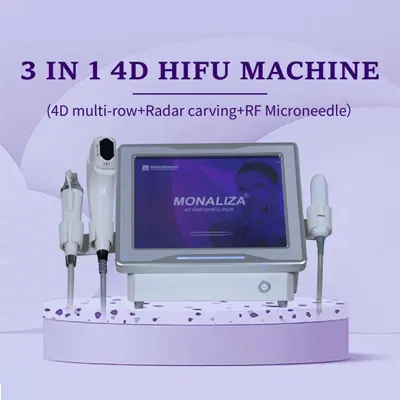
5. 4D HIFU + RF Combination Machine — Best Clinical-Grade Body Investment
The 4D HIFU + RF combination represents the ceiling of at-home body treatment intensity. HIFU (High-Intensity Focused Ultrasound) targets the SMAS layer (4.5mm depth) — the same structural layer addressed in surgical facelifts — while the RF component simultaneously treats the dermis (1.5–3mm). This dual-depth approach produces structural tightening that no RF-only device can replicate.
Key specs: HIFU (1.5mm / 3mm / 4.5mm cartridges) + monopolar RF, 0.1–2.0J HIFU energy adjustment, multiple cartridge depths, CE certified.
The key buyer consideration: HIFU requires a cooling interval of 90–120 days between full treatment sessions. Unlike RF, which can be used 2–3x per week, HIFU at therapeutic intensity causes a controlled inflammatory cascade that needs time to resolve into new structural collagen. Using HIFU more frequently doesn’t accelerate results — it causes cumulative tissue stress. This device is a quarterly-treatment investment, not a weekly routine tool.
Best for: Abdominal laxity, thigh and buttock skin, post-weight-loss skin tightening; serious buyers willing to invest in near-clinical results with a structured protocol.
Face vs. Body RF Beauty Device: Decision Framework
| Factor | Face Devices | Body Devices |
|---|---|---|
| Optimal RF Frequency | 1–3 MHz or 40.68 MHz | 0.8–1.5 MHz |
| Target Depth | 3–5mm (dermis) | 5–20mm (dermis to fascia) |
| Max Safe Temperature | 43–45°C | 40–44°C (larger area, lower risk) |
| Session Frequency | 2–4x per week | 2–3x per week (RF); 1x per 90 days (HIFU) |
| Surface Area per Session | 5–15cm² | 30–150cm² |
| Key Mechanism | Collagen remodeling, muscle toning | Structural tightening, fat layer treatment |
Internal Resources
For a full breakdown of top-rated RF tightening devices across both categories, see The Top 10 Radio Frequency Skin Tightening Devices of 2026. If neck laxity is your primary concern, The 10 Best RF Devices for Neck Tightening in 2026 covers the specialized protocols and device specs for that zone in detail.
Frequently Asked Questions: Jawline Contouring Devices
Can I use a facial RF device on my neck and décolletage?
How long before RF tightening results are visible?
Is RF safe to use with retinol or active acids?
What's the difference between monopolar and bipolar RF — and which is better?
Why do some cheap RF devices cause facial sagging after a few months?
Final Takeaways
Three principles should guide your decision:
- Match the device to the anatomy. Facial RF requires frequency precision, thermal ceiling control, and small electrode geometry. Body RF requires penetration depth, large surface coverage, and structural-layer targeting. No single device optimally does both at high intensity.
- Certifications are non-negotiable for high-power devices. FDA 510(k) clearance means a device has been reviewed for safety and efficacy claims. For devices above 10W output, uncleared units carry real thermal injury risk — the $50 savings is not worth it.
- Protocol compliance drives outcomes. The best device used incorrectly will underperform a mid-tier device used consistently and correctly. Session frequency, conductive medium, temperature management, and post-treatment skincare determine 60% of your results.

Please fill in your email in the form and we’ll get back to assist you soon!