


Quelle est la différence entre les appareils de beauté LED et RF ?

La différence entre les dispositifs de beauté LED et RF réside dans leur mode de livraison d'énergie principale : le LED utilise des longueurs d'onde lumineuses non thermiques pour déclencher la réparation cellulaire et la photobiomodulation pour des préoccupations de surface à médian-derme comme l'acné et l'inflammation, tandis que le RF emploie la chaleur électromagnétique pour le remodelage dermique profond et la contraction du collagène afin de traiter le raffermissement et la laxité—ce qui en fait des technologies complémentaires plutôt que concurrentes. Ce guide explore quelle est la différence entre les dispositifs de beauté LED et RF, avec leurs mécanismes, avantages et preuves pour vous aider à les choisir ou à les combiner.
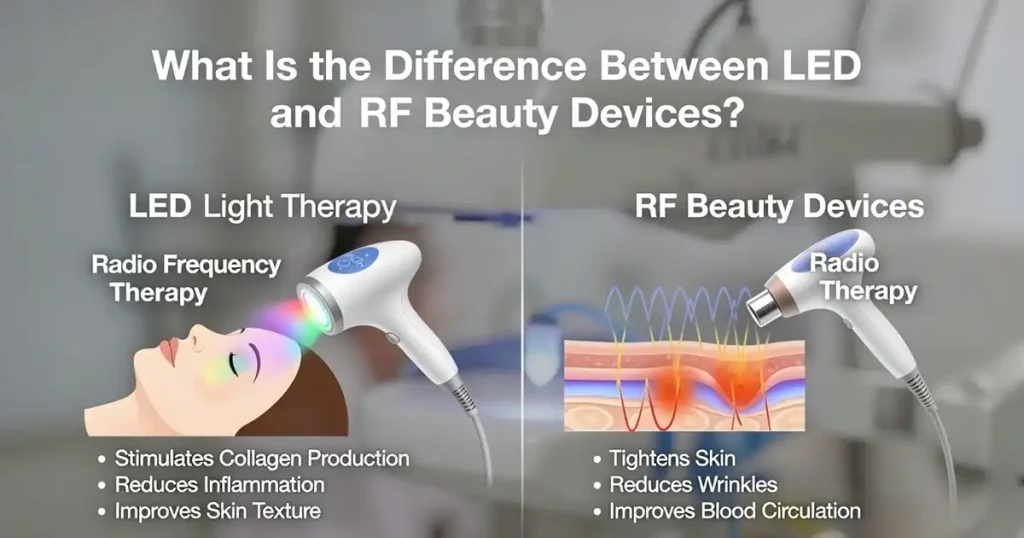
Analyse technique approfondie : comment les mécanismes des dispositifs de beauté LED et RF diffèrent dans leur interaction avec la peau
To select the right device, understanding their biological pathways is essential—LED relies on photon absorption for non-invasive cellular “recharging,” while RF uses controlled heat for a “wound-healing” response, leading to distinct results (source : Journal of Clinical and Aesthetic Dermatology, mécanismes comparatifs LED vs RF, 2023-2025).
Dispositifs de beauté LED : la puissance de la photobiomodulation pour stimuler l'ATP cellulaire
LED emits specific wavelengths absorbed by mitochondria’s cytochrome c oxidase, increasing adenosine triphosphate (ATP) production without generating heat or injury.
En quoi cela diffère : cette guérison ascendante accélère la réparation tissulaire, réduit l'inflammation et inhibe les bactéries comme C. acnes—en se concentrant sur l'entretien plutôt que sur la reconstruction (source : Harvard Health Publishing ; études cellulaires LED PubMed, 2024).
Dispositifs de beauté RF : blessure thermique contrôlée pour le remodelage du collagène
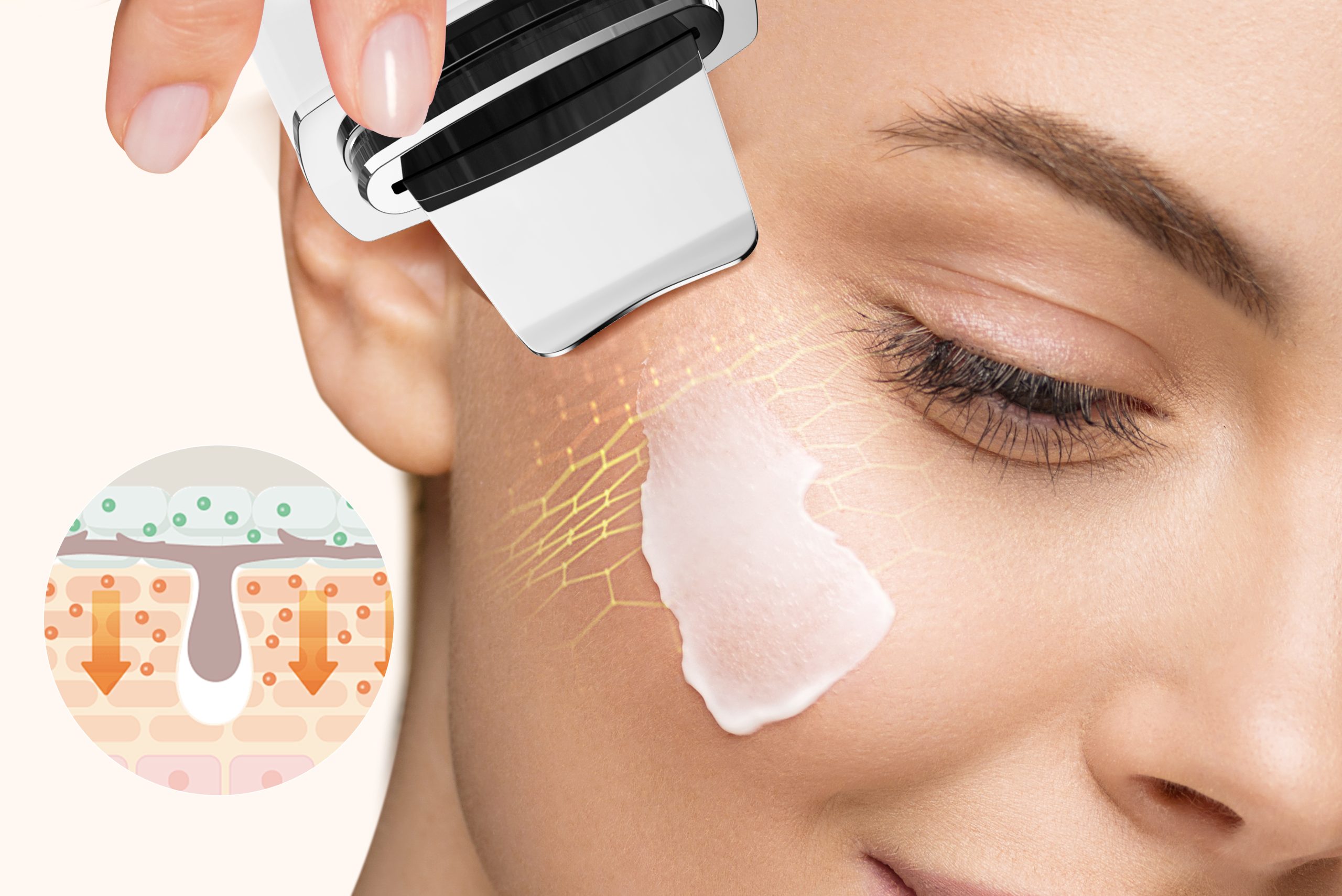
Le RF convertit l'énergie électromagnétique en chaleur (40-55°C) via la résistance de la peau, provoquant un rétrécissement immédiat du collagène et déclenchant la néocollagénèse par le biais de protéines de choc thermique.
How it differs: This induces a mild, controlled injury response for fiber contraction and new synthesis—more targeted for structural changes than LED’s gentle stimulation (source : PMC/NIH essais de blessure thermique RF, 2024).
Comparaison de la profondeur de pénétration : comment les dispositifs de beauté LED et RF ciblent différentes couches de la peau
Un piège courant est une profondeur inadéquate pour les préoccupations—l'efficacité dépend directement de l'énergie atteignant le bon tissu.
Pénétration de la surface au médian-derme dans les dispositifs de beauté LED
LED is wavelength-dependent: Blue (415nm) stays near-surface for acne; red (630nm) and near-infrared (850nm) reach 1-10mm. Energy density is lower, making it ideal for “maintenance” (source : Journal of Clinical and Aesthetic Dermatology cartographie de la pénétration LED).
Pénétration dans le derme profond et sous-cutanée dans les dispositifs de beauté RF
RF is “blind” to color but sensitive to water content, consistently targeting 3-6mm depths. For a deeper look at how this heat triggers change, see How Do Energy-Based Beauty Devices Stimulate Skin Renewal? (source: PMC/NIH RF depth profiling).
Utilisation synergique : comment la combinaison de dispositifs LED et RF maximise les résultats
Leading dermatologists now suggest that the most effective routine isn’t “LED vs. RF,” but rather “LED + RF.”
- La phase de lifting : utilisez un dispositif RF pour traiter le relâchement structurel. La chaleur prépare la peau en augmentant la microcirculation.
- La phase de guérison : suivez immédiatement avec une thérapie à la lumière rouge LED.
- La justification : Une étude de 2025 par l'Académie américaine de dermatologie suggère que la LED peut réduire significativement la rougeur transitoire causée par la chaleur RF tout en fournissant un stimulus secondaire pour la production de collagène.
Facteurs critiques pour la réussite de l'achat : Choisir entre les appareils de beauté LED et RF
Lors de l'évaluation d'appareils professionnels pour un usage domestique comme ceux de NICEMAY, recherchez ces indicateurs spécifiques de sécurité et de performance :
- Capteurs de température : Pour la RF, assurez-vous que l'appareil possède une thermistance intégrée pour éviter les brûlures de la peau.
- Irradiance Levels: For LED, the “brightness” (measured in mW/cm²) determines if the light is powerful enough to reach the dermis.
- Compatibilité : Si vous avez des implants métalliques ou si vous êtes enceinte, la RF est généralement contre-indiquée, alors que la LED est généralement sûre pour un plus grand nombre d'utilisateurs.
Matrice de comparaison : Principales différences entre les appareils de beauté LED et RF
| Caractéristique | Appareils de beauté LED | Appareils de beauté RF | Différence clé | Soutenu par des Sources |
|---|---|---|---|---|
| Énergie principale | Photons (Lumière) | Électromagnétique (Chaleur) | Non thermique vs basé sur la chaleur | Harvard Health Publishing |
| Preuves cliniques | Réduction de 60–80% de l'acné inflammatoire | 90.4% a rapporté une amélioration de la laxité cutanée | Surface vs structurel | PubMed ; PMC/NIH |
| Sensation | Aucune sensation (Frais / Relaxant) | Chaleur profonde ou légère sensation de picotement | Confort vs. chaleur | Journal de la dermatologie clinique et esthétique |
| Problèmes ciblés | Acné, Rosacée, Teint terne, Taches sombres | Jowls tombants, Rides profondes, Plis nasogéniens | Réparation vs. reconstruction | Journal of Drugs in Dermatology |
| Fréquence d'utilisation | Élevé (3–5 fois par semaine) | Faible (1–2 fois par semaine) | Quotidien vs. hebdomadaire | SRA 2025 |
Ce tableau décrit la différence entre les appareils de beauté LED et RF.
Pour les spécificités du LED, voir “Que font les différentes couleurs de lumière LED pour la peau ?”. Pour la concentration sur le raffermissement, voir “Quelle technologie d'appareil de beauté est la meilleure pour le raffermissement de la peau ?”.
Attentes réalistes : appareils de beauté LED vs RF pour les problèmes de peau
LED : plus rapide pour l'acné/éclat (4-8 semaines) ; RF : plus profond pour la laxité (8-12 semaines). Les deux sont sûrs, mais la combinaison donne de meilleurs résultats (source : essais de synergie du Journal of Cosmetic and Laser Therapy).
Conseils professionnels pour une utilisation efficace des appareils de beauté LED et RF
- Pour le LED : peau propre, protection des yeux, sessions de 10-20 minutes.
- Pour le RF : gel conducteur, mouvements lents, commencer doucement.
- Combinaison : RF d'abord pour le raffermissement, LED ensuite pour calmer.
- Suivi : photos hebdomadaires pour monitorer.
Les routines hybrides donnent de meilleurs résultats (source : avis combinés de RealSelf, 2024-2025).
Verdict final : distinct mais complémentaire pour des résultats optimaux
La différence entre les appareils de beauté LED et RF réside dans la réparation par la lumière contre le remodelage induit par la chaleur — LED pour l’éclat de surface / acné, RF pour le raffermissement en profondeur — ce qui les rend idéaux séparément ou combinés pour un soin complet.
Prêt pour votre correspondance technologique ? Faites notre quiz rapide sur les appareils pour voir si le LED ou le RF de NICEMAY (ou les deux) conviennent à vos préoccupations. Commencez votre routine personnalisée dès aujourd'hui !
Ce tableau évalue le raffermissement de la peau par RF est-il sûr pour une utilisation à domicile risques.
Veuillez remplir votre adresse e-mail dans le formulaire et nous reviendrons vers vous pour vous aider rapidement !