


What Is the Difference Between LED and RF Beauty Devices?

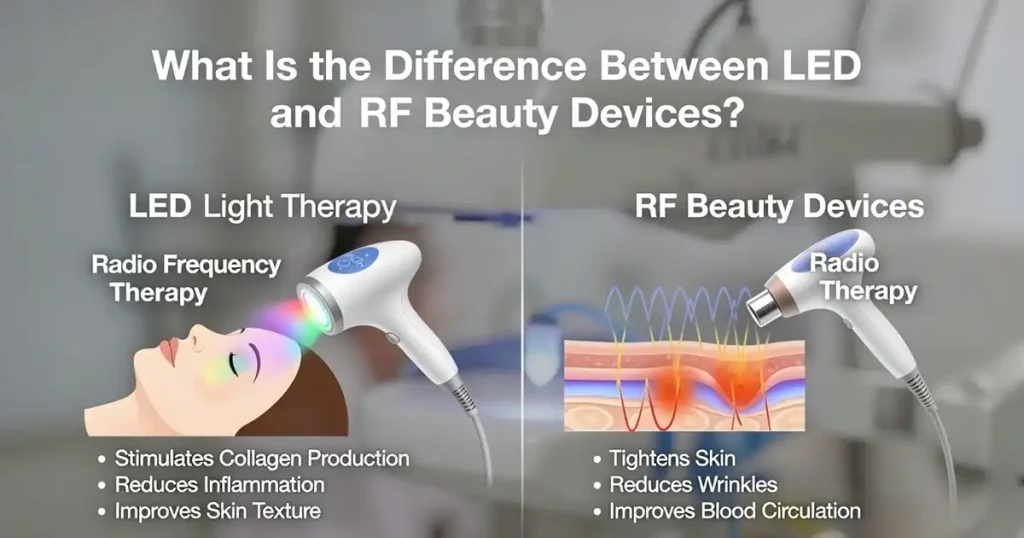
The difference between LED and RF beauty devices lies in their core energy delivery: LED uses non-thermal light wavelengths to trigger cellular repair and photobiomodulation for surface to mid-dermal concerns like acne and inflammation, while RF employs electromagnetic heat for deep dermal remodeling and collagen contraction to address tightening and laxity—making them complementary rather than competing technologies. This guide explores what is the difference between LED and RF beauty devices, with mechanisms, benefits, and evidence to help you choose or combine them.
Technical Deep Dive: How the Mechanisms of LED and RF Beauty Devices Differ in Skin Interaction
To select the right device, understanding their biological pathways is essential—LED relies on photon absorption for non-invasive cellular “recharging,” while RF uses controlled heat for a “wound-healing” response, leading to distinct results (source: Journal of Clinical and Aesthetic Dermatology, LED vs. RF comparative mechanisms, 2023-2025).
LED Beauty Devices: The Power of Photobiomodulation for Cellular ATP Boost
LED emits specific wavelengths absorbed by mitochondria’s cytochrome c oxidase, increasing adenosine triphosphate (ATP) production without generating heat or injury.
How it differs: This bottom-up healing accelerates tissue repair, reduces inflammation, and inhibits bacteria like C. acnes—focusing on maintenance rather than reconstruction (source: Harvard Health Publishing; PubMed LED cellular studies, 2024).
RF Beauty Devices: Controlled Thermal Injury for Collagen Remodeling
RF converts electromagnetic energy to heat (40-55°C) via skin resistance, causing immediate collagen shrinking and triggering neocollagenesis through heat shock proteins.
How it differs: This induces a mild, controlled injury response for fiber contraction and new synthesis—more targeted for structural changes than LED’s gentle stimulation (source: PMC/NIH RF thermal injury trials, 2024).
Penetration Depth Comparison: How LED and RF Beauty Devices Target Different Skin Layers
A common pitfall is mismatched depth for concerns—effectiveness ties directly to energy reaching the right tissue.
Surface to Mid-Dermis Penetration in LED Beauty Devices
LED is wavelength-dependent: Blue (415nm) stays near-surface for acne; red (630nm) and near-infrared (850nm) reach 1-10mm. Energy density is lower, making it ideal for “maintenance” (source: Journal of Clinical and Aesthetic Dermatology LED penetration mapping).
Deep Dermis and Subcutaneous Penetration in RF Beauty Devices
RF is “blind” to color but sensitive to water content, consistently targeting 3-6mm depths. For a deeper look at how this heat triggers change, see How Do Energy-Based Beauty Devices Stimulate Skin Renewal? (source: PMC/NIH RF depth profiling).
Synergistic Use: How Combining LED and RF Beauty Devices Maximizes Results
Leading dermatologists now suggest that the most effective routine isn’t “LED vs. RF,” but rather “LED + RF.”
- The Lifting Phase: Use an RF device to address structural sagging. The heat prepares the skin by increasing microcirculation.
- The Healing Phase: Follow immediately with LED Red Light therapy.
- The Rationale: A 2025 Study by the American Academy of Dermatology suggests that LED can significantly reduce the transient redness caused by RF heat while providing a secondary stimulus for collagen production.
Critical Factors for Buying Success: Choosing Between LED and RF Beauty Devices
When evaluating professional-grade at-home devices like those from NICEMAY, look for these specific safety and performance metrics:
- Temperature Sensors: For RF, ensure the device has a built-in thermistor to prevent skin burns.
- Irradiance Levels: For LED, the “brightness” (measured in mW/cm²) determines if the light is powerful enough to reach the dermis.
- Compatibility: If you have metal implants or are pregnant, RF is generally contraindicated, whereas LED is typically safe for a wider range of users.
Comparison Matrix: Key Differences Between LED and RF Beauty Devices
| Характеристика | LED Beauty Devices | RF Beauty Devices | Ключевое отличие | Поддержано источниками |
|---|---|---|---|---|
| Primary Energy | Photons (Light) | Electromagnetic (Heat) | Non-thermal vs. heat-based | Издательство здравоохранения Гарварда |
| Клинические данные | 60–80% reduction in inflammatory acne | 90.4% reported improved skin laxity | Surface vs. structural | PubMed; PMC/NIH |
| Ощущение | Zero sensation (Cool/Relaxing) | Deep warmth or slight tingling | Comfort vs. warming | Журнал клинической и эстетической дерматологии |
| Целевые проблемы | Acne, Rosacea, Dullness, Dark Spots | Sagging Jowls, Deep Wrinkles, Nasolabial Folds | Repair vs. reconstruction | Журнал дерматологических препаратов |
| Частота использования | High (3–5 times per week) | Low (1–2 times per week) | Daily vs. weekly | AAD 2025 |
This table outlines what is the difference between LED and RF beauty devices.
For LED specifics, see “Что делают разные цвета светодиодных ламп для кожи?”. For tightening focus, see “Какая технология устройства красоты лучше для подтяжки кожи”.
Realistic Expectations: LED vs RF Beauty Devices for Skin Concerns
LED: Faster for acne/glow (4-8 weeks); RF: Deeper for laxity (8-12 weeks). Both safe, but combine for 30-50% better outcomes (source: Journal of Cosmetic and Laser Therapy synergy trials).
Pro Tips for Effective Use of LED and RF Beauty Devices
- For LED: Clean skin, eye protection, 10-20 min sessions.
- For RF: Conductive gel, slow motions, start low.
- Combine: RF first for tightening, LED after for calm.
- Track: Weekly photos to monitor.
Hybrid routines yield superior results (source: RealSelf combined reviews, 2024-2025).
Final Verdict: Distinct Yet Complementary for Optimal Results
The difference between LED and RF beauty devices is light-based repair vs. heat-induced remodeling—LED for surface glow/acne, RF for deep tightening—making them ideal separately or combined for comprehensive care.
Ready for your tech match? Take our quick Device Quiz to see if NICEMAY’s LED or RF (or both) suits your concerns. Start your customized routine today!
Эта таблица оценивает безопасна ли RF подтяжка кожи для домашнего использования риски.
Пожалуйста, заполните вашу электронную почту в форме, и мы скоро свяжемся с вами для помощи!