


Hair Growth Comb vs LED Hair Cap: Which LLLT Device Delivers Real Results?

LED hair caps provide superior scalp coverage and hands-free convenience, making them the preferred choice for diffuse hair loss. Hair growth combs offer portability and affordability for localized thinning. Neither device is universally superior — the right pick depends on your pattern, lifestyle, and goals.
Both use photobiomodulation to energize dormant follicles, yet they differ dramatically in design, usage pattern, coverage area, and price. If you are deciding between these two devices, the choice ultimately hinges on the nature of your hair loss, how much active effort you are willing to invest, and your budget.
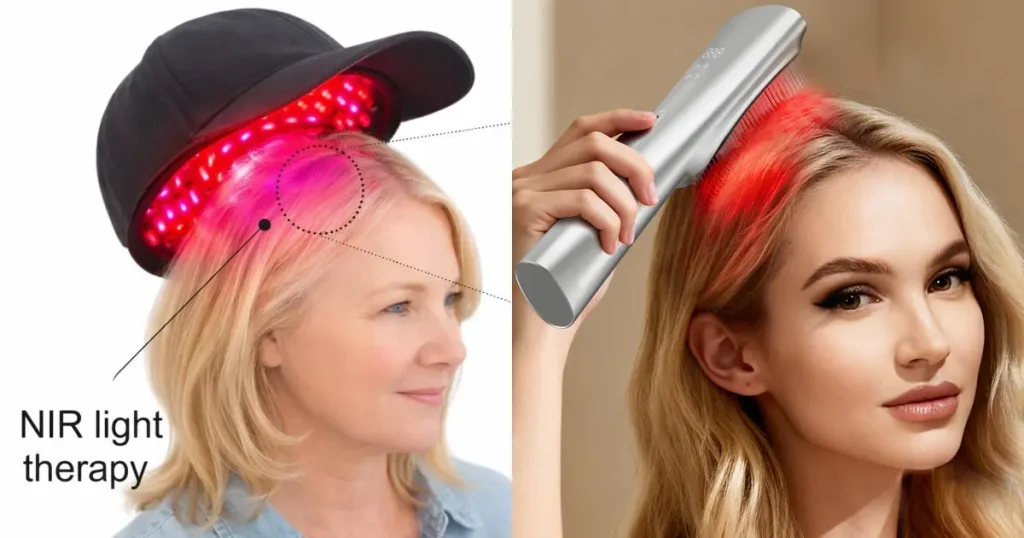
How Hair Growth Combs and LED Hair Caps Work?
Both devices are grounded in the same foundational science: low-level light therapy (LLLT), also called photobiomodulation. Specific wavelengths of red or near-infrared light — typically between 630 nm and 680 nm — penetrate the scalp and are absorbed by mitochondria inside hair follicle cells. This absorption stimulates cellular energy production (ATP), improves local circulation, prolongs the anagen (active growth) phase of the hair cycle, and reduces follicular inflammation — key drivers of androgenetic alopecia.
How a Hair Growth Comb Delivers Light Therapy?
A hair growth comb houses an array of laser or LED diodes within a handheld comb body. As you run the teeth through your hair, the diodes make direct contact with the scalp surface, ensuring the light is not diffused by hair density. Users typically stroke the comb slowly across thinning sections for 7–15 minutes per session. Higher-end models — particularly those pairing EMS (electrical muscle stimulation) with laser diodes — add microcurrent stimulation to complement the photobiomodulation, potentially boosting circulation and scalp metabolism simultaneously. If you are curious how this compares to pharmaceutical options, our in-depth guide Laser EMS Hair Growth Comb vs Minoxidil: More Effective Home Solution 2026? examines the head-to-head evidence between laser combs and the most widely used topical treatment.
How an LED Hair Cap Delivers Light Therapy
An LED hair cap (also marketed as a laser cap, laser helmet, or phototherapy cap) is worn on the head like a soft or rigid helmet. Hundreds of LED or laser diodes are distributed across its interior surface, simultaneously irradiating the entire scalp without any manual movement required. Sessions typically run 20–30 minutes, three to four times per week. Because the device is stationary, light energy density across every zone of the scalp remains consistent for the full session duration.

Scalp Coverage: Targeted Treatment vs. Full-Scalp Irradiation
Coverage is arguably the most practically significant difference between these two device categories, and it should be your first evaluation criterion.
Hair Growth Comb Coverage Limitations
A handheld comb can treat only the area directly beneath its diode array at any given moment. Effective treatment of the full scalp therefore requires methodical, section-by-section combing. In practice, most users struggle to achieve consistent coverage of the crown and occipital (back) region without assistance, meaning that treatment is inherently uneven. For individuals with hair loss concentrated in a single zone — a receding hairline, a small patch at the vertex — this focused delivery is actually an asset. For diffuse thinning that spans the entire scalp, the comb’s coverage constraint is a meaningful handicap.
LED Hair Cap Coverage Advantages
A well-designed LED cap uses a high diode count — often 200 to 350+ diodes — arranged to cover the full scalp surface, including temporal regions and the crown. Because the device remains stationary during the session, every follicle beneath the cap receives the same dose of photonic energy for the same duration. This uniformity is one of the primary reasons LED caps tend to outperform combs in studies measuring scalp-wide hair density improvement. For those with diffuse androgenetic alopecia or telogen effluvium affecting multiple scalp zones, full-scalp coverage is a clinically meaningful advantage.
| PROS | CONS |
|---|---|
| Closest possible shave — completely smooth finish | Elevated risk of cuts, nicks, and razor burn |
| High edge-lining precision for crisp beard borders | High irritation potential on sensitive skin |
| Lower upfront cost on most cartridge models | Can cause ingrown hairs, especially on coarse hair |
| Long-term cost efficiency with safety razors | Requires shaving cream, gel, or soap as prep |
| Works on all hair thickness and density | Blades dull and must be replaced regularly |
Clinical Efficacy and User Satisfaction: What the Data Shows
The published clinical literature on LLLT for androgenetic alopecia is broadly positive for both device categories, though direct, head-to-head randomized controlled trials comparing combs to caps are limited. What the evidence does allow us to compare is user satisfaction across device categories, which itself serves as a meaningful proxy for real-world effectiveness — since a device is only effective if it is used as directed.
LED Hair Cap Satisfaction and Clinical Evidence
Several peer-reviewed trials have demonstrated that laser caps and helmets producing statistically significant increases in hair count — measured as total terminal hairs per cm² — after 24 to 26 weeks of consistent use. Consumer satisfaction data compiled across multiple laser cap product lines shows positive review rates reaching up to 81%, a figure that reflects both perceived efficacy and satisfaction with the hands-free user experience. Importantly, this satisfaction rate is maintained even among users with more advanced thinning, likely because the cap’s uniform irradiation ensures no region is undertreated through user error.
Hair Growth Comb Efficacy and Compliance Challenges
Clinical studies on laser combs — most prominently a 2014 multicenter, randomized, double-blind trial published in the American Journal of Clinical Dermatology — found statistically significant hair count increases versus sham devices after 26 weeks. However, real-world consumer data tells a more mixed story. Some product categories of laser combs report negative review rates as high as 40%, a figure that dermatologists and researchers largely attribute not to the underlying LLLT technology, but to compliance failure. The manual, active-participation nature of comb therapy means users frequently miss sessions, under-treat certain scalp zones, or discontinue use before the 16–24 week threshold at which visible results typically emerge.

Treatment Compliance and Daily Usability
In chronic, self-administered therapies, compliance is not a peripheral concern — it is a primary determinant of whether any device produces results. The structural differences between combs and caps create meaningfully different compliance profiles.
The Compliance Advantage of LED Hair Caps
Using a hair cap requires placing it on your head and pressing a button. For the next 20–30 minutes, you are free to read, watch a screen, answer messages, or simply rest. This zero-effort maintenance window integrates seamlessly into existing routines and requires no behavioral change beyond remembering to put the cap on. The recommended frequency of three sessions per week is also psychologically manageable; it does not feel like a daily obligation. These structural features translate directly into higher adherence rates and, consequently, better outcomes in real-world — rather than controlled trial — conditions.
The Compliance Challenges of Hair Growth Combs
Laser combs typically require daily or near-daily active sessions of 7–15 minutes each, during which the user must move the device methodically across every scalp region. This demands sustained attention, an organized combing pattern, and the discipline to prioritize the session — with no passive multitasking available during use. For users with busy schedules, travel obligations, or low frustration tolerance for repetitive tasks, these demands represent genuine barriers to consistent use. It is not that combs require excessive time; it is that the time required is active, manual, and non-negotiable.

MF-2611

MR-2322

QM-1938
Technology Inside: LED vs. Laser Diodes
The naming conventions in this device category cause significant consumer confusion. Not all “laser caps” use true laser diodes, and not all combs labeled as “LED combs” use standard LEDs. The distinction matters — but perhaps less than marketing copy implies.
True Laser Diodes: Higher Coherence, More Concentrated Energy
Laser diodes emit coherent, monochromatic light — photons that travel in a single direction at a precise wavelength. This coherence allows laser energy to penetrate deeper into scalp tissue without divergence, theoretically delivering more photonic energy to the follicular bulb. High-quality laser combs, particularly those using pure 650 nm laser diodes, exploit this property effectively. Some premium hair growth combs pair these laser diodes with radiofrequency (RF) or EMS stimulation — an approach explored in detail in our comparison of RF Scalp Care vs LED Hair Growth Device: Hair Loss Prevention Comparison, which evaluates multi-modality scalp technologies against standalone phototherapy.
LED Diodes: Lower Cost, Broader Coverage
LED diodes emit non-coherent light at a broader wavelength band. They are less expensive to manufacture, which allows LED caps to house hundreds of diodes across a large surface area without prohibitive cost. While individual LED diodes deliver shallower penetration than lasers at equal power, the sheer density of diodes in a well-designed cap compensates — ensuring adequate energy density across the entire scalp surface. Many clinically validated LLLT caps use LEDs exclusively, with strong outcome data to support this approach.
Hybrid Devices and Multi-Modality Combs
The most sophisticated hair growth combs now combine true laser diodes with additional therapeutic modalities — EMS microcurrent, infrared heat, or vibration massage — to address follicular health through multiple mechanisms simultaneously. These hybrid devices narrow the performance gap with LED caps for targeted areas, though they cannot replicate a cap’s full-scalp coverage regardless of modality count.
Cost, Maintenance, and Long-Term Value
Hair Growth Comb Pricing
Entry-level laser combs are available at price points between $40 and $150, making them the most accessible LLLT entry point for budget-conscious users. Mid-range models with higher diode counts and additional modalities (EMS, vibration, heat) typically fall between $150 and $400. Most combs have no recurring maintenance costs — the diodes are rated for thousands of hours of use, and no consumable components require replacement. This makes the comb an attractive low-commitment option for users who want to trial LLLT before investing in a more expensive system.
LED Hair Cap Pricing
Consumer-grade LED hair caps generally start between $200 and $400 for entry-level models with lower diode counts. Mid-tier caps with 200+ diodes and FDA-clearance fall in the $400–$900 range, while clinical-grade or laser-diode caps can exceed $1,500–$3,000. As with combs, ongoing maintenance costs are minimal — most caps require only periodic lens cleaning and carry multi-year manufacturer warranties. The higher upfront cost is the primary deterrent for many users, though the long-term cost-per-session advantage over prescription treatments remains compelling.
Who Should Choose Which Device?
| Device | Situation / Requirement |
|---|---|
| LED CAP | Diffuse hair thinning across the full scalp. If your thinning is widespread — affecting the crown, mid-scalp, and temporal regions — a cap's uniform irradiation pattern is clinically the better match. You cannot achieve equivalent coverage with a handheld comb reliably. |
| COMB | Small, defined thinning zones. If you are treating a specific patch, a receding frontal hairline, or early focal loss, a laser comb's concentrated delivery is well-suited and more cost-efficient than a full-cap investment. |
| LED CAP | Low compliance tolerance or busy lifestyle. If daily active sessions feel unsustainable given your schedule, a hands-free cap requiring only three sessions per week dramatically improves the probability that you complete a full therapeutic course. |
| COMB | Tight budget or first-time LLLT user. A mid-range laser comb lets you experience photobiomodulation with minimal financial commitment. If you respond well and want broader coverage, upgrading to a cap later is always an option. |
| LED CAP | Advanced androgenetic alopecia (Norwood III–V or Ludwig II–III). More significant hair loss involves a larger number of compromised follicles distributed across broader scalp zones. Full-scalp irradiation from a cap is better positioned to address the scope of follicular involvement. |
| COMB | Portability is a priority. Frequent travelers or those who want a device that fits in carry-on luggage will find a comb far more practical than any helmet or cap system. |
Final Verdict: Hair Growth Comb vs LED Hair Cap
For the majority of people seeking a meaningful, sustained improvement in hair density, the LED hair cap holds the practical edge. Its hands-free design, full-scalp coverage, and lower-frequency treatment schedule produce the conditions most favorable to long-term compliance — and compliance, not device specification, is the single greatest predictor of real-world outcome. The higher user satisfaction rates documented for cap users over comb users are not primarily a reflection of superior technology; they reflect superior adherence made possible by a more forgiving usage model.
That said, the hair growth comb is far from obsolete. Its cost-accessibility, portability, and effectiveness for localized thinning make it the rational choice for a specific subset of users. For those in the early stages of hair loss, those treating a defined zone, or those who are highly self-disciplined about daily routines, a quality laser comb — particularly a multi-modality model — can deliver genuine, measurable results.

Please fill in your email in the form and we’ll get back to assist you soon!