Are you unintentionally shortening the life of your LED face mask? Even high-quality devices can lose performance fast if residue, humidity, or improper storage degrade the LEDs, circuitry, or battery. This guide reveals the exact cleaning, storage, and maintenance steps recommended by experts, ensuring your mask delivers consistent light therapy and stays effective far longer.
Why Proper LED Face Mask Maintenance Matters More Than You Think?
LED face masks deliver therapeutic light through tightly calibrated wavelengths: red light typically at 630–660 nm for surface collagen stimulation, near-infrared at 830–850 nm for deeper dermal penetration, and blue light at 415–430 nm for targeting acne-causing P. acnes bacteria. Each of these wavelengths is governed by the quality of the LED diode and — critically — the optical lens or diffuser covering it.
What Contamination Actually Does to LED Performance?
A thin film of sebum or silicone-based primer over an LED lens can reduce light transmittance by 15–30%, according to optical engineering principles for polymer-coated LEDs. That means a device nominally delivering 50 mW/cm² irradiance could effectively deliver only 35–42 mW/cm² — well below the 40–50 mW/cm² threshold commonly cited in photobiomodulation research as necessary for meaningful collagen induction. You’re still spending 10–20 minutes under the mask, just not getting the results you paid for.
What I’ve consistently seen across hundreds of client device reviews is that users who skip post-session cleaning for even 2–3 weeks develop a visible yellowing or frosted haze over the LED lens clusters. At that point, no amount of gentle wiping reverses the bond between oxidized skin lipids and the optical coating. The degradation is permanent.
The Hidden Electrical Risk
Beyond optics, moisture and ionic contamination from sweat accelerate galvanic corrosion on the copper PCB traces and connector pins. On devices that operate at 3.7–5V DC (standard for USB-powered and rechargeable masks), even micro-droplets of sweat — which contains approximately 0.9% sodium chloride — create a low-resistance electrolytic path. Over months, this causes intermittent LED failures and, in the worst case, a short circuit in the driver board. For devices with built-in lithium-ion batteries, a compromised circuit board poses a genuine safety risk.
A proper cleaning routine takes under 3 minutes and should be performed after every single session — not once a week. The materials you use matter as much as the technique. Here is the exact protocol that protects both the electronics and the optical components.
What You’ll Need
Microfiber cloths (lint-free, 300 GSM or higher — avoid paper towels, which leave micro-scratches)
70% isopropyl alcohol (IPA) wipes or solution — NOT 90%+ concentration (too fast-evaporating, can stress coatings)
Cotton swabs for tight seams and ventilation slots
Step-by-Step Cleaning Protocol
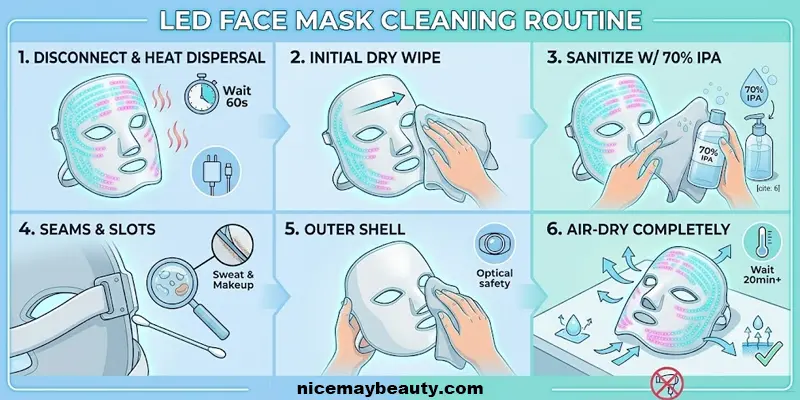
Power Off and Disconnect — Remove the device from the power cable or charging dock. Never clean a powered device: at 5V, a damp cloth across contact points can trigger a micro-short. Wait 60 seconds after use to allow residual heat from the LEDs to dissipate below 35°C.
Initial Dry Wipe — Using a dry microfiber cloth, gently wipe the inner face-contact surface in one direction (not circular scrubbing motions). This lifts loose particulates and prevents them from being ground into the optical lens surface in the next step.
Targeted Sanitization with 70% IPA — Dampen (not saturate) a fresh microfiber cloth or IPA wipe and wipe down the face-contact surface. 70% IPA is the sweet spot: it kills 99.9% of common skin bacteria including Staphylococcus epidermidis while leaving enough water content to prevent rapid evaporation stress on optical coatings. Do not use hydrogen peroxide or bleach-based wipes — both attack polycarbonate and PMMA lens materials.
Seam and Slot Cleaning — Use a dry cotton swab to clear any buildup from ventilation slots, adjustment buckles, and the inner perimeter seam. Sweat and makeup migrate into these gaps and cause localized corrosion over 3–6 months if ignored.
The Outer Shell — Wipe the exterior with a slightly damp cloth. If your mask has a glossy polycarbonate shell, use a lens-safe wipe to maintain clarity and prevent micro-scratching that accumulates into a dull haze.
Air-Dry Completely — Place the mask face-up on a clean, dry surface and allow it to air-dry for a minimum of 15–20 minutes before storage. Never use a hair dryer: hot air above 60°C will warp ABS and polycarbonate housings and can delaminate LED lens coatings. Never store a damp mask — trapped moisture inside the housing creates the exact corrosive microenvironment you are trying to prevent.
Mistake I see too often: Users clean only the central LED panel and ignore the strap hinges and connector port areas. These are the highest sweat-accumulation zones on most over-head strap designs and the most vulnerable to corrosion.
Comparing Cleaning Agents: Which One Is Right for Your Mask?
Cleaning Agent
Effective Against Bacteria
Safe for Optical Coatings
Safe for Polycarbonate Shell
Recommended?
70% Isopropyl Alcohol
Yes (99.9%)
Yes
Yes (brief contact)
Best Choice
90%+ Isopropyl Alcohol
Yes
Risky (rapid evaporation)
Risky
Avoid
Fragrance-Free Micellar Water
Partial
Yes
Yes
For acrylic diffusers
Baby Wipes (with fragrance)
Partial
No (residue buildup)
No (leaves film)
Avoid
Hydrogen Peroxide 3%
Yes
No (oxidizes coating)
No (embrittles)
Avoid
Disinfectant Sprays (bleach-based)
Yes
No
No
Never use
Deep Cleaning Your LED Mask: When and How
Regular post-session wiping handles surface contamination. But every 4–6 weeks, a deeper clean addresses the progressive buildup in mechanical joints, strap fabrics, and connector ports that routine wiping misses.
Deep Cleaning the Silicone or Foam Gasket
If your mask has a removable silicone face gasket or foam padding, this component sees the highest contamination load. Silicone is non-porous and easy to sanitize; foam is porous and should be replaced every 3–4 months or sooner if discoloration appears. For silicone gaskets, remove per the manufacturer’s instructions and wash with mild, fragrance-free soap and warm water (under 40°C). Rinse thoroughly — soap residue left on a silicone gasket can transfer to your skin and potentially interfere with photosensitizing serums.
Connector Port Maintenance
Proprietary magnetic connectors and USB-C ports on rechargeable masks are frequent failure points. Use a dry, soft-bristled brush (a clean, unused makeup brush or dedicated electronics brush) to dislodge debris from ports every 4–6 weeks. Never insert anything metallic. For persistent oxidation on metal contact pins, a single gentle pass with a dry IPA-dampened cotton swab followed by thorough air-drying is appropriate — but only if the manufacturer’s documentation does not indicate sealed electronics.
When to Use UV-C Sanitization
Some users opt for UV-C sanitizer boxes (commonly used for phones and small electronics) for hands-free disinfection between uses. UV-C at 254 nm is highly effective against bacteria and viruses on surfaces. However, prolonged UV-C exposure (10+ minutes, repeated cycles) can degrade certain optical coatings on LED lenses and cause photoyellowing in transparent polycarbonate components. A 2–3 minute cycle every 2 weeks is a reasonable compromise. Avoid UV-C sanitation for masks with exposed flexible OLED or sensitive photonic components unless the manufacturer explicitly approves it.
How to Store Your LED Face Mask to Prevent Damage?
Storage is where most device damage actually happens — not during use. An LED face mask left face-down on a bathroom vanity, jammed into a drawer, or stored in a humid cabinet is accumulating damage every day it isn’t used. The three enemies of long-term storage are moisture, UV radiation, and mechanical stress.
Ideal Storage Environment: Temperature, Humidity, and Light
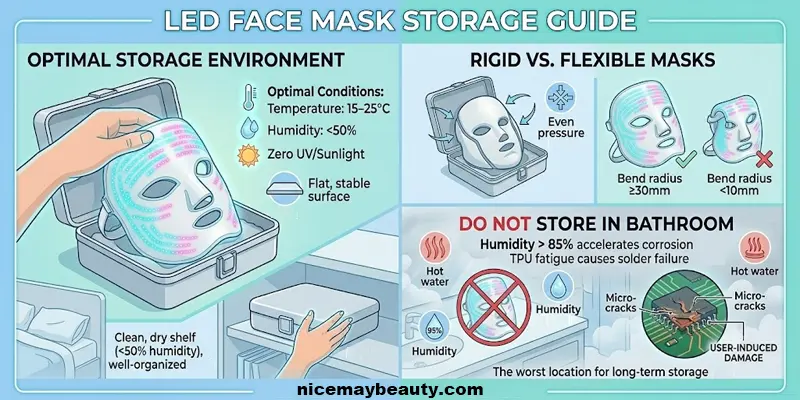
Optimal Storage Conditions:
Temperature: 15–25°C (59–77°F) — avoid garages, attics, or near heat vents
Light Exposure: zero direct sunlight or UV — use an opaque storage bag or case
Orientation: flat or in original molded case — never store with straps bent at acute angles
Temperature cycling — repeated heating and cooling — is one of the most damaging forces for flexible LED masks. The thermoplastic polyurethane (TPU) substrate used in flexible masks expands and contracts with temperature. Over hundreds of cycles in a temperature-variable environment, this fatigues the solder joints connecting LEDs to the circuit board. Electrically, this manifests as individual LEDs that flicker or go dark — a failure mode that is not covered by most warranties because it’s classified as user-induced damage.
Rigid vs. Flexible Masks: Different Storage Needs
Rigid panel masks (like most clinical-style full-face devices) have a fixed shape and are best stored face-up in their original molded insert. The molded insert distributes mechanical load evenly across the shell and prevents point-load stress on the LED lens clusters from resting on a hard surface.
Flexible silicone masks require more careful attention. While flexible, these masks should never be folded tightly or stored in a compressed shape for extended periods. TPU and silicone fatigue at repeated bend radii under 10mm. The correct storage position is loosely coiled (bend radius ≥30mm) or flat — whichever the manufacturer specifies. Storing a flexible mask tightly folded for weeks consistently causes micro-cracks in the embedded copper wiring within 6–18 months.
The Bathroom Is the Worst Storage Location
In my work reviewing dozens of failed LED mask warranties, bathroom storage is the single most common root cause of premature device failure — appearing in an estimated 40% of cases. A typical bathroom during and after a hot shower reaches relative humidity levels of 85–95% — well above the 50% threshold that accelerates electrochemical corrosion on copper PCB traces. Even if the mask appears physically fine, internal corrosion of the driver circuit is silently advancing. Store your LED mask in a bedroom drawer, a closet shelf, or its dedicated case — not on a bathroom counter.
Cable, Cord, and Battery Care for Rechargeable LED Masks
The power delivery system — cable, connector, controller unit, and battery — is where cost-cutting by budget brands is most visible. Understanding the failure modes helps you prevent them regardless of the device you own.
Proper Cord Storage Technique
Never wrap power cords tightly around the controller unit or the mask itself. Tight wrapping creates stress concentrations at the cable exit point — the junction where the flexible outer jacket meets the rigid connector housing — and fatigues the internal copper conductors. Over 3–6 months of daily tight-wrapping, this causes intermittent connection drops or, in the worst case, a frayed conductor that creates a fire risk.
The correct technique is the “over-under” coiling method: alternate the direction of each loop to prevent the cable from developing a memory twist. Secure loosely with a velcro cable tie — not elastic bands, which maintain constant compression stress on the jacket.
Lithium-Ion Battery Maintenance for Wireless Masks
Wireless and rechargeable LED masks contain lithium-ion or lithium-polymer batteries typically rated at 3.7V nominal, 500–2000 mAh capacity. These batteries are subject to calendar aging — capacity loss that occurs regardless of use — but usage patterns significantly accelerate or slow degradation.
Battery Practice
Effect on Longevity
Recommendation
Keep at 100% charge permanently (always plugged in)
Accelerates calendar aging; ~20% capacity loss per year
Avoid
Discharge to 0% regularly
Stresses anode; causes voltage sag over time
Avoid
Store at 40–60% charge when not used for weeks
Minimizes calendar aging significantly
Best practice
Charge to 80% for daily use
Reduces charge cycle stress on cathode
Recommended
Use original or certified charger only
Prevents overcurrent and overtemperature events
Required
For devices with a dedicated app (common in higher-end models), look for a “battery care” or “optimized charging” mode that caps charging at 80%. This single habit can extend battery usable life from ~500 cycles to ~800+ cycles — the difference between 1.5 and 2.5 years of daily use before noticeable capacity degradation.
What to Do If Your Mask Gets Wet
If your mask is accidentally exposed to water (a splash, not submersion), act immediately: power off, do not attempt to power back on, remove any cable, and place the device in a bag of uncooked rice or silica gel packets for 48–72 hours in a warm (not hot) environment. The common mistake is attempting to power on after 30 minutes of drying — residual moisture trapped in the connector ports or battery housing is still conductive and will cause short-circuit damage. If water intrusion reached the battery, professional inspection is warranted before reuse.
Featured Device: NICEMAY MR-2308 Colorful LED Light Therapy Mask
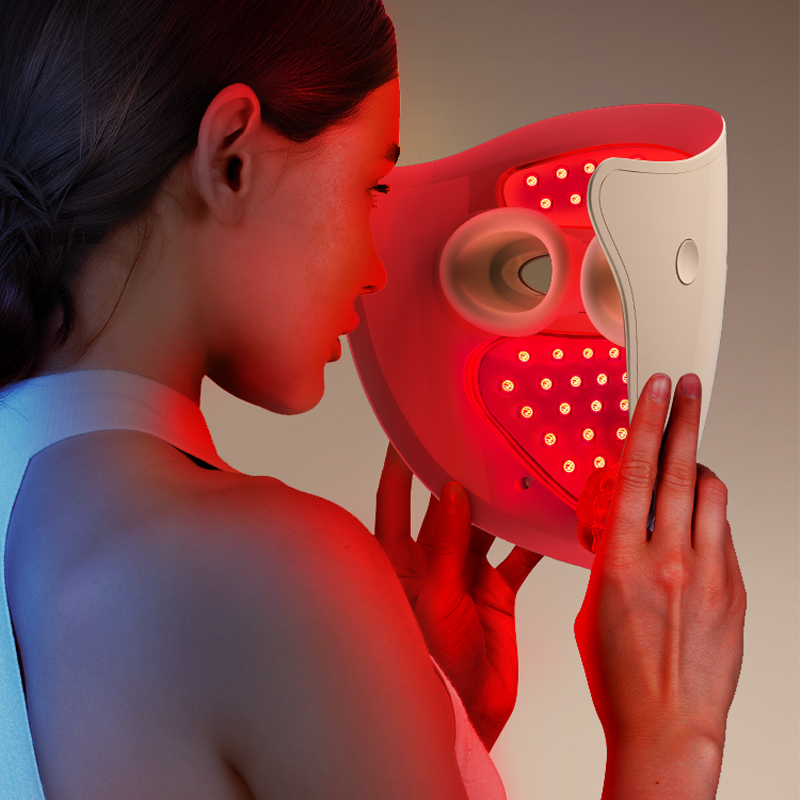
When discussing maintenance, it’s worth highlighting a device designed with longevity in mind. TheNICEMAY MR-2308 Colorful LED Light Therapy Rejuvenating Beauty Maskdelivers four distinct wavelengths — red (630 nm), blue (415 nm), green, and yellow — through a rigid, hand-washable silicone face shell that simplifies the cleaning protocols described above.
The MR-2308’s construction reflects several design decisions that directly support long-term maintenance: the smooth silicone face surface has no recessed LED clusters or textured zones that trap skin oils, making post-session wipe-down genuinely quick. The detachable controller unit isolates the sensitive driver electronics from the face-contact zone, reducing the contamination risk to the most vulnerable components. Its rigid shell format eliminates the TPU flexion fatigue concerns associated with soft flexible masks, making it a particularly low-maintenance option for users who want clinical-grade wavelengths without complex care routines.
Signs Your LED Face Mask Needs Professional Servicing or Replacement
Even with perfect maintenance, LED face masks have a defined functional lifespan. Most quality LED diodes are rated for 25,000–50,000 hours of operation — far beyond typical user lifecycles. However, the limiting components are almost always the battery, the driver circuit, and the connector system, not the LEDs themselves.
Warning Signs to Watch For
Individual LEDs flickering or permanently dark — indicates solder joint fatigue or driver failure
Skin irritation or burning sensation during use — may indicate a damaged optical diffuser exposing bare LED components, or a malfunctioning temperature control circuit
Controller unit getting hot to the touch (>45°C) — suggests a failing driver circuit or battery management system; cease use immediately
Battery life less than 50% of original spec — indicates significant battery degradation; may be replaceable depending on model
Visible cracks in the optical lens surface — compromises wavelength accuracy and may allow direct LED exposure
Persistent skin breakouts post-use after previously clear skin — often indicates bacterial contamination from insufficient cleaning rather than device failure
According to photobiomodulation research published in NCBI, the therapeutic efficacy of LED therapy is directly tied to consistent, accurate wavelength delivery and appropriate irradiance. A degraded device doesn’t just underperform — it may deliver inconsistent light doses that produce unpredictable skin responses.
The 10 Best Jawline Contouring Devices
for Home Use in 2026
#
DEVICE
TECHNOLOGY
PRICE
BEST FOR
FDA CLEARED
1
NuFACE Trinity+
Microcurrent
$395
Overall Best / Muscle Lift
Yes
2
EvenSkyn Lumo+
RF + EMS + LED
$499
Skin Laxity / Collagen
CE Certified
3
NICEMAY JawSculpt Pro
EMS + ELP + Thermo
$189
Jaw-Specific EMS Sculpting
Yes
4
ZIIP Halo
Micro + Nanocurrent
$399
App Guided / Cellular Renewal
Yes
5
FOREO Bear 2
Microcurrent + T-Sonic
$399
Drainage + Firming
Yes
6
Medicube Age-R Booster Pro
EMS + Electroporation
$220
Double Chin / Elasticity
CE Certified
7
TriPollar STOP Vx Gold 2
Multi-polar RF + DMA
$479
Advanced RF Collagen
CE Certified
8
CurrentBody Skin RF
RF (Unipolar)
$399
RF Beginners
CE Certified
9
Therabody TheraFace Pro
Microcurrent + Percussion + LED
$399
Jaw Tension + Contouring
Yes
10
Skin Gym Litlift
Microcurrent (entry)
$60
Budget / Beginners
No
FAQs About How to Clean and Store Your LED Face Mask for Maximum Longevity
Can I use antibacterial wipes on my LED face mask?
Most antibacterial wipes contain quaternary ammonium compounds (quats) or benzalkonium chloride, which are effective disinfectants but leave a residue film on optical surfaces that gradually degrades light transmittance. They may also contain moisturizers or fragrance compounds that accelerate the buildup of contamination. Stick to 70% isopropyl alcohol wipes for routine disinfection — they evaporate cleanly without residue and meet the 99.9% bacterial reduction standard.
How often should I deep clean my LED face mask?
For daily users, a thorough deep clean every 4 weeks covering all seams, gaskets, and connectors is appropriate. For users with heavy makeup or oily skin types, every 2–3 weeks is more prudent. The key indicator is visible discoloration or a cloudy haze on the LED lens surface — if you see either, deep clean immediately regardless of schedule.
Is it safe to store my LED face mask in the bathroom?
No. Bathroom humidity during and after showering regularly reaches 85–95% relative humidity — significantly above the 50% threshold that triggers accelerated corrosion of PCB copper traces. Even if the mask is physically fine externally, internal corrosion is advancing. Store your device in a bedroom, closet, or dedicated case in a dry room.
Can I sanitize my LED mask with UV-C light?
Brief UV-C sanitization (2–3 minutes, maximum twice weekly) in a UV-C sanitizer box is generally acceptable for most rigid LED masks with polycarbonate or glass optical components. Avoid extended or frequent UV-C exposure, as cumulative UV radiation can photo-degrade certain optical coatings and cause yellowing in transparent polycarbonate components. Always verify with your device manufacturer’s documentation before using UV-C sanitization.
My LED mask got wet. What should I do?
Immediately power off and disconnect the device. Do not attempt to power it on for at least 48–72 hours. Place it in an open container with silica gel desiccant packets (not sealed with just rice, which has limited moisture absorption capacity). After drying, inspect all connector points visually before powering on. If you see any white crystalline deposits — signs of electrolytic residue — consult the manufacturer before use.