


How to Combine Red Light Therapy with Your Daily Skincare Routine?

Most people investing in red light therapy still end up with disappointing results—not because the technology fails, but because they’re using it incorrectly in their skincare routine. Are you unknowingly blocking light penetration with the products you apply beforehand, or limiting your results by following the wrong sequence? The order of your skincare routine can dramatically impact how much light actually reaches your dermis, with certain actives enhancing results while others may reduce effectiveness. In this guide, you’ll discover the science behind product layering, which ingredients to pair—or avoid—during RLT sessions, and how to build optimized morning and evening protocols to finally get the results your device was designed to deliver.

Why Skincare Product Order Matters More Than Most Guides Admit
Red light therapy operates in the 630–660 nm (visible red) and 810–850 nm (near-infrared) wavelength ranges. These photons must physically reach your dermal fibroblasts — the cells responsible for collagen and elastin synthesis — at a sufficient energy density, typically 3–6 J/cm² for superficial collagen stimulation and 10–20 J/cm² for deeper dermal remodeling.
The moment you apply a product to skin before an RLT session, you introduce an optical variable. Thick occlusive creams, mineral sunscreen particles, and foundation all scatter or absorb photons before they reach the epidermis. A 2019 study published in Photobiomodulation, Photomedicine, and Laser Surgery confirmed that topical barriers can reduce effective irradiance at the skin surface by 30–60% depending on formulation opacity and thickness. That’s not a rounding error — it’s the difference between a therapeutic dose and a sub-therapeutic one.
The bottom line: RLT is a physics-based treatment. Treat your skin preparation as a technical requirement, not an afterthought.
The Skin Absorption Window After RLT
Here’s what most guides miss entirely: the 10–20 minutes immediately following a red light therapy session represent a unique absorption window. RLT transiently increases skin permeability by stimulating the formation of temporary micro-channels in the stratum corneum and by increasing local blood circulation. Studies measuring transdermal absorption post-photobiomodulation show a 30–40% increase in topical penetration of low-molecular-weight actives (under 500 Daltons) during this window. This means the timing of your serums relative to your RLT session isn’t just about avoiding interference — it’s about actively exploiting a biochemical opportunity.
The Complete Step-by-Step Skincare Routine Around Red Light Therapy

Step 1: Cleanse Thoroughly (Non-Negotiable)
Use a gentle, pH-balanced cleanser to remove makeup, sunscreen, sebum, and pollutants. Any residue left on the skin — even a well-blended BB cream or a “barely there” SPF moisturizer — will create optical interference. Pay particular attention to the T-zone and hairline, where product buildup is most common. Pat dry with a clean towel; don’t rub, as irritated skin is more photosensitive.
Avoid: Cleansers with silicone-heavy ingredients (dimethicone, cyclopentasiloxane) that leave a thin film. They’re harder to rinse fully and can create a reflective barrier.

Step 2: Optional Pre-Session Hyaluronic Acid (Choose Wisely)
This step is conditional, not universal. If your skin is dehydrated or tight after cleansing, a low-molecular-weight hyaluronic acid serum (under 50 kDa) can be applied before RLT. Here’s the science: low-MW HA is a water-based, optically clear molecule. It doesn’t scatter red or near-infrared light meaningfully, and it may actually enhance cellular responsiveness by improving skin hydration and turgor.
What you must avoid pre-session: high-molecular-weight HA with thickening agents, niacinamide (creates a slight reflective coating at higher concentrations), and anything containing physical UV filters (zinc oxide, titanium dioxide), which are specifically designed to reflect electromagnetic radiation — including therapeutic wavelengths.

Step 3: Red Light Therapy Session (The Core Treatment)
Apply your device to clean, dry skin for 10–20 minutes, maintaining the manufacturer-specified treatment distance. For panel-style devices, this is typically 6–12 inches. For mask-style devices, the distance is built in. For wand-style devices used in contact mode, ensure the lens is clean.
For a high-powered clinical-grade option, the NICEMAY MR-2322 High Power LED Light Therapy Lamp combines red (630 nm) and near-infrared (850 nm) wavelengths at a professional irradiance level, allowing both superficial collagen stimulation and deeper dermal penetration in a single session. The dual-wavelength design means you’re addressing skin texture and laxity simultaneously — something single-wavelength devices can’t match.
Eye protection is mandatory. Regardless of device type, always wear the goggles or shields provided. The retina has no pain receptors, meaning photochemical damage from repeated unprotected exposure accumulates silently. This applies to near-infrared wavelengths especially — they’re invisible to the naked eye but not to retinal tissue.
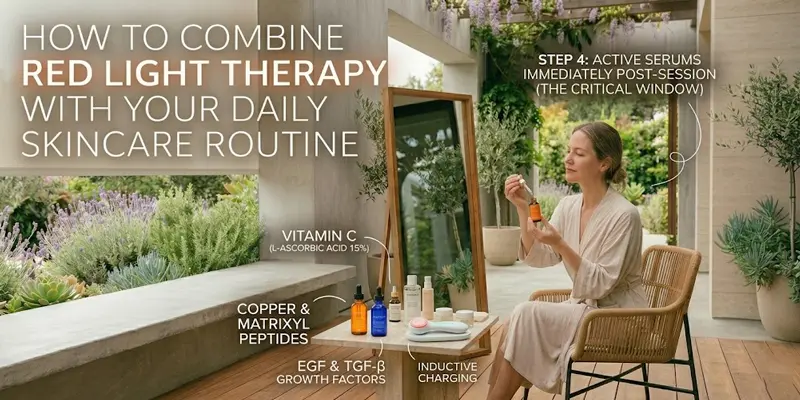
Step 4: Active Serums Immediately Post-Session (The Critical Window)
Apply your targeted actives within 5 minutes of finishing your RLT session to exploit the absorption window described earlier. Evidence-supported ingredients that work synergistically with RLT:
- Vitamin C (L-ascorbic acid, 10–20%): RLT upregulates collagen type I synthesis via fibroblast mitochondrial activation. Vitamin C is a required cofactor in collagen crosslinking (hydroxylation of proline and lysine residues). Applying it post-session provides the raw biochemical material for the collagen cascade already initiated by the light.
- Peptides (copper, matrixyl, argireline variants): Signal peptides communicate directly with fibroblasts to produce more collagen and elastin. Post-RLT upregulation of cellular receptors may improve peptide binding efficiency.
- Growth factors (EGF, TGF-β): These bioactive molecules work on the same cellular repair pathways activated by photobiomodulation. Stacking them post-session is one of the more advanced strategies in medical-grade facial protocols.
What to avoid immediately post-session: Physical exfoliants and anything with harsh pH extremes. Your skin barrier is temporarily more permeable — great for beneficial actives, but also for irritants.

Step 5: Moisturizer and SPF (Lock and Protect)
After your actives have been absorbed (3–5 minutes), apply your moisturizer. Focus on ceramide-rich formulations to reinforce the skin barrier, followed by broad-spectrum SPF 30–50 if performing your routine in the morning.
A note on evening routines: If you use retinol or chemical exfoliants (AHAs, BHAs), these should always come after your RLT session and strictly reserved for evenings. Retinol applied before RLT can cause excessive photosensitivity and irritation. Moreover, retinoids and RLT work on complementary but distinct mechanisms (retinoids regulate gene expression; RLT stimulates mitochondrial ATP production), so sequencing them — RLT first, retinol after — allows both to perform at full efficacy without interference.
Morning vs. Evening RLT Protocols: Which Is Better?
This is one of the most debated questions in at-home light therapy communities, and the honest answer is: it depends on your goals and your existing product stack.
Morning Protocol Advantages
Morning RLT can jumpstart cellular energy production and lymphatic circulation, reducing overnight puffiness more effectively than most tools. The adenosine triphosphate (ATP) boost from photobiomodulation peaks approximately 2–4 hours post-session, meaning cells are operating at elevated energy levels during the day when metabolic activity is naturally higher.
Morning routine order: Cleanse → optional low-MW HA → RLT (10–15 min) → Vitamin C serum → moisturizer → SPF
Evening Protocol Advantages
The skin’s natural circadian repair cycle peaks between 11 PM and 4 AM. Combining RLT with evening application of peptides, growth factors, and retinoids aligns with this biological window. Dermatologists who integrate RLT into clinical protocols often recommend evening sessions precisely because cellular repair pathways are most receptive during the skin’s endogenous regeneration phase.
Evening routine order: Cleanse → optional low-MW HA → RLT (15–20 min) → peptides or growth factors → moisturizer → retinol (if using, as the final step)
Frequency Recommendation
For most at-home users, 4–5 sessions per week is the optimal frequency for anti-aging goals. Daily use is not more effective and can lead to a phenomenon called “biphasic dose response” — at very high cumulative doses, RLT can actually inhibit the cellular processes it’s meant to stimulate. Clinical studies typically use 3–5 sessions per week over 8–12 week periods to establish measurable collagen improvements.
Ingredients That Boost Red Light Therapy Results (And Two That Undermine Them)
The Synergistic Stack
| Ingredient | Mechanism | Best Timing |
|---|---|---|
| L-ascorbic acid (Vit C) | Collagen cofactor, antioxidant | Immediately post-RLT |
| Copper peptides | Fibroblast stimulation | Immediately post-RLT |
| Low-MW hyaluronic acid | Hydration, permeability | Optional pre-RLT or post |
| Niacinamide | Barrier support | Post-RLT (not pre) |
| Retinol | Gene-level collagen regulation | Post-RLT, evenings only |
Two Ingredients That Actively Interfere
Mineral sunscreen filters (zinc oxide/titanium dioxide): These inorganic compounds are specifically engineered to reflect and scatter UV radiation — but their scattering effect extends into the visible red spectrum. A product containing 15–20% zinc oxide can reflect a meaningful portion of 630–660 nm wavelengths, directly reducing your session’s effective dose. Never apply these before RLT.
High-concentration retinol pre-session: Retinoids increase epidermal photosensitivity by thinning the stratum corneum and increasing cellular turnover rate. Using retinol before RLT is one of the most common mistakes I see — it doesn’t improve results; it increases the risk of inflammation, post-inflammatory hyperpigmentation, and surface irritation.
For a deeper understanding of how the collagen and elastin pathways activated by RLT translate into visible tightening outcomes, see our detailed breakdown: The Role of Collagen and Elastin in Skin Tightening Device Results.
Common Mistakes That Sabotage Your Red Light Therapy Results
Mistake #1: Using RLT over SPF or foundation. This is the single most common error among new users. Even a light CC cream reduces photon delivery to the dermis substantially.
Mistake #2: Inconsistent session length. Red light therapy operates on cumulative dosing. Doing 5-minute sessions because you’re rushed delivers sub-therapeutic energy density. The minimum effective dose for measurable collagen response in clinical literature is approximately 3 J/cm², which at typical at-home device irradiance (~30–50 mW/cm²) requires 60–170 seconds of exposure per area. A full face treatment at proper distance requires 10–20 continuous minutes.
Mistake #3: Applying too many actives simultaneously post-session. Yes, the absorption window is valuable — but stacking 5–6 actives back-to-back can overwhelm a temporarily permeable barrier. Layer two to three targeted actives maximum, wait for absorption, then proceed.
Mistake #4: Treating RLT as a substitute for sun protection. Red light therapy does not confer UV protection. In fact, because post-session skin is transiently more permeable, unprotected morning sun exposure after an RLT session carries a slightly elevated risk for pigmentation in sensitive skin types.
Mistake #5: Ignoring device specifications. At-home devices vary enormously in irradiance output. A device emitting 10 mW/cm² will require 3x longer session time to match the dose of a 30 mW/cm² device. Understanding your device’s output specification — and calibrating your session length accordingly — is foundational to getting results.
When evaluating whether RLT or microcurrent better fits your anti-aging goals, our comparison article on LED Mask vs. Microcurrent: Which Gives Faster Anti-Aging Results? provides a side-by-side protocol and results timeline analysis.
Frequently Asked Questions: Jawline Contouring Devices
Can I use red light therapy every day?
How long before I see results from red light therapy?
Is it safe to use red light therapy if I'm on prescription retinoids?
Can I use red light therapy with rosacea or sensitive skin?
Can I combine red light therapy with a microcurrent device in the same routine?
Please fill in your email in the form and we’ll get back to assist you soon!