


How to Get the Most Out of Your LED Hair Growth Comb at Home?

Are you using your LED hair growth comb regularly but still not seeing the results you expected — or worse, wondering whether it’s even working at all?Most people make the same handful of mistakes: wrong session timing, dirty scalp, inconsistent frequency, or simply moving the device too fast. This guide cuts through the noise to give you a precise, science-backed protocol that actually works — from technique and wavelength science to the right serums and maintenance habits that separate real results from wasted effort.
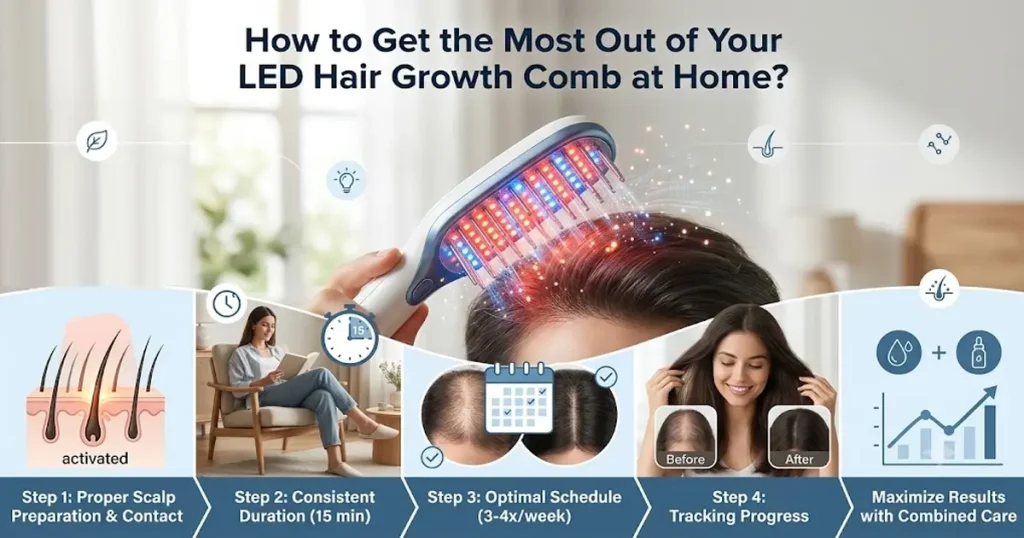
What Is an LED Hair Growth Comb and How Does It Work?
An LED hair growth comb is a handheld device that delivers low-level light therapy (LLLT) directly to the scalp through LED or laser diodes embedded in the comb’s teeth. The mechanism is called photobiomodulation — light energy at specific wavelengths penetrates the scalp and is absorbed by mitochondria in hair follicle cells, stimulating ATP (adenosine triphosphate) production and accelerating cellular activity.
The two most therapeutically relevant wavelengths are:
- Red light (630–660 nm): Penetrates 2–3 mm into scalp tissue. Stimulates follicle stem cells, increases blood microcirculation, and extends the anagen (active growth) phase of the hair cycle. Clinical studies show measurable increase in hair density after 16–26 weeks of consistent use at this range.
- Near-infrared (820–850 nm): Penetrates up to 5 mm, reaching the dermal papilla. Reduces scalp inflammation and supports follicle recovery in cases of androgenetic alopecia.
A common mistake I see is assuming that higher power output always equals better results. For LLLT, the therapeutic window is narrow: energy density between 1–4 J/cm² per session is optimal. Exceeding this through overuse doesn’t accelerate growth — it can actually inhibit follicle activity, a phenomenon called biphasic dose response.
The Right Technique: How to Use Your LED Comb Correctly
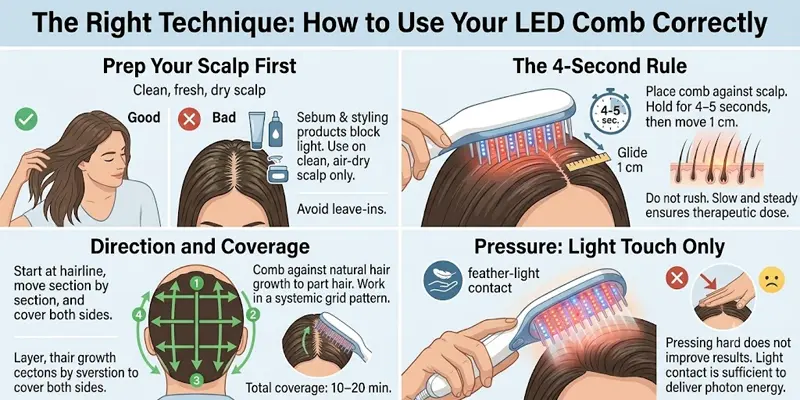
Prep Your Scalp First
Always use your LED comb on a clean, dry scalp. Sebum buildup, styling products, and heavy oils scatter light before it reaches the follicle. Wash your hair and let it air-dry completely — or blow-dry on a cool setting — before starting your session. Even a thin layer of leave-in conditioner can reduce light penetration by up to 30%.
The 4-Second Rule
Place the comb flat against the scalp (not the hair shafts), hold it on one spot for 4–5 seconds, then glide it approximately 1 cm (half an inch) to the next position. Moving too quickly is the single biggest technique error — it means each follicle receives a fraction of the therapeutic dose.
Direction and Coverage
Comb against your natural hair growth direction. This parts the hair and exposes the scalp directly to the LEDs, rather than letting hair block the light. Work in a systematic grid pattern:
- Start at the front hairline
- Move section by section toward the crown
- Work from the crown down to the nape
- Cover both sides (temples to ears)
Total coverage takes 10–20 minutes depending on scalp size and the degree of thinning.
Pressure: Light Touch Only
The LEDs deliver photon energy — physical pressure does nothing to enhance this. Pressing hard doesn’t improve results and can cause scalp irritation or discomfort. A feather-light contact is sufficient.
Optimal Frequency and Session Schedule
The most clinically validated protocol for home LLLT devices is 3 sessions per week on non-consecutive days (e.g., Monday / Wednesday / Friday). This spacing allows the follicle’s photobiological response cycle to complete before the next stimulation.
| Schedule | Result |
|---|---|
| Daily use | Diminishing returns; potential inhibitory effect |
| 3x/week (alternating days) | Optimal — validated by most clinical studies |
| 1-2x/week | Insufficient cumulative dose; minimal results |
| Skipping 2+ weeks | Resets early progress; follicle stimulation is cumulative |
Consistency over 4–6 months is non-negotiable. Hair follicles operate on a cycle of 3–6 months, so expecting visible results in 4–6 weeks is a common source of early abandonment. In my experience working with clients on hair restoration protocols, the ones who quit at 8 weeks are often the ones who would have seen significant improvement by week 20.
Dual-Light Therapy: Red + Blue LED — When to Use Each

Many advanced LED combs now include blue light (415–450 nm) alongside red. Each wavelength serves a distinct purpose:
Red LED (630–660 nm):
- Primary hair growth stimulator
- Increases follicle blood supply
- Reduces DHT-related inflammation at the follicle level
- Best for thinning, shedding, and androgenetic alopecia
Blue LED (415–450 nm):
- Targets Cutibacterium acnes bacteria on the scalp
- Regulates sebum production
- Reduces scalp itchiness, dandruff, and folliculitis (inflamed follicles)
- Best used when scalp health is compromised before focusing on growth
For most users, the protocol is: blue light first (if scalp is oily, irritated, or flaky) → heal the scalp environment → red light consistently for growth stimulation. Running both in the same session is fine if your device supports it.
Recommended Product: NICEMAY MF-2611 Laser Hair Growth Comb
For a device that genuinely delivers on the science above, the NICEMAY MF-2611 Laser Hair Growth Comb is one of the most well-specified options in its category. It combines laser diodes with LED light, covers both the red and blue wavelength spectrum, and includes a massage mode with vibration to enhance scalp microcirculation — compounding the photobiomodulation effect mechanically.
Key specs worth noting:
- Dual-mode operation: laser + LED for broader coverage
- Integrated vibration massage to boost blood flow during sessions
- Ergonomic handle designed for the systematic grid technique described above
- Easy-clean bristle design for low-maintenance weekly upkeep
If you’re serious about optimizing your at-home LLLT routine, having a device with both laser diodes and LEDs in one unit gives you more consistent energy output per session than LED-only combs.
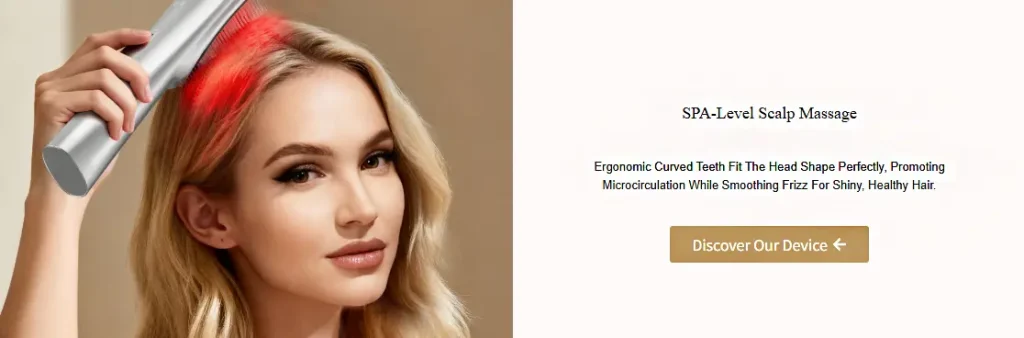
Pairing LED Therapy with Scalp Serums for Amplified Results
Light therapy and topical actives work on complementary pathways — combining them intelligently can meaningfully accelerate results.
What to apply and when:
- Before your session: A lightweight, water-based scalp serum with niacinamide or peptides primes the follicle environment without blocking light. Avoid heavy oils immediately before use.
- After your session: This is the optimal window. Post-LLLT, scalp microcirculation is elevated and follicle cell membranes are temporarily more permeable. Apply:
- Minoxidil (2–5%): If you’re using it, post-LED application may enhance absorption via increased blood flow.
- Caffeine serums: Shown in studies to inhibit DHT at the follicle level and extend the anagen phase.
- Biotin + Keratin serums: Support structural protein synthesis already stimulated by red light.
One clear failure mode: using thick pomades or scalp oils before your LED session. These physically obstruct the light path and leave follicles under-dosed. Always sequence your routine with light therapy first, serums second.
How to Build a Sustainable At-Home Routine?
A 10–20 minute session three times a week sounds manageable — but it’s easy to skip when life gets busy. Habit stacking is the most reliable strategy:
- Morning routine: Use your LED comb while listening to a podcast or during your first coffee
- Evening routine: Pair with a skincare routine — your face mask or moisturizer application time maps well to a 15-minute scalp session
- Weekend ritual: Stack with a scalp massage or hair mask treatment on Saturdays
Set a recurring reminder in your phone labeled “Hair Session” rather than relying on memory. The data is consistent: users who complete 90%+ of their scheduled sessions in the first 3 months are significantly more likely to report visible results by month 5–6.
Device Maintenance: What Most Users Neglect
Dirty LED combs deliver compromised results. Sebum, dead skin cells, and product residue accumulate on the diodes and reduce effective light output — sometimes by a measurable margin within just a few weeks of use.
Weekly cleaning protocol:
- Turn the device off and unplug
- Wipe the LED teeth and bristles with a cotton swab dampened with 70% isopropyl alcohol
- Allow to air-dry completely before next use (minimum 10 minutes)
- Never submerge in water — moisture in the handle will short-circuit the electronics
Storage: Keep the comb in its case or pouch, away from humidity (avoid bathroom cabinet long-term storage if your bathroom has poor ventilation).
Battery and cord care: Don’t leave the device plugged in overnight repeatedly — lithium batteries in these devices degrade faster with chronic overcharging.
LED Hair Growth Comb vs. Laser Cap — Which Gives Better Results?
If you’re weighing whether a comb is the right format for your needs, this comparison matters. For a full breakdown, read our guide on LED Hair Growth Caps vs Combs – Which Works Better in 2026.
The short version:
| Factor | LED/Laser Comb | LED/Laser Cap |
|---|---|---|
| Coverage per session | Targeted, requires active use | |
| Follicle contact precision | High (direct scalp contact) | Variable (depends on cap fit) |
| Session effort | Active (10–20 min combing) | Passive (wear and wait) |
| Portability | High | Moderate |
| Best for | Spot treatment, targeted thinning | Diffuse thinning, full scalp loss |
| Price range | $50–$300 | $200–$900+ |
For localized thinning (crown, hairline, temples), a precision comb like the NICEMAY MF-2611 often outperforms a cap because it delivers more concentrated light dose directly to the affected zones.
Realistic Results Timeline: What to Expect Month by Month
| Month | What’s Happening | What You May Notice |
|---|---|---|
| 1-2 | Follicle stimulation begins; DHT inflammation reduces | Possible initial shedding (normal); scalp feels healthier |
| 3-4 | Anagen phase extension underway; new follicles activating | Fine vellus hairs appear in thinning areas |
| 5-6 | Terminal hair thickening; density increase | Visible improvement in hair fullness and coverage |
| 7-12 | Continued consolidation | Sustained results with ongoing maintenance use |
Initial shedding in months 1–2 alarms most users. This is actually a positive sign — existing weak hairs are displaced by stronger incoming growth. It’s analogous to the purging phase in skincare. Do not stop.
- The Top 10 Best Ultrasonic Facial Cleansers of 2026 — If you’re investing in scalp health, a complete beauty routine matters. Our facial cleanser guide covers the best devices for complementary skin and pore care.
- The Top 10 LED Hair Growth Caps vs Combs – Which Works Better in 2026 — A head-to-head comparison to help you decide which format suits your hair loss pattern and lifestyle.
FAQs About How to Get the Most Out of Your LED Hair Growth Comb at Home
How long before I see results from my LED hair growth comb?
Can I use my LED comb every day to get faster results?
Can I use an LED comb on wet hair?
Is an LED hair growth comb safe for color-treated or chemically processed hair?
How do I know if my LED comb is actually working?

Please fill in your email in the form and we’ll get back to assist you soon!