


自宅用美容機器とサロンでのトリートメント:コストと結果 2026

At-home beauty devices have become remarkably sophisticated—but do they actually rival professional salon treatments? The short answer: it depends on your goals, skin concerns, and budget. For consistent maintenance and gradual improvement, today’s consumer-grade devices deliver genuine results. For accelerated, clinically significant outcomes, professional-grade salon treatments remain the benchmark. Understanding precisely where each excels—and where it falls short—can save you both money and disappointment.
その global home beauty device market is projected to surpass $100 billion by 2028, fueled by advances in radiofrequency, LED phototherapy, IPL, and ultrasound technology. Yet the proliferation of options has made it harder than ever to cut through marketing claims and make an informed decision. This guide offers a rigorous, treatment-by-treatment comparison so you can build a routine that genuinely works.

How At-Home Beauty Devices vs Salon Treatments Differ at the Core
Before evaluating individual treatments, it helps to understand the fundamental engineering difference between consumer and professional devices. Regulatory bodies in most markets—including the FDA in the United States and CE in the European Union—require that consumer devices operate well below the energy thresholds approved for clinical settings. This is a safety measure, not a marketing distinction.
Professional devices deliver higher fluence (energy density), operate at frequencies or wavelengths calibrated to specific tissue depths, and are paired with clinician expertise to adjust parameters in real time. At-home devices are designed to be safe across a wide range of untrained users, which inherently limits their ceiling. That said, the gap has narrowed considerably in the past five years—particularly in LED therapy and certain radiofrequency platforms—making the comparison more nuanced than a simple “professional wins” verdict.
At-Home Beauty Devices: Strengths and Limitations
The most compelling argument for at-home devices is cumulative dosing. A salon facial using LED therapy might last 30 minutes; a quality LED mask used four times per week delivers that same total exposure within a few days. For photobiomodulation—where consistent, repeated light exposure drives collagen synthesis and cellular repair—frequency matters as much as intensity. At-home devices win on frequency by a wide margin.
Where at-home devices genuinely perform?
LED light therapy is arguably the strongest category for home use. Devices cleared by the FDA for consumer use emit red (630–700 nm) and near-infrared (800–900 nm) wavelengths that penetrate dermal layers to stimulate fibroblast activity. Clinical studies—including peer-reviewed work published in Seminars in Cutaneous Medicine and Surgery—have confirmed measurable improvements in skin texture and fine lines with consistent at-home protocols of 8–12 weeks.
Microcurrent devices represent another category where home use is well-supported by evidence. When used daily or near-daily, microcurrent stimulates the adenosine triphosphate (ATP) production in facial muscles, producing a toning and lifting effect that accumulates over time. Because the mechanism is cumulative rather than acute, the lower amperage of consumer devices is less of a drawback.
Where at-home devices fall short?
Hair removal is the starkest example of home-device limitation. Consumer IPL (Intense Pulsed Light) devices reduce hair regrowth but rarely achieve the permanent follicle destruction of professional laser systems. Professional Nd:YAG and diode lasers operate at energies and pulse durations tuned to photothermolysis—selectively heating and disabling the follicle while sparing surrounding tissue. Most at-home IPL devices rely on user-selected intensity levels and cannot replicate this precision.
Deep skin resurfacing is similarly out of reach. Professional fractional laser resurfacing (e.g., Fraxel), ablative CO₂ lasers, and medical-grade chemical peels create controlled micro-injuries that trigger significant collagen remodeling. The results—reduction of deep wrinkles, acne scarring, and significant pigmentation—require energy levels that would be unsafe without clinical oversight and post-treatment protocols.

Salon Treatments: What Professional-Grade Actually Means
The word “professional” in aesthetics is not a marketing term—it refers to a specific regulatory and clinical framework. Licensed practitioners operating medical-grade devices are subject to strict training requirements, device calibration standards, and liability frameworks that don’t apply to consumer products. This matters for both safety and efficacy.
The role of clinical assessment in salon outcomes
A significant advantage of salon treatments that is rarely discussed is the pre-treatment skin assessment. A trained aesthetician or dermatologist will evaluate skin type (Fitzpatrick scale), identify contraindications, assess active conditions like rosacea or post-inflammatory hyperpigmentation, and select treatment parameters accordingly. At-home devices cannot perform this assessment—and incorrect use on certain skin conditions can cause adverse reactions, including post-inflammatory hyperpigmentation on darker skin tones using high-intensity IPL.
Cost per session vs. cost per result
Salon treatments appear expensive on a per-session basis—professional laser hair removal runs $150–$400 per session, and a series of 6–8 sessions is typically required. However, when measured as cost-per-permanent-result, professional laser hair removal frequently outperforms the cumulative cost of at-home IPL devices plus replacement cartridges over five or more years of continuous use. The calculus shifts depending on the treatment area, skin and hair type, and the specific device being compared.
Treatment-by-Treatment Comparison: At-Home Devices vs Professional Salon Results
| 治療 | 家庭用デバイス | Salon/Professional | 結論 |
|---|---|---|---|
| Hair removal | IPL reduces regrowth; requires ongoing use; not effective on all skin/hair types | Laser (Nd:YAG, diode, alexandrite) achieves permanent reduction; clinician-adjusted parameters | Salon for permanent results; IPL for maintenance |
| LED光線療法 | Strong category; frequent use compensates for lower fluence; peer-reviewed evidence supports results | Higher-intensity panels; often combined with other modalities in one session | At-home competitive with consistent use |
| Radiofrequency skin tightening | Effective for maintenance; gradual collagen stimulation; multipolar RF devices closing gap | Monopolar RF (Thermage), HIFU (Ultherapy); single-session results; deeper tissue penetration | Salon for significant laxity; at-home for prevention |
| Microcurrent facial toning | Daily use delivers cumulative ATP stimulation; well-documented for toning | Higher amperage; often combined with serums; immediate visible lift | At-home viable; salon for visible event-day results |
| Chemical exfoliation / peels | OTC acids (AHAs, BHAs) at safe concentrations; surface-level improvement | TCA, phenol, glycolic at clinical concentrations; controlled dermal penetration | Salon for deep resurfacing and scarring |
| Ultrasound / HIFU | Consumer HIFU emerging; limited evidence; minimal depth penetration | Ultherapy reaches SMAS layer; clinical outcomes for significant lifting | Salon significantly superior |
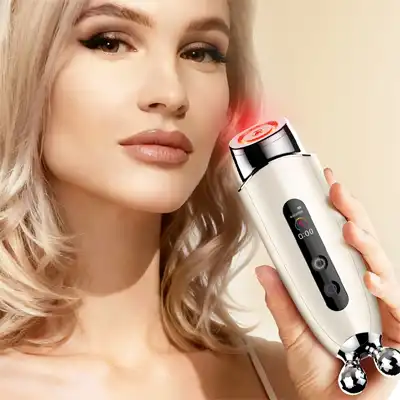
MR-2590

MR-2319

MR-2310
Radiofrequency and LED: The Case for Combining Devices
Many users find that the most effective home routine combines multiple modalities—radiofrequency for deep collagen stimulation, LED for surface healing and inflammation reduction, and microcurrent for muscle toning. This has driven the growth of multi-function home beauty platforms that attempt to consolidate these technologies into a single device. If you’re evaluating whether an all-in-one approach makes sense for your needs, our in-depth analysis of 6-in-1マルチデバイス対シングルRF/LED:オールインワンは価値があるのか? breaks down the engineering tradeoffs, performance data, and which configurations actually justify the higher price point.
Safety Considerations When Choosing Between At-Home and Salon Treatments
Safety is not a binary between “dangerous salon lasers” and “harmless home devices.” Both categories carry risks—the difference is the mitigation framework. Salon environments require trained practitioners to identify contraindications and adjust treatment protocols in response to patient feedback. At-home devices must be safe in the hands of someone with no training, which means their safety limits are set conservatively by design.
Skin type and at-home device risk
The Fitzpatrick scale, which classifies skin from Type I (very fair) to Type VI (very dark), is central to IPL and laser safety. At-home IPL devices are generally safe for Fitzpatrick Types I–IV but carry a meaningful risk of post-inflammatory hyperpigmentation and burns on Types V–VI. This is because the melanin concentration in darker skin tones absorbs IPL energy more broadly, making selective follicle targeting difficult without clinical precision. Many consumer devices include skin tone sensors, but these are a risk-reduction measure, not an elimination of risk.
Conditions that require professional assessment before home device use
Active acne with open lesions, rosacea in a flare state, perioral dermatitis, and melasma all warrant consultation with a dermatologist before beginning any energy-based home device protocol. Photosensitizing medications (including certain antibiotics, retinoids, and antidepressants) also affect device safety thresholds. When in doubt, a single consultation with a licensed aesthetician or dermatologist is worth far more than the cost of a misused device.
The hidden cost of unsupervised treatment
Adverse outcomes from improperly used at-home devices—burns, scarring, and hyperpigmentation—often require professional corrective treatment that costs significantly more than the original salon treatment would have. This is not an argument against home devices; it is an argument for using them with appropriate knowledge of your skin type, the device’s parameters, and any contraindications relevant to your health profile.

Building a Hybrid Beauty Routine: At-Home Devices and Salon Treatments Together
The most sophisticated approach to modern beauty routines is not a binary choice between at-home and salon—it is a strategic layering of both. This hybrid model treats salon visits as the foundation and periodical resets, while at-home devices maintain, extend, and build upon those results between appointments.
The maintenance model: extending salon results at home
Professional treatments like Thermage RF, Ultherapy HIFU, and fractional laser resurfacing create acute biological responses—significant collagen remodeling events that unfold over weeks and months. The results from these treatments can be meaningfully extended with consistent at-home maintenance. LED therapy used post-laser, for example, has been shown to reduce downtime and accelerate healing. Microcurrent used between professional facial appointments maintains the muscle toning effect. Used this way, at-home devices amplify the ROI of salon investments.
Recommended hybrid approach by treatment goal
Anti-aging and skin laxity: One annual Ultherapy or Thermage session paired with daily at-home RF and three-times-weekly LED therapy. Hyperpigmentation: 一連のプロフェッショナルな化学ピーリングまたはレーザーセッションの後、毎日の赤色LEDメンテナンスと一貫した広域スペクトルのSPFを行います。. 脱毛: 永久的な減少のためのフルプロフェッショナルレーザーシリーズの後、敏感または手の届きにくい部位の偶発的な再生管理のために自宅でのIPLを使用します。.
サロンの治療計画に合った自宅用デバイスの選択
自宅用デバイスを購入する前に、補完または置き換えるプロフェッショナルな治療が何であるかを知っておくと役立ちます。四半期ごとにプロフェッショナルなRFボディトリートメントに投資する消費者は、自宅でのプロトコルを主なスキンケア介入として使用する人とは異なるデバイスのニーズがあります。マルチ機能デバイスとカテゴリ特化型ツールのどちらが特定の目標に対してより良い投資であるかを判断しようとしている場合、私たちのガイドにある詳細な比較が役立ちます。 2026年のマルチ機能ホームビューティーデバイス対単機能:オールインワンまたは専門化? デバイスの構造をスキンケアの目標に合わせるためのフレームワークを提供します。.
最終的な結論:2026年の自宅用ビューティーデバイス対サロン治療
自宅用ビューティーデバイスを支える技術は劇的に進歩しましたが、消費者とプロフェッショナルグレードの機器の間の臨床的ギャップは埋まっていません。それは単により微妙になっただけです。LED療法とマイクロカレントは、裏付けのある正当な自宅用治療です。IPL、RF、および超音波の自宅用デバイスは、サロンの同等品よりも実際には控えめな結果をもたらします。永久脱毛、重要な肌の再生、複雑な状態の治療は、依然としてプロフェッショナルの領域にしっかりと留まっています。.
FAQ:自宅用ビューティーデバイス対サロン治療
治療サイクルの途中で自宅用機器とサロンでのトリートメントを切り替えることはできますか、それとも一つのアプローチにコミットする必要がありますか?
自宅用美容デバイスが投資する価値があるかどうか、十分な臨床証拠があるかをどうやって知ることができますか?
自宅用美容デバイスが、LEDのような低強度の治療でさえも永久に不適切にする皮膚の状態はありますか?
自宅でレチノールやAHAのような強力なアクティブスキンケア成分を使用すると、プロのサロンでのトリートメントの効果は失われますか?
医療スパで行われるプロフェッショナルな治療と標準的な美容サロンで行われる治療の結果に意味のある違いはありますか?
フォームにメールアドレスを入力してください。すぐにお手伝いします!