


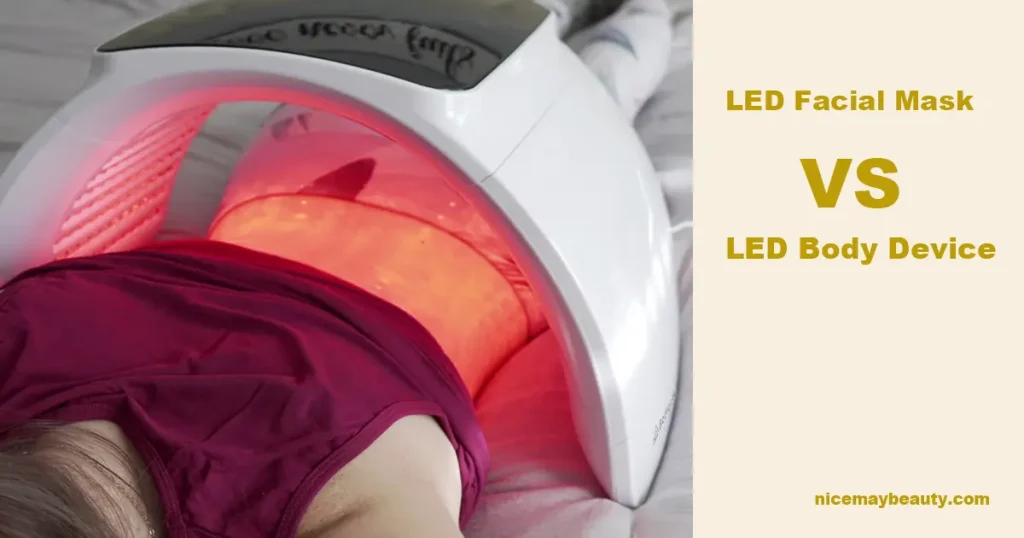
LED Facial Mask vs LED Body Device: Which One Do You Actually Need?

LED facial masks and LED body devices share the same core technology — light-emitting diodes that deliver therapeutic wavelengths to your skin — but they are engineered for fundamentally different purposes. A facial mask prioritizes precision coverage and gentle, daily-use intensity for aesthetic concerns like fine lines and acne. A body device (panel, pad, or mat) prioritizes raw power density and surface area for musculoskeletal recovery, pain management, and deeper tissue stimulation. Choosing the wrong category won’t just limit your results — it could mean significantly overpaying for a device that doesn’t address your actual goals.
The LED light therapy market has exploded in recent years, and the terminology hasn’t kept pace. Consumers routinely compare products from entirely different performance tiers as if they were equivalent, which leads to mismatched expectations and wasted money. This guide breaks down exactly how each device category is built, what the clinical science supports, and which one — or which combination — belongs in your routine.
How LED Light Therapy Works: The Shared Science Behind Both Devices?
All photobiomodulation (PBM) devices — the technical umbrella term for LED therapy — operate on the same biological principle: specific wavelengths of light penetrate tissue and are absorbed by chromophores in your cells, particularly cytochrome c oxidase in the mitochondria. This absorption triggers a cascade of cellular responses including increased ATP production, reduced oxidative stress, and modulated inflammatory signaling.
The differences between a facial mask and a body panel are not about whether the light “works.” They are about irradiance (power density), wavelength selection, treatment area geometry, and total energy dose (fluence) — all of which determine what outcomes the device can realistically produce.
The Key Wavelengths and What They Target
| 波長 | COLOR | 浸透深度 | PRIMARY APPLICATION |
|---|---|---|---|
| 415–420 nm | 青 | Epidermis (~1 mm) | Acne-causing bacteria (P. acnes) |
| 630~660 nm | 赤 | Dermis (3–5 mm) | Collagen synthesis, wound healing |
| 810–850 nm | Near-infrared | Subcutaneous / muscle (5–10+ mm) | Inflammation, joint pain, circulation |
| 940–1000 nm | Deep NIR | Deep tissue / bone (10–20 mm) | Neuropathy, deep musculoskeletal recovery |
Facial masks typically center on 630–660 nm red and 415–420 nm blue. Higher-end models add 830 nm near-infrared (NIR). Body panels commonly feature 660 nm and 850 nm as their primary wavelength pair, with some clinical-grade panels adding 810 nm, 940 nm, or even 1064 nm for deeper penetration. This wavelength hierarchy alone signals a meaningful difference in therapeutic intent.

LED Facial Masks: Precision Skincare in a Hands-Free Format
LED facial masks are purpose-built for the face — a topographically complex, high-visibility surface where consistent, uniform coverage matters enormously. Their ergonomic design ensures every zone of the face receives comparable light exposure, something that is genuinely difficult to achieve with a flat panel held at varying distances.
Design and Performance Characteristics of LED Facial Masks
Power Density (Irradiance)
Consumer LED facial masks typically deliver 5–30 mW/cm² at the skin surface. This is intentionally moderate — dense LED arrays in rigid or flexible masks sit within a few millimeters of the skin, meaning even lower irradiance can accumulate adequate fluence over a 10–20 minute session. The skin around the eyes is especially sensitive, and responsible mask design accounts for this with lower-density emitters near periorbital areas.
Wavelength Coverage and Multi-Mode Functionality
Entry-level masks typically offer red and blue. Mid-range masks add NIR and sometimes yellow (590 nm, used for hyperpigmentation and redness) or cyan (520 nm). Professional-grade home masks increasingly mirror clinical LED panels, offering five or more discrete wavelengths in a single ergonomic shell — a significant convenience advantage over dedicated body panels, which often require separate accessories to treat the face safely.
Treatment Consistency and User Compliance
Photobiomodulation outcomes are cumulative and dose-dependent. The primary predictor of results is consistency. A mask that you wear hands-free while reading or watching a screen will realistically produce better long-term outcomes than a more powerful device you use sporadically because of setup friction. This ergonomic convenience factor is often underweighted in clinical comparisons.
Best Candidates for an LED Facial Mask
An LED facial mask is the right primary device if your core concerns are facial anti-aging (fine lines, skin laxity, uneven texture), active acne, post-inflammatory hyperpigmentation, or general facial skin health. It is also the pragmatic choice for anyone whose schedule demands a low-friction, set-and-forget protocol.

LED Body Devices (Panels, Pads & Mats): Clinical Power for the Whole Body
LED body devices encompass a wide range of form factors — rigid panels, flexible silicone pads, wrap-around mats, and modular arrays — but they share a common design philosophy: maximize irradiance and treatment area. These devices are frequently benchmarked against research-grade photobiomodulation equipment and, at the premium end, can approach clinical parameters.
Design and Performance Characteristics of LED Body Devices
Power Density and Total Output
Quality body panels deliver 50–250+ mW/cm² at 6 inches — up to 10–50 times the irradiance of most facial masks. This power density is what makes LED body panels viable for outcomes that require deep tissue penetration: joint inflammation, muscle soreness, peripheral neuropathy, and post-exercise recovery. Lower-wattage panels marketed as “starter” body devices (under 100W total system power) should be evaluated carefully; irradiance drops significantly with distance, and cheap panels frequently misrepresent their actual output.
Treatment Area Coverage
A full-size body panel (typically 12″×36″ to 12″×60″) can treat a lumbar region, both shoulders, or upper and lower back in a single session. Flexible body pads wrap joints or limbs for targeted treatment. For individuals managing chronic pain, post-surgical recovery, or training load, this coverage area is simply not replicable with a facial device.
Wavelength Range and Tissue Depth
Body panels designed for musculoskeletal applications prioritize 660 nm and 850 nm — the most evidence-supported wavelengths for pain and recovery. Premium panels add 810 nm for nerve-adjacent tissue, and some include 940 nm or proprietary deep-NIR emitters for bone-adjacent applications. The physiological targets are categorically different from the epidermal and dermal targets of facial skincare.
Best Candidates for an LED Body Device
A body panel or flexible LED pad is the right primary investment for anyone dealing with chronic or acute musculoskeletal pain, active athletes managing recovery, individuals post-surgery or post-injury, or those seeking systemic anti-inflammatory and circulation benefits. It also serves as an effective full-body skin health and collagen tool for non-facial areas — chest, neck, hands, décolletage — that are high-visibility aging zones often neglected in skincare routines.

LED Facial Mask vs LED Body Device: Head-to-Head Comparison
| CATEGORY | LED FACIAL MASK | LED BODY DEVICE |
|---|---|---|
| 照度 | 5–30 mW/cm² | 50–250+ mW/cm² |
| 主な波長 | Red (630–660 nm), Blue (415 nm), NIR (830 nm) | Red (660 nm), NIR (850 nm), Deep NIR (940 nm) |
| Target tissue depth | Epidermis to upper dermis (1–5 mm) | Dermis to muscle/joint (5–20+ mm) |
| 治療エリア | Face only (~300–500 cm²) | Large body regions (1,000–5,000+ cm²) |
| Primary use cases | Anti-aging, acne, hyperpigmentation | Pain relief, recovery, inflammation, skin |
| Session setup | Minimal (wear and forget) | Moderate (positioning, distance, timer) |
| 価格帯 | $100–$800+ | $200–$2,500+ |
| 携帯性 | High — pocket/travel-friendly | Low to moderate — panel or mat format |
Making the Right Choice: Which LED Device Fits Your Goals?
The simplest way to decide is to anchor your choice to your primary complaint, not to device form factor or price point.
- If your goal is Facial anti-aging or acne → LEDフェイシャルマスク
- If your goal is Daily, low maintenance skincare → LEDフェイシャルマスク
- If your goal is Décolletage or neck skin → LED Body Device
- If your goal is Muscle pain or joint recovery → LED Body Panel
- If your goal is Full-body wellness and inflammation → LED Body Device
- If your goal isTravel-friendly skincare → LEDフェイシャルマスク
Can You Use Both? Stacking LED Facial Masks and Body Devices
Yes — and for serious users, both categories are genuinely complementary rather than redundant. A body panel’s high irradiance makes it excellent for neck, chest, and upper back (common sites of postural tension and aging skin). A facial mask handles the contoured geometry of the face more efficiently than any flat panel. Used in combination, they cover fundamentally different anatomical zones with optimized tools for each.
The question of whether to stack devices — or whether an all-in-one approach makes more economic sense — is one that comes up repeatedly in the home beauty device market. If you’re considering consolidating your routine, it’s worth reading our in-depth analysis of 6-in-1マルチデバイス対シングルRF/LED:オールインワンは価値があるのか?, which examines whether multi-function home beauty devices can match the clinical output of dedicated tools across RF, LED, EMS, and more.

MR-2308ヌード

MR-2322

MR-2308
Why Power Density Matters More Than LED Count?
One of the most common misconceptions in the LED therapy market is that more LEDs equals better results. Manufacturers exploit this by advertising bulb counts (300 LEDs! 500 LEDs!) without disclosing their wattage rating, beam angle, or measured irradiance. A device with 500 low-power SMD LEDs can easily under-perform a device with 100 high-power diodes in terms of actual therapeutic output.
What to Look for on a Spec Sheet?
When comparing any LED device — mask or body panel — prioritize these three metrics over marketing language:
1. Irradiance at the skin surface (mW/cm²): For facial masks, look for a measured value at contact or within 1 cm. For body panels, look for irradiance measured at 6 inches (the typical treatment distance). Third-party testing data is more reliable than manufacturer claims.
2. Wavelength specificity (nm): A device that claims “red light” without specifying nanometers is concealing something. Effective wavelengths for collagen are 630–660 nm; for deep recovery, 850 nm. Vague claims like “warm red” or “therapeutic light” are red flags.
3. Treatment time to therapeutic dose: Adequate fluence for photobiomodulation starts around 3–10 J/cm² for most skincare applications and 10–60 J/cm² for deeper tissue. A low-irradiance mask can still hit adequate dose — it just takes longer. Transparency about session time requirements is a sign of an honest manufacturer.
Clinical LED panels used in dermatology and physiotherapy typically operate at 100–250 mW/cm² with sessions of 5–20 minutes. Consumer body panels can now reach this range. Most consumer facial masks operate at 5–30 mW/cm², requiring longer sessions to accumulate equivalent fluence — this is not a flaw, but it does define the ceiling of achievable outcomes.
Single-Function LED Devices vs Multi-Function Beauty Tools: Knowing the Trade-offs
As both LED facial masks and body panels have become more sophisticated, they are increasingly offered alongside multi-function devices that combine LED with radiofrequency (RF), microcurrent, ultrasonic, or EMS technologies. For some users — particularly those managing a comprehensive anti-aging or recovery protocol — this raises a legitimate question about whether device consolidation offers real value.
The honest answer is nuanced. Dedicated LED devices win on depth of function within their category: a standalone body panel will outperform the LED component of a multi-function device that also includes RF and EMS. However, multi-function devices can offer meaningful convenience for users whose goals are broad and whose priority is a streamlined toolkit. For a thorough breakdown of when the all-in-one approach outperforms specialized devices — and when it doesn’t — our guide on 2026年のマルチ機能ホームビューティーデバイス対単機能:オールインワンまたは専門化? covers the evidence across device categories in depth.
Safety, Frequency, and Getting the Most from Either Device
General Safety Considerations for LED Light Therapy
LED therapy at consumer device intensities has an excellent safety profile compared to other energy-based skin treatments. There is no thermal injury risk at typical consumer power densities, and unlike UV light, photobiomodulation wavelengths do not damage DNA or trigger photocarcinogenesis. The main safety precautions are:
目の保護: All LED devices — including facial masks — should include appropriate occlusion for the eyes. NIR wavelengths are invisible and can accumulate retinal dose without the blink reflex being triggered. Quality facial masks include opaque or specialized eye covers; body panels should never be directed at the eyes.
Photosensitizing medications: Certain medications (some antibiotics, retinoids, NSAIDs) can increase photosensitivity. Consult your prescribing physician before beginning any LED therapy protocol if you are on photosensitizing drugs.
Active malignancy: LED therapy should not be used directly over known or suspected malignant tissue without oncological guidance.
Optimal Usage Frequency for LED Facial Masks
Most clinical protocols and device manufacturers recommend 週に3〜5回 for facial LED therapy during an initial 8–12 week protocol, followed by 2–3 maintenance sessions per week. Daily use at low irradiance (under 20 mW/cm²) is generally considered safe for healthy skin. Results from anti-aging protocols typically become measurable at 8–12 weeks with consistent use.
Optimal Usage Frequency for LED Body Devices
For musculoskeletal applications, LED body panels are typically used once or twice daily for acute injury or pain, with session durations of 10–20 minutes per area. Chronic pain management protocols often settle at 3–5 sessions per week. Post-exercise recovery sessions are most effective within 2–4 hours following training. At clinical irradiance levels (100+ mW/cm²), daily use for extended periods should be monitored; some users experience diminishing returns with excessive frequency, a phenomenon called biphasic dose response.
FAQs About LED Facial Mask vs LED Body Device
Can an LED facial mask be used on the neck, chest, and décolletage?
Technically yes — there is no physiological reason LED light applied via a facial mask would harm the neck or upper chest. However, ergonomic design makes off-face use impractical. Rigid masks are contoured for facial geometry and sit poorly against flat or curved body surfaces, resulting in uneven LED-to-skin contact distance and inconsistent irradiance across the treatment area.
More importantly, the neck, chest, and décolletage are high-priority aging zones with significantly more surface area than the face. A facial mask covers roughly 300–500 cm² optimally; the décolletage alone can exceed that. Treating these areas with a facial mask means multiple repositioning steps, incomplete coverage, and substantially longer session times — often making it impractical for regular use.
How long does it take to see results from an LED facial mask vs an LED body panel?
The timeline differs significantly between these two device categories — not because of device quality, but because the underlying biological processes they stimulate operate on different timescales.
LED facial masks for anti-aging: Collagen remodeling is a slow process. Clinical studies consistently show measurable improvements in skin texture, fine lines, and firmness beginning at 8~12週間 of regular use (3–5 sessions per week). Acne reduction can appear faster — some users report fewer active breakouts within 2–4 weeks — because the anti-bacterial mechanism of blue light is more immediate than collagen synthesis.
LED body panels for pain and recovery: Acute pain relief and post-exercise muscle recovery can show effects within 24〜72時間 of treatment, which is why athletes commonly use them immediately following training. Chronic pain or inflammation management typically requires 3–6 weeks of consistent use before cumulative benefits become sustained rather than session-dependent.
Is LED light therapy safe during pregnancy — does it matter which device you use?
This is one of the most searched questions in the LED therapy space, and it deserves a careful answer. LED light therapy does not use ionizing radiation, UV light, or significant thermal energy — the mechanisms that create known fetal risk with other energy-based treatments. At the wavelengths and intensities used in consumer devices, there is no established evidence of harm to pregnancy.
However, the distinction between device types does matter in this context. LEDは、 used during pregnancy carry minimal theoretical concern — the light is applied superficially to the face and does not penetrate systemically. The primary precaution is avoiding any device that also uses radiofrequency, microcurrent, or thermal energy, which carry clearer contraindications.
LED body panels present a more nuanced situation. High-irradiance panels applied directly over the abdomen are generally contraindicated during pregnancy — not because of documented harm from the light itself, but because: (1) sufficient human safety data does not exist for direct abdominal application at high irradiance, and (2) the biological effects of photobiomodulation on developing tissue are understudied. Use on the back, limbs, or neck is typically discussed as lower risk.
Can you use retinol or vitamin C serum before using an LED facial mask or body device?
This is a high-frequency question because many people use LED therapy as part of a broader skincare stack alongside active ingredients, and the sequencing genuinely matters.
Retinol before LED facial mask: Proceed with caution. Retinol (and its prescription-strength derivatives like tretinoin) increases photosensitivity. While LED devices do not emit UV radiation — the primary concern with retinol-sensitized skin — there is still the potential for heightened irritation or erythema when combining retinoids with concentrated visible/NIR light. Most dermatologists recommend using retinol in the evening after LED therapy, or on alternating nights, rather than immediately before a session.
Vitamin C (L-ascorbic acid) before LED therapy: This combination is generally considered synergistic rather than contraindicated. LED-stimulated collagen production and vitamin C’s role as a co-factor in collagen synthesis make this a logical pairing. Apply a stable vitamin C serum, allow it to absorb, then proceed with your mask. The combination may enhance overall brightening and anti-aging outcomes.
For body devices: The same principles apply to any topical applied over the treatment area. Avoid photosensitizing topicals (some AHAs, retinoids, certain herbal extracts) directly on skin prior to high-irradiance body panel treatment.
Do LED facial masks or body devices actually work for darker skin tones?
Yes — with important nuance that the LED therapy industry has historically underaddressed. Photobiomodulation works by stimulating mitochondrial activity in cells, a process that occurs across all skin types. The underlying biology is not melanin-dependent.
However, melanin does absorb some wavelengths of visible light — particularly in the 400–600 nm range. This means darker skin tones (Fitzpatrick IV–VI) may absorb a slightly higher proportion of red light in the epidermal melanocytes before it reaches the dermis, potentially reducing the effective dose to deeper target tissue. In practice, this effect is more relevant at clinical irradiance levels and tends to be negligible for consumer-grade LED masks operating in the red spectrum.
Near-infrared wavelengths (810–850 nm) are absorbed far less by melanin and penetrate tissue more uniformly across skin tones. This is one reason NIR-dominant body panels may perform more consistently across Fitzpatrick types for deep-tissue applications — and one reason to prioritize devices with strong NIR output if you have a deeper skin tone and are primarily targeting pain or recovery goals.
For facial use, the more meaningful concern is whether the device was clinically tested on diverse skin tones. Many published LED therapy efficacy studies have predominantly white study populations, which limits generalizability. Brands that specifically publish multi-Fitzpatrick data deserve credibility points for this transparency.

フォームにメールアドレスを入力してください。すぐにお手伝いします!