


主要なOEMサプライヤーが推奨するサンプル承認プロセスは何ですか?

The beauty device sample approval process is a pivotal stage in beauty device OEM partnerships. It’s not merely a formality but a commercial risk control system that ensures prototypes meet exact specifications for function, safety, aesthetics, and compliance before full production. Leading suppliers recommend a structured, multi-phase approach that minimizes revisions, accelerates timelines, and reduces risks of costly changes later. This process protects importers, distributors, and private-label brand owners from mismatches that could delay launches or erode margins. In the personal beauty instrument sector—covering EMS, RF, and microcurrent facial tools—this process bridges design intent with manufacturable reality.
Industry leaders like those adhering to ISO 13485 quality systems emphasize iterative, documented approvals involving clear criteria, objective testing, and timely feedback. A well-executed process can cut development time by 20-30% and prevent up to 80% of post-production issues, based on best practices from OEM manufacturing guides. This article outlines the recommended stages, key checkpoints, common pitfalls, and practical strategies to implement an efficient approval workflow.
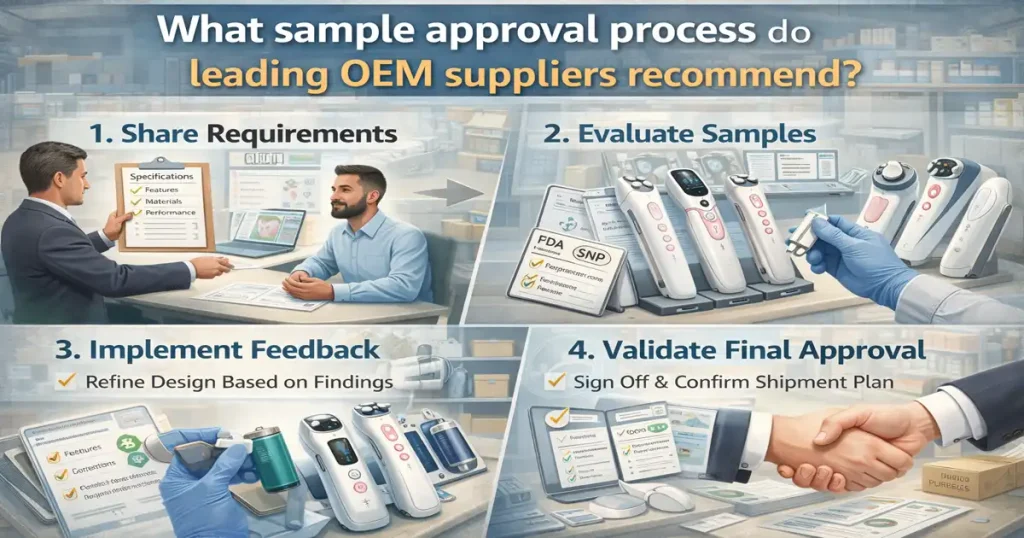
Why a Robust Beauty Device Sample Approval Process Matters
Beauty device sample approval goes beyond simple “yes/no” decisions—it validates that prototypes align with technical drawings, regulatory needs, and market expectations. It is a critical decision point because problems discovered after mass production are rarely minor. Common consequences include:
- Regulatory rejection due to undocumented changes
- Inconsistent performance between approved beauty device samples and bulk units
- User complaints caused by overlooked ergonomic or firmware issues
- Cost overruns from repeated tooling or component replacement
For premium facial lifting devices, where precision in electrode placement or material feel directly impacts efficacy and user satisfaction, skipping rigorous checks risks field failures or returns. Leading OEM suppliers therefore position beauty device sample approval as a cross-functional validation step, not merely a visual or functional check.
Effective processes foster trust between buyers and suppliers, streamline scaling, and support regulatory submissions. Early alignment on beauty device samples also informs logistics planning—details in “美容リフティングデバイスの輸入障壁を減らす物流戦略は何か? “—and ensures documentation readiness for approvals, as covered in “ 買い手が市場承認のために規制文書を要求すべき時期」をご覧ください。?”. Leading OEM suppliers view this phase as collaborative, incorporating buyer expertise to refine products before committing resources.
Recommended Stages in the Beauty Device Sample Approval Process
Stage 1: Pre-Sample Preparation and Specification Lock (Requirement Lock-In)

This pre-beauty device sample confirmation phase eliminates ambiguity before any physical beauty device sample is produced.
Core Activities Buyers submit finalized technical packs, including 3D drawings, BOM (Bill of Materials), performance targets, and aesthetic references. Suppliers confirm feasibility and propose any design-for-manufacturing (DFM) adjustments. This stage validates:
- Target market and positioning (professional vs. consumer use)
- Performance benchmarks (energy output, modes, cycle stability)
- Material and surface finish requirements
- Branding elements (logo placement, color, labeling)
- Compliance scope based on destination markets
Recommended Best Practices Use signed specification sheets with measurable criteria (e.g., EMS output ±5%, surface finish Ra 0.8). Include tolerance ranges and test methods upfront.
Real-World Benefit A leading OEM in Shenzhen, China, required locked specifications for a client, ‘LumiGlow Cosmetics,’ before tooling began. This proactive step avoided three revision cycles that saved the buyer an estimated $8,000 in mold changes and weeks of delay.
Key Insight: Clear, signed specs prevent scope creep and set objective approval standards.
Stage 2: Initial Prototype (Beauty Device Engineering Sample - EVT-Level Validation)
The first functional beauty device samples, often referred to as beauty device engineering samples, focus on technical feasibility rather than aesthetics.
Core Activities Suppliers produce 5-20 functional prototypes using rapid methods (e.g., 3D printing or soft tooling). Focus is on core functionality, basic assembly, and preliminary safety checks.
Evaluation Criteria
- Core performance stability under continuous operation
- Power management and thermal behavior
- Firmware logic consistency across modes
- Safety protection response under abnormal conditions
- Mechanical fit and basic ergonomics
- Initial material verification
Recommended Best Practices Buyers conduct in-house or third-party lab tests. Provide structured feedback forms rating each criterion (pass/fail/conditional). Leading OEMs document all test results internally, ensuring traceability.
Real-World Benefit During the development of a microcurrent device for a startup in London, ‘AuraTech Innovations,’ early beauty device engineering samples caught electrode misalignment. This critical issue was corrected before expensive aesthetic tooling investment, saving significant costs and rework.
Key Insight: This stage identifies major issues cheaply, before expensive hard tooling.
Stage 3: Appearance and Pre-Production Beauty Device Sample (DVT-Level Confirmation)

Once core performance is validated, suppliers proceed to design verification beauty device samples, where buyer-facing evaluations become critical.
Core Activities Using production-intent materials and processes (hard molds, final finishes), suppliers deliver 20-50 units reflecting mass-production quality.
Evaluation Criteria
- Full aesthetics (color matching Pantone ±ΔE 2.0, surface texture)
- Ergonomic comfort and handling balance
- Button response and interface clarity
- Surface contact feel and skin safety perception
- Packaging fit and presentation consistency
- Packaging and labeling accuracy
- User manual integration—assess readiness via How to evaluate language manual readiness for premium buyers?
Recommended Best Practices Perform golden beauty device sample comparison (retain approved unit as reference). Include drop tests, aging simulations, and user trials. Buyers targeting premium segments often use this stage to assess brand alignment and user perception before approval.
Real-World Benefit For a premium facial cleansing brush project for ‘Silken Skin Co.’ based in New York, appearance beauty device samples revealed subtle color shifts under different lighting conditions. This was fixed before bulk runs, ensuring consistent retail presentation.
Key Insight: Production-intent beauty device samples mirror final output, catching issues invisible in earlier prototypes.
Stage 4: Pilot Run and Golden Beauty Device Sample Sign-Off
This stage involves a small production run and the final approval that green-lights mass production. Professional OEM suppliers align beauty device sample approval with regulatory readiness, ensuring that approved beauty device samples match future certification submissions.
Core Activities Small production run (100-500 units) using full assembly lines. Tests full process capability and packaging. Before mass production, leading OEMs issue a golden beauty device sample, which becomes the reference standard for incoming quality inspection, assembly line checks, and final random inspection before shipment. Any deviation from this golden beauty device sample requires formal buyer approval, protecting consistency across production batches.
Evaluation Criteria
- Yield rates and consistency
- Full regulatory compliance testing
- Logistics-ready packaging
- Confirmation that no material, firmware, or structural changes will occur without revalidation.
Recommended Best Practices Conduct on-site or third-party inspections (e.g., AQL 0/1.0 for critical defects). Sign off only after all criteria met. Buyers should also coordinate documentation timelines at this stage.
Real-World Benefit A pilot run for ‘MediSpa Solutions,’ a beauty device distributor in Berlin, Germany, exposed minor firmware glitches in batch conditions. These were resolved before scaling to thousands of units, preventing costly recalls.
Key Insight: Final approval green-lights mass production with confidence.
Common Pitfalls and How Leading Suppliers Avoid Them
- Vague Feedback: Suppliers recommend quantitative scoring sheets over subjective comments.
- Rushed Reviews: Enforce fixed review windows (7-10 days) in contracts.
- Skipping Stages: Insist on sequential approvals to prevent compounded errors.
- Ignoring Packaging/Manuals Early: Integrate from appearance stage onward.
Practical Implementation Strategies
- Define Clear SOPs: Co-create with suppliers at project kickoff.
- Use Digital Tools: Shared platforms for annotations and tracking.
- Allocate Budget for Iterations: Plan 2-3 beauty device sample rounds.
- Involve Cross-Functional Teams: Include regulatory, marketing, and quality experts.
- Document Everything: Maintain signed records for traceability.
Beauty Device Sample Approval Stages Table
| Stage | Sample Type | Quantity | Focus Areas | 標準所要期間 |
|---|---|---|---|---|
| Pre-Sample | Specification Review | 該当なし | Feasibility, DFM | 1~2週間 |
| Initial Prototype | Engineering Sample | 5-20 | Function, basic safety | 2〜4週間 |
| Appearance Sample | Pre-Production | 20-50 | Aesthetics, materials | 3〜5週間 |
| Pilot Run | Production Trial | 100-500 | Consistency, full process | 2〜4週間 |
Beauty Device Sample Approval Process Checklist
- Beauty device specifications signed and measurable?
- Feedback provided within agreed timelines?
- All criteria objectively tested?
- Packaging and manuals reviewed?
- Pilot run yield meets targets?
How Beauty Device Sample Approval Affects Logistics and Market Entry
A disciplined beauty device sample approval process directly reduces import and clearance risks. When beauty device samples are aligned with production and documentation, buyers experience fewer customs delays and fewer disputes during transit.
Why Manual and Label Readiness for Beauty Devices Should Be Evaluated During Sampling
Leading OEMs also validate user manuals and labeling accuracy during the beauty device sample phase, especially for premium markets. Language accuracy, safety warnings, and usage clarity can influence regulatory acceptance, distributor confidence, and end-user satisfaction.
What Professional Buyers Gain From a Structured Beauty Device Sample Approval Process
By following the beauty device sample approval workflow recommended by top OEM suppliers, buyers achieve:
- Fewer mass-production surprises
- Lower regulatory and recall risk
- Better cost control through early issue detection
- Stronger brand consistency across markets
For distributors and private-label owners, this process transforms beauty device samples from “test units” into commercial decision tools.
Conclusion: Streamlining Success with Structured Beauty Device Sample Approval
Leading beauty device OEM suppliers recommend a phased, collaborative beauty device sample approval process—from locked specifications through pilot runs and golden beauty device sample sign-off—to deliver premium facial lifting tools that meet exact requirements. By emphasizing clear criteria, timely feedback, and progressive validation, buyers minimize risks and accelerate production.
In competitive beauty device markets, success is rarely defined by speed alone. Buyers who respect and leverage a professional beauty device sample approval process consistently outperform those who rush into production without structured validation. Choosing an OEM supplier that treats beauty device sample approval as a strategic system—not a checkbox—is a long-term advantage. NICEMAY follows these industry-best practices in its wholesale and OEM/ODM services, ensuring reliable, high-quality outcomes for personal beauty instruments. Adopt this structured approach to enhance your customization projects and achieve superior results.
フォームにメールアドレスを入力してください。すぐにお手伝いします!