


Body Microcurrent vs Multi-Functional Facial Device: Which One Does Your Skin Actually Need?

If you’re weighing a body microcurrent device against a multi-functional facial device, the short answer is this: they serve fundamentally different masters. Body microcurrent tools are purpose-engineered to firm and contour large muscle groups — think abdomen, thighs, and upper arms — while multi-functional facial devices deliver layered technologies (microcurrent, EMS, LED, RF) to lift, rejuvenate, and retexturize the face. Choosing between them isn’t about which is “better” — it’s about which is built for the results you’re actually chasing.
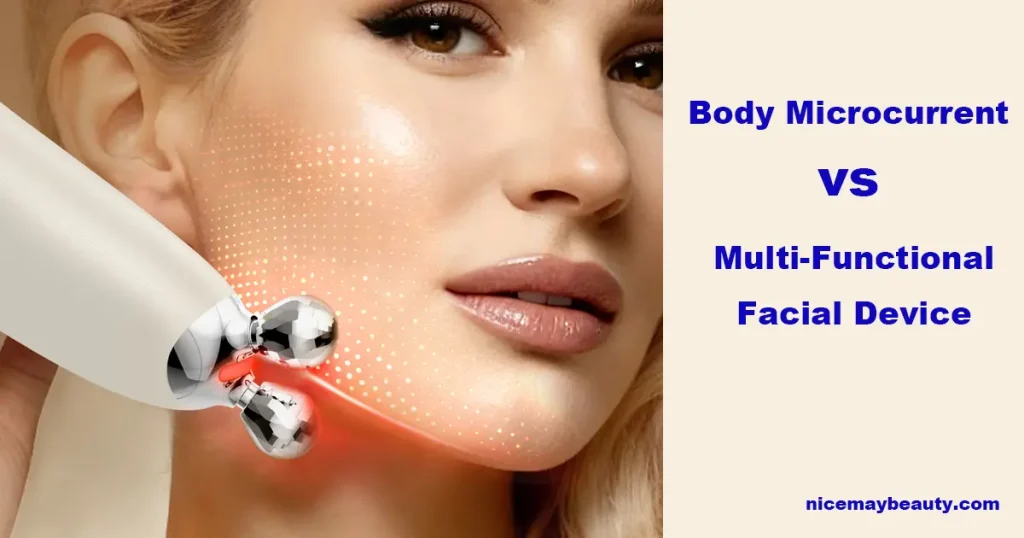
What Is a Body Microcurrent Device — and How Does It Differ From a Facial One?
Microcurrent therapy has long moved beyond its medical origins in wound healing and muscle rehabilitation. Today, it’s a clinically recognized tool for non-invasive body contouring and skin tightening. But not all microcurrent devices are interchangeable.
The Physiology Behind Body Microcurrent Technology
Body microcurrent devices are calibrated to penetrate deeper tissue layers, accounting for the significantly thicker dermis and denser underlying muscle structures found on the abdomen, buttocks, and limbs. The low-level electrical current — calibrated to mirror the body’s own bioelectrical signals — stimulates ATP(腺苷三磷酸)產生 at the cellular level, which in turn drives 膠原蛋白合成, improves local circulation, and gradually restores elasticity to skin that has lost structural protein density with age.
The key distinction from facial microcurrent lies in output intensity and electrode surface area. Body devices typically deliver higher milliampere outputs across wider treatment zones, a specification driven by the biomechanical demands of large muscle bellies versus the delicate, thin-skinned musculature of the face.
What Body Microcurrent Targets That Facial Devices Cannot?
A dedicated body microcurrent device is purpose-built for:
- Skin laxity on large surface areas: Post-weight-loss skin, loose upper-arm skin, abdominal looseness after pregnancy — areas where facial-grade tools simply lack the electrode coverage and current strength to create meaningful change.
- Deep muscle stimulation: Large skeletal muscles like the rectus abdominis or gluteus maximus require stronger, more sustained current pulses than any facial device is designed to provide.
- Gradual, structural body remodeling: Unlike injectable treatments or surgical body lifts, body microcurrent works incrementally — improving tone, skin texture, and firmness over weeks of consistent use.
If you’re uncertain whether microcurrent or EMS is the right current-based technology for your body goals, the comparison is worth examining closely. 微電流與EMS美容儀:哪一種能提供更持久的居家輪廓塑造? breaks down how both technologies behave on muscle tissue, how long results last, and which protocol yields more sustainable outcomes for different body types and ages.

What Is a Multi-Functional Facial Device — and What Makes It Multi-Functional?
The multi-functional facial device represents the convergence of several skin technologies into a single handheld platform. Rather than delivering one modality, these devices stack complementary treatments to address the layered nature of facial aging — which affects the skin surface, mid-dermis, and underlying muscle simultaneously.
The Technology Stack Inside a Multi-Functional Facial Device
High-quality multi-functional facial devices typically combine two or more of the following:
微電流 — Low-level current that gently tones facial muscles and increases ATP production, supporting collagen and elastin synthesis over time. Often described as a “passive workout” for facial muscles.
EMS(電肌刺激) — Delivers more intense, rhythmic muscle contractions than traditional microcurrent. EMS creates immediate visible contouring — particularly along the jawline and cheekbones — making it effective for users who want faster sculpting results. The sensation is noticeably stronger than microcurrent.
LED光療 — Photobiomodulation using red, near-infrared, or blue wavelengths. Red LED supports collagen remodeling and reduces inflammation; near-infrared penetrates more deeply to stimulate cellular repair; blue LED addresses acne-causing bacteria at the skin surface.
射頻(RF) — Generates controlled heat in the dermis to trigger a wound-healing response, prompting the body to produce new collagen fibers. RF is particularly effective for improving skin texture, reducing fine lines, and addressing mild to moderate skin laxity on the face and neck.
Why the Multi-Functional Approach Works for Facial Aging
Facial aging is rarely a single-variable problem. A 45-year-old may simultaneously experience loss of muscle tone (corrected with microcurrent or EMS), reduced collagen density (addressed by RF and LED), and surface pigmentation or texture irregularity (treated by specific LED wavelengths). A single-technology device addresses one layer of this problem. A thoughtfully engineered multi-functional device can address several at once — in a single session.
This is why the category has grown so significantly: not because it’s fashionable, but because the science of facial aging genuinely supports a layered approach. If you’re evaluating whether a comprehensive multi-technology device justifies its price point compared to a single-modality tool, 6合1多功能設備與單一RF/LED:全能型值得嗎? provides a rigorous, evidence-grounded analysis of whether combination devices consistently outperform their single-function counterparts — and when they don’t.

Body Microcurrent vs Multi-Functional Facial Device: Head-to-Head Comparison
| 特徵 | Body Microcurrent Device | Multi-Functional Facial Device |
|---|---|---|
| 主要目標 | Body firming, muscle toning, skin laxity reduction | Facial lifting, rejuvenation, collagen stimulation |
| 治療區域 | Abdomen, thighs, arms, buttocks | Face, jawline, neck, décolletage |
| Core Technology | High-intensity microcurrent | Microcurrent + EMS + LED + RF (varies by device) |
| Current Intensity | Higher (thicker skin/muscle depth) | Lower to moderate (calibrated for facial tissue) |
| 療程時長 | 10-20 minutes per zone | 5-15 minutes (full face) |
| 可見效果時間表 | 6-12 weeks with consistent use | 4-8 weeks; some EMS sculpting visible within sessions |
| 最佳適用於 | Post-pregnancy laxity, arm/abdominal toning | Fine lines, jawline definition, skin texture, overall rejuvenation |
| Conductive Medium Required | Yes — body gel or serum | Yes — microcurrent-compatible facial serum or gel |
How to Determine Which Device Is Right for You?
Choose a Body Microcurrent Device If…
You are primarily concerned with structural skin laxity on the body — areas where gravity, weight fluctuation, or the natural decline in collagen production has left skin visibly loose or deflated. A body microcurrent device is the appropriate tool if:
- Your target areas are below the jawline: abdomen, inner arms, thighs, buttocks, or knees
- You’ve experienced significant weight loss and are managing residual skin looseness without surgery
- You want to maintain body firmness between professional treatments or as a standalone long-term investment
- You’re already satisfied with your facial skincare routine and want to extend the same non-invasive philosophy to your body
A Note on Frequency for Body Microcurrent
For body microcurrent, most clinical protocols recommend starting with 5 sessions per week for the first 4–6 weeks, then tapering to 2–3 sessions per week for maintenance. Unlike some other devices, overuse is a genuine concern: excess stimulation can lead to temporary muscle fatigue rather than improved tone, particularly in the early adaptation phase. Follow manufacturer guidelines precisely — the intensity calibrations in body devices are meaningfully higher than facial tools, and they are calibrated against specific usage windows for a reason.
Choose a Multi-Functional Facial Device If…
Your primary concern is the face, and you want to address multiple aging concerns without assembling a collection of single-purpose tools. A multi-functional facial device is the appropriate investment if:
- You’re seeing early to moderate signs of facial aging: mild jowling, reduced jawline definition, fine lines, or uneven skin texture
- You want to consolidate your at-home skincare technology into one device
- You value treatment customization — the ability to use LED for one concern, EMS for another, and microcurrent for maintenance
- You’re looking to enhance your professional facial results between clinic visits rather than replace them
A Note on Frequency for Multi-Functional Facial Devices
Because multi-functional devices can be adjusted by modality, frequency recommendations vary by the technologies being used. Microcurrent components can typically be used daily or every other day. EMS and RF components, which create more significant tissue responses, are often limited to 2–3 times per week to allow adequate cellular recovery. Always treat the device’s included protocol as the authoritative guide — combining high-intensity technologies at excessive frequency does not accelerate results; it risks irritation, surface sensitivity, and diminishing returns.

MR-2590

MR-2622

MR-2331
Can You Use Both a Body Microcurrent Device and a Multi-Functional Facial Device?
Yes — and for many users, this is the most complete approach to non-invasive, technology-driven skincare. The two categories do not compete; they address distinct anatomical concerns with appropriately calibrated tools. A body microcurrent device handles structural firmness from the neck down; a multi-functional facial device handles the layered complexity of facial aging from the jawline up.
The important caveat is budget and consistency. Two devices mean two protocols, two maintenance routines, and two financial investments. If you can only commit to one, the decision should be governed by your most pressing concern — not by what sounds more comprehensive. A body device you use consistently will outperform a multi-functional facial device you abandon after three weeks, and vice versa. Consistency is the single variable that determines whether any of these technologies delivers meaningful results.
Safety Considerations for Both Device Categories
Both body microcurrent and multi-functional facial devices carry a well-established safety profile when used as directed. However, specific populations should exercise caution:
- Pacemaker or electronic implant users: Electrical current-based devices (microcurrent, EMS, RF) are contraindicated without explicit medical clearance.
- 懷孕: All electrical stimulation devices should be avoided during pregnancy unless specifically cleared by a healthcare provider.
- Active skin conditions: Rosacea, open lesions, active acne cysts, or eczema flare-ups in a treatment area warrant either device modification or temporary suspension of treatment.
- Cancer or active medical treatment: Consult an oncologist or dermatologist before using any current-based or light-based device.
| 因素 | 居家IPL | 居家激光 |
|---|---|---|
| 技術類型 | 寬譜光(500–1200nm) | 單波長聚焦光束 |
| 初次療程需求 | 10–12次以上 | 6–8次 |
| 可見效果的速度 | 中度(第4–5次療程) | 較快(第3–4次療程) |
| 膚色範圍 | Fitzpatrick I–IV | Fitzpatrick I–V(依設備而定) |
| 最佳身體部位 | 大面積(腿、手臂、背部) | 所有部位;適用於臉部與精細區域 |
| 設備預付費用 | $80–$450 | $300–$700+ |
| 維護頻率 | 每月到每3個月 | 每3–6個月 |
| 疼痛程度 | 輕微刺痛/溫熱感 | 輕度至中度;冷卻系統為標準配置 |
| 對細軟/淺色毛髮有效 | No | No |
常見問題:熱毛孔清潔與冷緊膚的常見疑問
Can I use a body microcurrent device on my face in a pinch?
How long do results from body microcurrent typically last without maintenance sessions?
Does skin tone or ethnicity affect how well microcurrent or multi-functional facial devices work?
Is there a minimum age recommendation for using these devices?
Do I still need to see a professional esthetician if I invest in both types of devices?
請在表單中填寫您的電子郵件,我們將儘快回覆您!